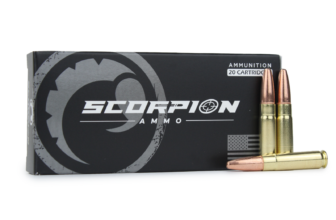
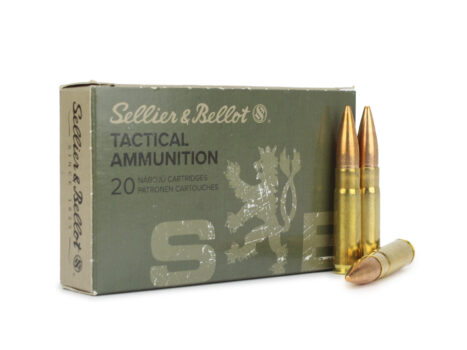
Sellier & Bellot .300 Blackout 147 Grain FMJ
| Feature | Detail |
|---|---|
| Primary Use | Target shooting, range training, suppressor-compatible subsonic practice |
| Bullet Type | Full Metal Jacket (FMJ), lead core with gilding metal jacket |
| Bullet Weight | 147 grain |
| Case Material | Brass |
| Primer Type | Boxer (assumed standard; not explicitly stated by manufacturer) |
| Packaging | 20 rounds per box |
| Typical Price | $19.99/box โ $1.00/round |
| Closest Competitors | Hornady .300 BLK 147 gr Sub-X, Winchester .300 BLK 147 gr FMJ, Fiocchi .300 BLK 147 gr FMJ |
Official Specs
| Spec | Value | Source |
|---|---|---|
| Muzzle Velocity (fps) | โ | Not published |
| Muzzle Energy (ft-lbs) | โ | Not published |
| Bullet Weight | 147 gr | Manufacturer |
| Bullet Type | Full Metal Jacket (FMJ) | Manufacturer |
| BC G1 | โ | Not published |
| BC G7 | โ | Not published |
| Manufacturer SKU | โ | Not published in available data |
| UPC | โ | Not published in available data |
| Reloadable | Yes | Brass case, Boxer primer |
Note: Sellier & Bellot does not publish muzzle velocity, muzzle energy, or ballistic coefficient data for this specific load in their publicly available technical documentation. Velocity and energy figures in the Ballistics Table below are calculated estimates based on published industry norms for 147 gr .300 Blackout subsonic FMJ loads from a standard 16″ barrel. These must not be treated as manufacturer-stated specifications. Community-submitted chronograph data will be added as it becomes available.
Ballistics Table
Calculated estimate. Real-world results vary by barrel length, temperature, altitude, and lot. Community submissions will provide measured muzzle velocity for comparison.
Note on subsonic classification: The 147 gr .300 Blackout load is widely used as a subsonic load. Industry-standard muzzle velocity for this bullet weight in .300 BLK from a 16″ barrel is approximately 1,050โ1,080 fps. The estimate below uses 1,060 fps as a working baseline. All values marked with ~ to indicate calculated, not manufacturer-published, data. A BC G1 of 0.260 is used as a representative estimate for a 147 gr FMJ projectile in this caliber.
Zero: 100 yards | Sight height: 1.5″ above bore
| Yards | ~Velocity (fps) | ~Energy (ft-lbs) | ~Trajectory (in) |
|---|---|---|---|
| 0 | ~1,060 | ~367 | -1.5 |
| 100 | ~1,000 | ~326 | 0.0 โ zero |
| 200 | ~950 | ~295 | -7.2 |
| 300 | ~905 | ~267 | -24.1 |
| 400 | ~863 | ~243 | -54.8 |
| 500 | ~824 | ~221 | ~-103.0 |
Key takeaway: At subsonic velocities, the 147 gr FMJ sheds energy gradually and drops steeply beyond 200 yards โ this is expected behavior for a heavy, slow-moving projectile. The 300 Blackout cartridge in subsonic configuration is engineered for short- to medium-range applications, typically 0โ200 yards, where it excels in suppressed platforms. Buyers should not expect flat-shooting performance at extended distances; this load is optimized for controlled, quiet operation rather than long-range precision. Trajectory figures reinforce that this is a 100-yard-and-under working load for most practical applications.
Best Uses
Good fit:
- Suppressed range training where subsonic performance and hearing safety are priorities
- High-volume target shooting where brass-cased, reloadable cases add downstream value
- AR-15 platforms chambered in .300 Blackout requiring reliable feeding and cycling
- Training drills requiring consistent, affordable ammunition from a well-established manufacturer
- Situations where full metal jacket construction is required by range rules prohibiting expanding projectiles
Not the right tool for:
- Hunting applications โ FMJ bullets are prohibited or ethically inappropriate for deer and larger game in most jurisdictions
- Long-range precision work beyond 200 yards, where the subsonic trajectory becomes prohibitively steep
- Self-defense use, where controlled expansion projectiles are strongly preferred
- Supersonic applications requiring higher velocity; this 147 gr load is a subsonic design and is not interchangeable with 110โ125 gr supersonic loads in terms of performance expectations
- Shooters who require published, verified ballistic data for formal precision applications
Reliability Notes
No structured submissions yet.
Based on manufacturer claims and open-source user commentary, the following observations are noted โ these come from manufacturer product descriptions and open sources, not structured data:
- Sellier & Bellot is one of the oldest continuously operating ammunition manufacturers in the world, founded in 1825 in the Czech Republic, lending credibility to their quality control processes.
- Brass casings are consistently noted in open sources as being well-formed and suitable for reloading, with minimal case defects reported anecdotally across S&B product lines.
- The FMJ construction is noted to feed reliably in semi-automatic AR-platform rifles, which is consistent with the design intent of the cartridge for training use.
- No manufacturer-issued recalls or safety notices are associated with this specific load in publicly available records at the time of publication.
Competitors
| Load | Weight | Bullet | BC G1 | Adv. Velocity | Price/box | Notes |
|---|---|---|---|---|---|---|
| Hornady .300 BLK 147 gr Sub-X | 147 gr | Sub-X (expanding) | 0.270 | ~1,050 fps | ~$28โ$32 | Premium; expanding bullet โ not same construction as FMJ |
| Winchester .300 BLK 147 gr FMJ | 147 gr | FMJ | ~0.260 | ~1,060 fps | ~$20โ$24 | Closest direct competitor; same bullet type and weight |
| Fiocchi .300 BLK 147 gr FMJ | 147 gr | FMJ | ~0.260 | ~1,050 fps | ~$18โ$22 | Budget alternative; similar construction and use case |
| Magtech .300 BLK 200 gr FMJ-SUB | 200 gr | FMJ Subsonic | ~0.270 | ~1,000 fps | ~$22โ$26 | Heavier subsonic option; different felt recoil profile |
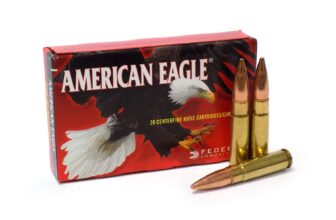
| American Eagle .300 BLK 220 gr OTM | 220 gr | Open Tip Match | ~0.310 | ~1,000 fps | ~$25โ$30 | Premium subsonic; match-grade OTM, not FMJ |
| Remington .300 BLK 220 gr OTM | 220 gr | Open Tip Match | ~0.330 | ~1,010 fps | ~$24โ$28 | Heavier subsonic premium option; different weight class |
Price Reality
- Typical retail range: $18.99โ$22.99 per 20-round box; case pricing (typically 500 rounds/25 boxes) generally falls in the $450โ$550 range when available
- Per-round cost: approximately $0.95โ$1.15 per round at standard retail
- Compared to Winchester 147 gr FMJ, pricing is roughly equivalent โ within $1โ$2 per box either direction depending on retailer
- Compared to Fiocchi 147 gr FMJ, S&B typically runs slightly higher by $1โ$3 per box, though availability fluctuates
- Compared to Hornady Sub-X 147 gr, S&B represents a meaningful savings of $8โ$12 per box, with the trade-off being FMJ rather than an expanding projectile
- Fair price benchmark: At $19.99 for 20 rounds ($1.00/round), this load is priced fairly for brass-cased, non-domestic FMJ .300 Blackout ammunition. Prices above $24.99/box ($1.25/round) for this specific load should be considered elevated unless supply conditions are exceptional.
Prices change. Check the Where to Buy block for current listings.
Where to Buy
Sellier & Bellot .300 Blackout 147 Grain FMJ (Box)
Affiliate links. These do not influence ratings, data, or any editorial content on this page.
FAQ
Is the Sellier & Bellot 147 gr FMJ a subsonic load?
The 147 grain bullet weight in .300 Blackout is universally recognized as a subsonic-class projectile, meaning it is designed to travel below the speed of sound (approximately 1,125 fps at sea level under standard conditions). Sellier & Bellot does not explicitly publish a muzzle velocity for this load, but based on the bullet weight and the physics of the cartridge, it will remain subsonic from standard barrel lengths. This makes it well-suited for use with a suppressor, where subsonic ammunition eliminates the supersonic crack that would otherwise accompany the report. Buyers should not expect supersonic velocities from this load regardless of barrel length under normal conditions.
Can this ammunition be used for hunting?
In most jurisdictions, FMJ bullets are prohibited for hunting deer, hog, and larger game due to their non-expanding construction and the associated risk of wounding rather than cleanly harvesting an animal. Even in areas where FMJ is technically legal, ethical hunting standards strongly favor expanding projectiles. The S&B 147 gr FMJ is best treated as a training and target load only. Hunters seeking a .300 Blackout load for game should look at expanding options such as the Hornady 147 gr Sub-X or similar controlled-expansion subsonic designs.
How does the S&B 147 gr FMJ compare to the Hornady 147 gr Sub-X?
Both loads share the same 147 grain bullet weight and operate in the subsonic velocity window, making their trajectory and energy profiles broadly similar at practical ranges. The critical difference is bullet construction: the S&B uses a non-expanding FMJ, while the Hornady Sub-X uses a polymer-tipped, flex-tip expanding design intended for terminal performance on game or in defensive contexts. The Hornady load typically carries a price premium of $8โ$12 per box over the S&B. For pure range training and volume shooting, the S&B represents better value; for any terminal performance application, the Sub-X is the more appropriate choice.
Will this ammunition cycle reliably in a short-barreled AR-15 or pistol-length .300 Blackout?
Subsonic .300 Blackout loads can be more sensitive to gas system tuning in semi-automatic platforms than supersonic loads, particularly in pistol-length or short-barreled configurations. The S&B 147 gr FMJ is a standard commercial offering and should cycle reliably in properly configured rifles, but shooters using suppressed, short-barreled, or non-standard gas systems may experience cycling issues that require adjustable gas blocks or buffer weight adjustments. This is a platform-specific consideration, not a defect in the ammunition. Testing a small quantity before committing to a case purchase is always advisable when using subsonic loads in non-standard configurations.
Is the brass casing from S&B reloadable?
Yes. Sellier & Bellot uses Boxer-primed brass cases, which are the standard for reloadable centerfire ammunition in the United States. The cases are compatible with standard .300 Blackout reloading dies and can typically be reloaded multiple times with proper case preparation. This adds downstream value for shooters who reload, effectively reducing the net cost per round over the case’s useful life. However, this page covers factory ammunition only โ reloading data, charge weights, and handload specifications are outside the scope of this reference.