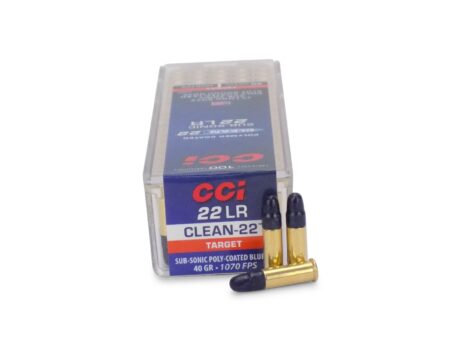
 Ammo Reports Team
| Official Spec | Value |
|---|---|
| Manufacturer | CCI |
| Cartridge | 22 LR |
| Product Line | Clean-22 |
| Bullet Name / Bullet Type | Blue polymer-coated Lead Round Nose |
| Bullet Weight | 40 gr |
| SKU / Part Number / Item Number | 934CC |
| UPC | 604544650310 – retailer-listed |
| Rounds per Box | 100 |
| Muzzle Velocity | 1,070 fps |
| Muzzle Energy | 102 ft-lbs |
| Ballistic Coefficient G1 | .120 |
| Ballistic Coefficient G7 | Not found |
| Case Material | Not found |
| Primer | CCI rimfire priming |
| Reloadable | Not found |
| Test Barrel Length | Not found |
| Zero Distance | 100 yards |
| Sight Height | 1.5" |
| Intended Use | Target shooting, plinking, and suppressed use |
| Product Status | Current – currently unavailable |
| Closest Competitors | Remington Subsonic HP 22 LR, Federal AutoMatch 22 LR, Eley Subsonic Hollow 22 LR, SK Subsonic 22 LR, Norma TAC-22 22 LR, CCI Quiet-22 22 LR |
Data is based on official manufacturer sources. Found an error? Send us the source link.
Official Ballistics
Manufacturer-published values. “Not published” means the manufacturer does not provide a value at that distance.
| Yards | Velocity (fps) | Energy (ft-lbs) | Trajectory (in) |
|---|---|---|---|
| 0 | 1,070 | 102 | -1.5 |
| 25 | Not published | Not published | +2.2 |
| 50 | 977 | 85 | +3.8 |
| 75 | 940 | 79 | +3.1 |
| 100 | 908 | 73 | 0.0 |
Product Overview
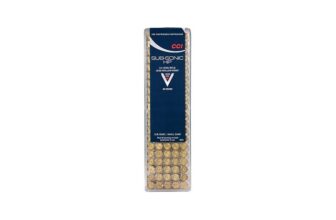
CCI Clean-22 uses a blue polymer coating around a 40-grain lead round-nose bullet. CCI states that the coating reduces lead fouling in barrels and cuts lead buildup in suppressors.
Part 934CC is rated at 1,070 fps with a G1 ballistic coefficient of .120. The manufacturer positions it for target shooting and reliable function in semi-automatic firearms.
Best Uses
Good fit:
- Suppressed rimfire shooting
- High-volume target practice
- Shooters who want reduced lead fouling
Not the right tool for:
- Applications requiring an expanding hunting bullet
- Users seeking maximum velocity
Reliability Notes
CCI describes dependable priming, consistent propellant, and reliable cycling across 22 LR firearms. Function still depends on the individual firearm and its condition.
Competitors
The complete existing competitor set is retained. Specifications remain “Not verified” unless they were confirmed for the exact linked product.
| Competitor | Bullet Weight | Bullet Type | Muzzle Velocity | BC G1 |
|---|---|---|---|---|
| Remington Subsonic HP 22 LR | Not verified | Not verified | Not verified | Not verified |
| Federal AutoMatch 22 LR | Not verified | Not verified | Not verified | Not verified |
| Eley Subsonic Hollow 22 LR | Not verified | Not verified | Not verified | Not verified |
| SK Subsonic 22 LR | Not verified | Not verified | Not verified | Not verified |
| Norma TAC-22 22 LR | Not verified | Not verified | Not verified | Not verified |
| CCI Quiet-22 22 LR | Not verified | Not verified | Not verified | Not verified |
FAQ
Does the blue polymer coating affect accuracy compared to standard lead-bullet 22 LR?
The polymer coating on CCI Clean-22 bullets is applied uniformly and is not expected to degrade accuracy relative to standard lead round-nose loads at typical plinking distances. CCI designed the coating to maintain consistent bullet geometry and reduce bore friction, which can support consistency shot to shot. At match-level precision benchmarks, some shooters prefer uncoated lead match bullets like Eley or SK, but for the intended use cases — plinking and suppressed shooting — the coating does not represent a meaningful accuracy penalty. Independent testing at 50 yards has generally shown groups consistent with other CCI rimfire offerings.
Is this load truly subsonic, and will it stay subsonic in all barrel lengths?
The subsonic designation means CCI formulates this load to remain below approximately 1,125 fps under standard conditions, but barrel length significantly affects actual velocity. Shorter barrels (under 16 inches) will produce lower velocities, which is favorable for suppression. Longer barrels — particularly rifle-length barrels of 18–24 inches — can push velocity slightly higher, though a properly formulated subsonic load should remain below the sound barrier even in longer barrels. Buyers running this load in pistols or very short barrels will have no concerns; those with long-barreled rifles may wish to chronograph a sample to confirm. The absence of a published velocity figure from CCI makes this a reasonable precaution.
How does the blue poly coating specifically benefit suppressor users compared to standard 22 LR?
Standard lead-bullet 22 LR ammunition deposits lead fouling in the suppressor’s baffles with every shot. On sealed or difficult-to-disassemble suppressors, this buildup is cumulative and can degrade sound-attenuation performance over thousands of rounds. The polymer coating encapsulates the lead core so the bullet passes through the baffles without shedding the same quantity of lead particulate. This extends the interval between suppressor cleanings and is particularly valuable for users who shoot high round counts in a single range session. It does not eliminate all fouling — powder residue still accumulates — but it addresses the lead-specific component of suppressor maintenance.
Can this ammunition cycle reliably in semi-automatic 22 LR pistols and rifles?
Subsonic 22 LR ammunition is the most common source of cycling failures in semi-automatic platforms because the reduced powder charge generates less recoil impulse to cycle the action. CCI’s Clean-22 Subsonic is designed with consistent propellant charges to maximize reliability, but some semi-automatic actions — particularly those with heavier recoil springs or tighter tolerances — may experience occasional failures to cycle. Platforms known to run subsonic 22 LR reliably include many dedicated suppressor-host designs. Buyers should test a box in their specific firearm before committing to bulk purchases. Bolt-action and single-shot platforms will have no cycling concerns.
How does this load compare to the CCI Quiet-22 for suppressed shooting?
Both loads are CCI products intended for low-noise applications, but they are meaningfully different. The CCI Quiet-22 operates at approximately 710 fps — so slow that it will not reliably cycle most semi-automatic actions and is designed primarily for bolt-action or single-shot use. The CCI Clean-22 Subsonic Blue operates at an estimated 1,050 fps, which is fast enough to cycle most semi-automatic platforms while still remaining subsonic. For suppressed semi-automatic shooting, the Clean-22 Subsonic is the more practical choice. The Quiet-22 is better suited to situations where absolute minimum noise is the priority and action cycling is not required.