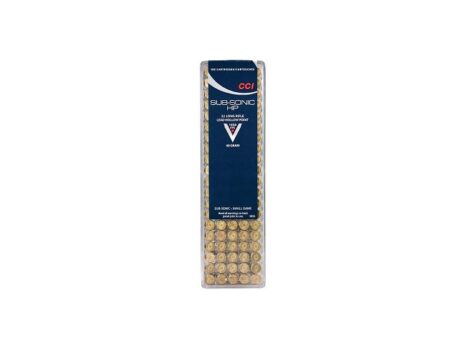
 Ammo Reports Team
| Official Spec | Value |
|---|---|
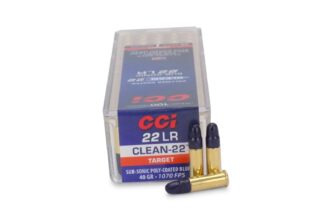
| Manufacturer | CCI |
| Cartridge | 22 LR |
| Product Line | Sub-Sonic HP |
| Bullet Name / Bullet Type | Lead Hollow Point |
| Bullet Weight | 40 gr |
| SKU / Part Number / Item Number | 56 |
| UPC | 076683000569 – retailer-listed |
| Rounds per Box | 100 |
| Muzzle Velocity | 1,050 fps |
| Muzzle Energy | 98 ft-lbs |
| Ballistic Coefficient G1 | .120 |
| Ballistic Coefficient G7 | Not found |
| Case Material | Brass |
| Primer | CCI rimfire priming |
| Reloadable | Not found |
| Test Barrel Length | Not found |
| Zero Distance | 100 yards |
| Sight Height | 1.5" |
| Intended Use | Small-game hunting and low-noise shooting |
| Product Status | Current – currently unavailable |
| Closest Competitors | Federal Champion Subsonic 22 LR, Remington Subsonic 22 LR, Winchester Super-X Subsonic 22 LR, Aguila SSS 22 LR, SK Subsonic 22 LR, Lapua Center-X 22 LR |
Data is based on official manufacturer sources. Found an error? Send us the source link.
Official Ballistics
Manufacturer-published values. “Not published” means the manufacturer does not provide a value at that distance.
| Yards | Velocity (fps) | Energy (ft-lbs) | Trajectory (in) |
|---|---|---|---|
| 0 | 1,050 | 98 | -1.5 |
| 25 | Not published | Not published | +2.3 |
| 50 | 963 | 82 | +3.9 |
| 75 | 928 | 77 | +3.2 |
| 100 | 897 | 72 | 0.0 |
Product Overview
CCI Sub-Sonic HP combines a 40-grain lead hollow point with a 1,050 fps muzzle velocity. CCI states that the bullet expands without fragmenting and is intended for small-game performance with reduced noise.
The exact current part number is 56. The manufacturer publishes a .120 G1 ballistic coefficient and a 100-yard-zero trajectory.
Best Uses
Good fit:
- Small-game hunting at appropriate rimfire distances
- Suppressed and low-noise shooting
- Bolt-action, lever-action, and single-shot firearms
Not the right tool for:
- Platforms that do not cycle lower-velocity ammunition reliably
- Long-range use where trajectory becomes demanding
Reliability Notes
CCI lists consistent primers and brass. Semi-automatic function should be verified in the specific firearm before field use.
Competitors
The complete existing competitor set is retained. Specifications remain “Not verified” unless they were confirmed for the exact linked product.
| Competitor | Bullet Weight | Bullet Type | Muzzle Velocity | BC G1 |
|---|---|---|---|---|
| Federal Champion Subsonic 22 LR | Not verified | Not verified | Not verified | Not verified |
| Remington Subsonic 22 LR | Not verified | Not verified | Not verified | Not verified |
| Winchester Super-X Subsonic 22 LR | Not verified | Not verified | Not verified | Not verified |
| Aguila SSS 22 LR | Not verified | Not verified | Not verified | Not verified |
| SK Subsonic 22 LR | Not verified | Not verified | Not verified | Not verified |
| Lapua Center-X 22 LR | Not verified | Not verified | Not verified | Not verified |
FAQ
Does the CCI 22 LR Subsonic 40 gr LHP reliably cycle semi-automatic firearms?
This is the most important operational question for this load. At 1,050 fps, the bolt velocity generated on firing is lower than with standard or high-velocity .22 LR loads, and many semi-automatic actions — particularly pistols and some rifles — require a minimum energy threshold to fully cycle. Platforms with adjustable gas systems or lighter recoil springs (such as some dedicated rimfire target rifles) tend to handle subsonic loads more reliably. Bolt-action, lever-action, and pump-action rimfire firearms are unaffected by this consideration. Testing function in your specific firearm before field use is strongly recommended.
How does the hollow point cavity perform at subsonic velocities?
Terminal expansion from a lead hollow point at subsonic velocities is less reliable than at higher velocities. At 1,050 fps, the hollow point cavity may partially expand, fully expand, or fail to expand depending on the medium struck, range, and specific tissue density. For small game hunting, this load is most effective at close range — inside 50 yards — where retained velocity and impact energy are highest. Hunters should not assume consistent expansion equivalent to higher-velocity hollow point loads. The hollow point design still produces a more effective wound channel than a round nose at equivalent velocity even when expansion is incomplete.
Is this load suitable for use with a .22 LR suppressor?
Yes — this is one of the primary intended applications for subsonic .22 LR ammunition. Because the muzzle velocity of 1,050 fps stays below the speed of sound (~1,125 fps at standard conditions), there is no supersonic ballistic crack. When paired with a quality rimfire suppressor, the dominant sound becomes the mechanical action of the firearm rather than the report or bullet flight. Note that at high altitude or in very warm temperatures, the speed of sound changes slightly, but 1,050 fps provides adequate margin under most realistic shooting conditions in North America.
How does this CCI load compare to the Aguila SSS 60 gr subsonic?
These two loads occupy the same subsonic .22 LR category but differ significantly in terminal design. The Aguila SSS uses a 60 gr solid lead bullet at approximately 950 fps, producing deeper penetration with no expansion — a profile better suited to situations requiring penetration through light cover or where expansion is not the priority. The CCI 40 gr LHP is designed to expand on impact, making it the more appropriate choice for small game hunting where rapid energy transfer is desired. The Aguila SSS also has a longer overall cartridge length that can cause feeding issues in some semi-automatic platforms. The two loads are not interchangeable in terms of terminal behavior.
What barrel length does CCI use to measure the 1,050 fps muzzle velocity for this load?
CCI does not publish the test barrel length for SKU 0056 in the available product data. This is a meaningful gap: rimfire muzzle velocity is highly sensitive to barrel length, and a 16" rifle barrel will produce measurably higher velocity than a 4" pistol barrel with the same ammunition. The 1,050 fps figure should be treated as a general reference, likely measured from a standard test barrel in the 18"–24" range. Shooters using short-barreled pistols or carbines may see lower actual velocities, potentially as much as 50–100 fps below the stated figure, which can further affect cycling reliability in semi-automatic platforms.