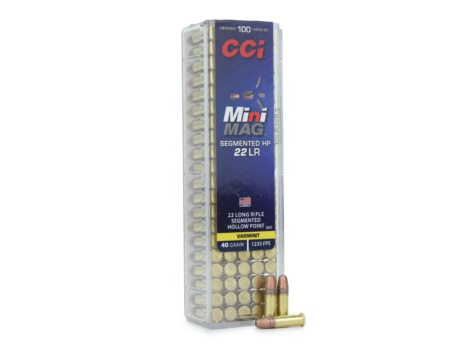
 Ammo Reports Team
| Official Spec | Value |
|---|---|
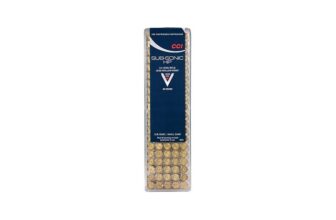
| Manufacturer | CCI |
| Cartridge | 22 LR |
| Product Line | Mini-Mag Segmented HP |
| Bullet Name / Bullet Type | Segmented Hollow Point (SHP) |
| Bullet Weight | 40 gr |
| SKU / Part Number / Item Number | 36CC |
| UPC | Not found |
| Rounds per Box | 100 |
| Muzzle Velocity | 1,235 fps |
| Muzzle Energy | 135 ft-lbs |
| Ballistic Coefficient G1 | .118 |
| Ballistic Coefficient G7 | Not found |
| Case Material | Not found |
| Primer | CCI rimfire priming |
| Reloadable | Not found |
| Test Barrel Length | Not found |
| Zero Distance | 100 yards |
| Sight Height | 1.5" |
| Intended Use | Varmint and small-game hunting |
| Product Status | Current – currently unavailable |
| Closest Competitors | CCI Velocitor 22 LR 40 gr GDHP, Federal Champion 22 LR 40 gr HP, Winchester Super-X 22 LR 40 gr PSHP, Remington Golden Bullet 22 LR 40 gr PLHP, Aguila Super Extra 22 LR 40 gr CPHP, Lapua Midas+ 22 LR 40 gr LRN |
Data is based on official manufacturer sources. Found an error? Send us the source link.
Official Ballistics
Manufacturer-published values. “Not published” means the manufacturer does not provide a value at that distance.
| Yards | Velocity (fps) | Energy (ft-lbs) | Trajectory (in) |
|---|---|---|---|
| 0 | 1,235 | 135 | -1.5 |
| 25 | Not published | Not published | +1.5 |
| 50 | 1,081 | 104 | +2.9 |
| 75 | 1,027 | 94 | +2.5 |
| 100 | 982 | 86 | 0.0 |
Product Overview
CCI Mini-Mag Segmented HP uses a 40-grain bullet designed to split into three equal-size pieces on impact. CCI positions the load for varmints and small game, with reliable feeding and clean-burning propellant.
The current manufacturer page identifies part 36CC. The older 0047 identifier previously shown in this article belongs to a different CCI load and has been removed.
Best Uses
Good fit:
- Small-game and varmint hunting
- Rifles that function reliably with high-velocity 22 LR
- Users seeking a segmenting projectile
Not the right tool for:
- Applications requiring a non-expanding target bullet
- Use where expanding ammunition is restricted
Reliability Notes
CCI states that this load uses consistent priming, clean-burning powder, and a design intended for reliable feeding.
Competitors
The complete existing competitor set is retained. Specifications remain “Not verified” unless they were confirmed for the exact linked product.
| Competitor | Bullet Weight | Bullet Type | Muzzle Velocity | BC G1 |
|---|---|---|---|---|
| CCI Velocitor 22 LR 40 gr GDHP | Not verified | Not verified | Not verified | Not verified |
| Federal Champion 22 LR 40 gr HP | Not verified | Not verified | Not verified | Not verified |
| Winchester Super-X 22 LR 40 gr PSHP | Not verified | Not verified | Not verified | Not verified |
| Remington Golden Bullet 22 LR 40 gr PLHP | Not verified | Not verified | Not verified | Not verified |
| Aguila Super Extra 22 LR 40 gr CPHP | Not verified | Not verified | Not verified | Not verified |
| Lapua Midas+ 22 LR 40 gr LRN | Not verified | Not verified | Not verified | Not verified |
FAQ
Does the segmented hollow point actually split into three pieces every time, or is this marketing?
The three-segment split is a function of impact velocity and target medium density. At the rated 1,235 fps from a 24″ barrel and within practical hunting distances — roughly inside 75 yards — the segmented hollow point is designed to initiate reliably in soft tissue. Independent terminal ballistics testing in ballistic gelatin has generally confirmed three-fragment separation under those conditions, though results vary with velocity. At lower velocities (longer range or shorter barrels), the bullet may not achieve full segmentation and can behave more like a conventional hollow point. This is not unique to CCI — all expansion-dependent bullet designs are velocity-sensitive.
How does this load compare to the standard CCI Mini-Mag 40 gr HP?
The standard CCI Mini-Mag 40 gr copper-plated hollow point expands as a single mass on impact, similar to most conventional hollow points. The SHP variant replaces that bullet with the segmenting design, which creates three separate wound channels rather than one expanding cavity. For small game hunting where rapid energy transfer is the goal, the SHP is the more purpose-built option. The standard Mini-Mag HP is a better choice for general-purpose use where terminal performance is secondary to cost and versatility. Both loads use the same case and priming system.
Is this load appropriate for use in a .22 LR pistol or handgun?
It can be used in a .22 LR pistol, but with an important caveat: muzzle velocity from a handgun barrel — typically 4″ to 6″ — will be substantially lower than the 1,235 fps rating from a 24″ rifle barrel. Velocity losses of 200–350 fps are common when moving from a rifle to a pistol barrel in rimfire calibers. At those reduced velocities, the segmenting mechanism may not function as designed, and the bullet may behave like a standard hollow point or partially expand. For handgun-specific use, CCI’s own Stinger or purpose-designed pistol loads may be more appropriate choices.
Can I use this ammunition for pest control inside structures, such as a barn or outbuilding?
The segmented design is actually well-suited to pest control scenarios where over-penetration is a concern, because the three fragments disperse energy quickly and are less likely to exit the target than a solid or non-expanding bullet. However, any live firearm discharge inside a structure carries serious safety and legal considerations regardless of ammunition type. Ricochet risk from hard surfaces (concrete, metal) is a separate hazard that the bullet design does not eliminate. Always verify local regulations and ensure a safe backstop before discharging any firearm, regardless of the load selected.
Why does CCI rate velocity from a 24″ barrel — and what should I expect from my rifle?
The 24″ barrel is an industry-standard test length for rimfire ammunition, chosen because it produces consistent, repeatable results for specification purposes. Most .22 LR sporting rifles have barrels in the 16″–22″ range, and each inch of barrel lost typically costs 20–30 fps in a rimfire load. A shooter using an 18″ barrel can reasonably expect velocities in the range of 1,100–1,175 fps from this load — still sufficient for terminal performance at close range, but noticeably below the published spec. Bolt-action rifles with 20″–22″ barrels will come closer to the rated figure. If precise velocity data matters for your application, chronograph testing with your specific firearm is the only reliable method.