 Ammo Reports Team
| Official Spec | Value |
|---|---|
| Manufacturer | CCI |
| Cartridge | 22 LR |
| Product Line | Pistol Match |
| Bullet Name / Bullet Type | Lead Round Nose |
| Bullet Weight | 40 gr |
| SKU / Part Number / Item Number | 51 |
| UPC | 076683000514 – retailer-listed |
| Rounds per Box | 50 |
| Muzzle Velocity | 1,070 fps |
| Muzzle Energy | 102 ft-lbs |
| Ballistic Coefficient G1 | .120 |
| Ballistic Coefficient G7 | Not found |
| Case Material | Not found |
| Primer | Not found |
| Reloadable | Not found |
| Test Barrel Length | Not found |
| Zero Distance | 100 yards |
| Sight Height | 1.5" |
| Intended Use | Rimfire handgun competition and target shooting |
| Product Status | Current – currently unavailable |
| Closest Competitors | Federal Gold Medal Target 22 LR, Remington Target 22 LR, Aguila Super Extra 22 LR, CCI Standard Velocity 22 LR, Lapua Center-X 22 LR, SK Standard Plus 22 LR |
Data is based on official manufacturer sources. Found an error? Send us the source link.
Official Ballistics
Manufacturer-published values. “Not published” means the manufacturer does not provide a value at that distance.
| Yards | Velocity (fps) | Energy (ft-lbs) | Trajectory (in) |
|---|---|---|---|
| 0 | 1,070 | 102 | -1.5 |
| 25 | Not published | Not published | +2.2 |
| 50 | 977 | 85 | +3.8 |
| 75 | 940 | 79 | +3.1 |
| 100 | 908 | 73 | 0.0 |
Product Overview
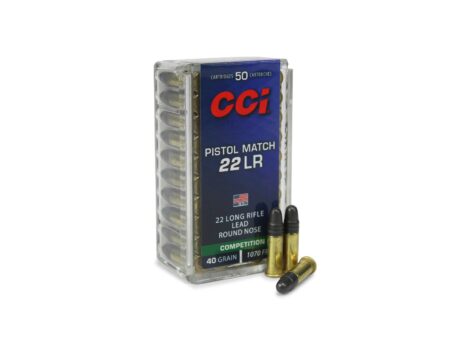
CCI Pistol Match is a 40-grain lead round-nose load intended for rimfire competition. The manufacturer emphasizes precision components, tight tolerances, accuracy, feeding, and handgun function.
Part 51 is rated at 1,070 fps with a .120 G1 ballistic coefficient. The official trajectory data uses a 100-yard zero and 1.5-inch sight height.
Best Uses
Good fit:
- Rimfire pistol competition
- 25- and 50-yard target practice
- Training where consistent handgun function is important
Not the right tool for:
- Hunting applications that call for an expanding bullet
- Use where a verified pistol-barrel velocity is required
Reliability Notes
CCI specifically positions Pistol Match for reliable cycling and accuracy in rimfire pistols. Individual firearm testing remains necessary.
Competitors
The complete existing competitor set is retained. Specifications remain “Not verified” unless they were confirmed for the exact linked product.
| Competitor | Bullet Weight | Bullet Type | Muzzle Velocity | BC G1 |
|---|---|---|---|---|
| Federal Gold Medal Target 22 LR | Not verified | Not verified | Not verified | Not verified |
| Remington Target 22 LR | Not verified | Not verified | Not verified | Not verified |
| Aguila Super Extra 22 LR | Not verified | Not verified | Not verified | Not verified |
| CCI Standard Velocity 22 LR | Not verified | Not verified | Not verified | Not verified |
| Lapua Center-X 22 LR | Not verified | Not verified | Not verified | Not verified |
| SK Standard Plus 22 LR | Not verified | Not verified | Not verified | Not verified |
FAQ
Does the "Pistol Match" designation mean this load meets any formal match specification?
The name Pistol Match is a CCI marketing designation, not a reference to compliance with a specific governing body’s match standard such as those set by the NRA or ISSF. It indicates the load is intended and tuned for pistol use at target distances, rather than certifying it against a published performance threshold. Shooters entering sanctioned bullseye pistol competition should verify whether their specific event rules require ammunition with published lot data or velocity certification before relying on this load for scored competition.
Why does this load lack published muzzle velocity data when other CCI 22 LR loads include it?
This is a genuine data gap. CCI publishes velocity figures for most of its rimfire lineup, including the Standard Velocity and Mini-Mag lines, but available product listings for the Pistol Match do not include that figure. This may reflect the load’s positioning as a general-practice round rather than a precision product, or it may simply be an omission in the retail product sheet. If confirmed velocity data becomes available from CCI directly, this page will be updated accordingly.
How does bare lead fouling from this LRN bullet compare to copper-plated alternatives?
Unjacketed lead projectiles deposit lead residue in the barrel’s rifling more readily than copper-plated or full-metal-jacket bullets. In practical terms, a shooter firing 50–100 rounds will notice minimal difference in accuracy or function. At 200–300 rounds or more in a single session, lead fouling accumulates enough to warrant more thorough cleaning before the next use. Copper-plated 22 LR loads — such as CCI’s own Mini-Mag — reduce this fouling rate, though they typically cost more per round.
Is this load appropriate for use on steel targets?
Yes, and this is one of the more practical applications for an unjacketed LRN at pistol velocities. Soft lead deforms significantly on contact with a steel plate rather than fragmenting into high-energy particles, which reduces splash-back and lateral ricochet compared to harder-jacketed projectiles at similar velocities. Standard steel target safety distances still apply — most manufacturers recommend a minimum of 10 yards for pistol-caliber rimfire — but the LRN construction is genuinely better suited to steel use than jacketed or harder-alloy bullets at close range.
How does this load compare directly to the CCI Standard Velocity 22 LR?
Both loads use a 40 grain lead round nose projectile from the same manufacturer and are positioned as standard-velocity offerings. The key difference is that the CCI Standard Velocity carries a published muzzle velocity of 1,070 fps and is often available at a lower per-round price. For a shooter whose primary goal is affordable, reliable 22 LR practice ammunition from CCI, the Standard Velocity merits direct comparison before purchasing the Pistol Match — particularly if documented ballistic data matters for the intended application.