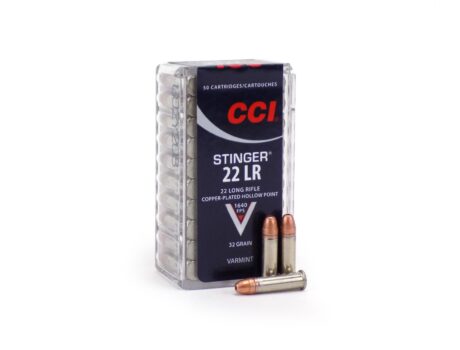
 Ammo Reports Team
| Official Spec | Value |
|---|---|
| Manufacturer | CCI |
| Cartridge | 22 LR |
| Product Line | Stinger |
| Bullet Name / Bullet Type | Copper Plated Hollow Point |
| Bullet Weight | 32 gr |
| SKU / Part Number / Item Number | 50 |
| UPC | 076683000507 – retailer-listed |
| Rounds per Box | 50 |
| Muzzle Velocity | 1,640 fps |
| Muzzle Energy | 191 ft-lbs |
| Ballistic Coefficient G1 | .084 |
| Ballistic Coefficient G7 | Not found |
| Case Material | Brass |
| Primer | CCI rimfire priming |
| Reloadable | Not found |
| Test Barrel Length | Not found |
| Zero Distance | 100 yards |
| Sight Height | 1.5" |
| Intended Use | Varmint and small-game hunting |
| Product Status | Current – available |
| Closest Competitors | CCI Velocitor 22 LR, Remington Yellow Jacket 22 LR, Winchester Super-X 22 LR, Federal Game-Shok 22 LR, Aguila Super Maximum 22 LR, Lapua Midas+ 22 LR |
Data is based on official manufacturer sources. Found an error? Send us the source link.
Official Ballistics
Manufacturer-published values. “Not published” means the manufacturer does not provide a value at that distance.
| Yards | Velocity (fps) | Energy (ft-lbs) | Trajectory (in) |
|---|---|---|---|
| 0 | 1,640 | 191 | -1.5 |
| 25 | Not published | Not published | +0.7 |
| 50 | 1,292 | 119 | +1.9 |
| 75 | 1,162 | 96 | +1.7 |
| 100 | 1,066 | 81 | 0.0 |
Product Overview
CCI Stinger pairs a 32-grain copper-plated hollow point with a published muzzle velocity of 1,640 fps. It is a high-velocity varmint load designed for rapid expansion and a flat short-range trajectory.
CCI specifies use only in firearms with standard ANSI sporting barrel and chamber dimensions.
Best Uses
Good fit:
- Varmint and small-game hunting
- Users seeking high muzzle velocity from 22 LR
- Firearms confirmed compatible with the Stinger case
Not the right tool for:
- Firearms whose manufacturer excludes Stinger ammunition
- Applications favoring standard-velocity target loads
Reliability Notes
CCI states that Stinger uses its priming and brass for reliable performance. Confirm dimensional compatibility and function in the firearm before use.
Competitors
The complete existing competitor set is retained. Specifications remain “Not verified” unless they were confirmed for the exact linked product.
| Competitor | Bullet Weight | Bullet Type | Muzzle Velocity | BC G1 |
|---|---|---|---|---|
| CCI Velocitor 22 LR | Not verified | Not verified | Not verified | Not verified |
| Remington Yellow Jacket 22 LR | Not verified | Not verified | Not verified | Not verified |
| Winchester Super-X 22 LR | Not verified | Not verified | Not verified | Not verified |
| Federal Game-Shok 22 LR | Not verified | Not verified | Not verified | Not verified |
| Aguila Super Maximum 22 LR | Not verified | Not verified | Not verified | Not verified |
| Lapua Midas+ 22 LR | Not verified | Not verified | Not verified | Not verified |
FAQ
Does the CCI Stinger’s longer case cause problems in all semi-automatic 22 LR firearms?
Not all semi-automatic 22 LR firearms are affected, but the extended Stinger case is a known compatibility consideration. The case is approximately 0.1" longer than standard 22 LR, which can create feeding or extraction issues in firearms with tight chambers or specific magazine geometries. Most modern semi-automatic rifles function without problems, but some older tube-fed autoloaders and a handful of pistols have reported elevated malfunction rates. The safest approach is to test a single box through your specific firearm before relying on Stinger ammunition for hunting or pest control. Bolt-action, lever-action, and single-shot platforms are almost universally compatible.
How does the CCI Stinger compare to the CCI Velocitor for varmint hunting?
These two loads represent different engineering philosophies for 22 LR varmint performance. The Stinger prioritizes maximum velocity with a lighter 32 gr bullet at 1,640 fps, while the Velocitor uses a heavier 40 gr Speer Gold Dot hollow point at 1,435 fps. The Velocitor’s heavier bullet and higher BC retain energy better at distance and the Gold Dot bullet has a well-documented expansion profile. The Stinger’s advantage is raw speed and a flatter trajectory inside 50 yards. For most varmint hunting inside 75 yards, either load is effective; beyond that range, the Velocitor’s better ballistic coefficient gives it a meaningful edge in retained energy.
Is the CCI Stinger suitable for squirrel or rabbit hunting, or is it too destructive?
The 32 gr hollow point at hyper velocity does produce more tissue disruption than standard velocity 22 LR loads, which is intentional for varmint applications. For squirrel or rabbit hunting where meat preservation matters, this trade-off is worth considering. Head shots minimize meat damage regardless of load, and many hunters use the Stinger specifically for its reliable expansion and quick kills. Hunters primarily concerned with meat quality for table use may prefer a standard velocity 40 gr round nose load, which produces less hydrostatic disruption. For pest control or non-table-fare small game, the Stinger’s terminal performance is a clear advantage.
Why does the CCI Stinger use a 32 grain bullet instead of the more common 36 or 40 grain weights?
The lighter 32 gr bullet is central to achieving the Stinger’s hyper velocity performance. A lighter projectile requires less energy to accelerate to a given velocity, allowing the same powder charge to push it significantly faster than heavier bullets. The trade-off is a lower ballistic coefficient, meaning the bullet decelerates more rapidly after leaving the muzzle. CCI designed the Stinger specifically for short-range varmint and pest applications where the high impact velocity — not long-range ballistic performance — is the primary terminal effect mechanism. The 32 gr weight also contributes to reliable hollow point expansion at the velocities this load generates, even after modest velocity loss at typical hunting distances.
Can the CCI Stinger be used effectively in a 22 LR pistol for small game or pest control?
It can be used in compatible pistols, but the velocity reduction from a shorter pistol barrel is significant and should factor into expectations. A pistol barrel of 4–6 inches will typically yield 200–350 fps less than the 24" test barrel velocity of 1,640 fps, bringing muzzle velocity closer to 1,300–1,440 fps depending on the specific firearm. At those velocities, the hollow point may still expand reliably on small targets at close range, but the hyper velocity advantage over standard high-velocity loads is substantially reduced. Pistol shooters should verify both mechanical compatibility with the Stinger’s extended case and confirm that the load cycles reliably before field use.