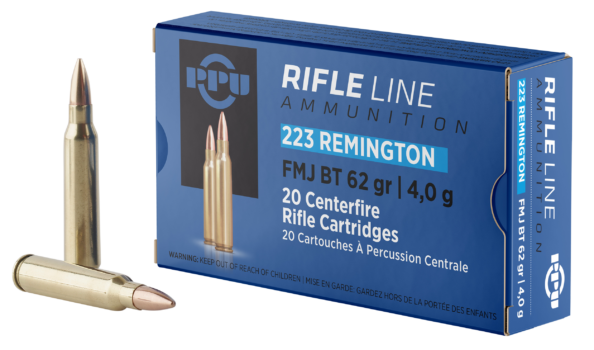
PPU Standard Rifle 223 Rem 62 Gr FMJ BT
| Feature | Detail |
|---|---|
| Primary Use | Target shooting, range training, varmint and small predator hunting |
| Bullet Type | Full Metal Jacket Boat Tail (FMJ-BT) |
| Bullet Weight | 62 grains |
| Case Material | Brass |
| Primer Type | Boxer (non-corrosive) |
| Packaging | 20 rounds per box |
| Typical Price | $20.99/box โ $1.05/round |
| Closest Competitors | Federal American Eagle .223 Rem 62 Gr FMJ-BT, Hornady Steel Match .223 Rem 62 Gr BTHP, PMC Bronze .223 Rem 62 Gr FMJ-BT |
Official Specs
| Spec | Value | Source |
|---|---|---|
| Muzzle Velocity (fps) | 3,042 | Manufacturer / Retailer listing |
| Muzzle Energy (ft-lbs) | 1,270 | Manufacturer / Retailer listing |
| Bullet Weight | 62 gr | Manufacturer |
| Bullet Type | Full Metal Jacket Boat Tail (FMJ-BT) | Manufacturer |
| BC G1 | โ | Not published |
| BC G7 | โ | Not published |
| Manufacturer SKU | โ | Not published |
| UPC | โ | Not published |
| Reloadable | Yes | Manufacturer (brass/Boxer) |
Note โ BC: PPU does not publish ballistic coefficient data for this load in standard retail channels. G1 and G7 values used in the ballistics table below are estimated from comparable 62 gr FMJ-BT projectiles and are labeled accordingly.
Note โ Energy cross-check: A 62 gr projectile at 3,042 fps yields a calculated muzzle energy of approximately 1,272 ft-lbs โ consistent with the stated 1,270 ft-lbs. No data integrity flag required; the figures are in reasonable agreement.
Ballistics Table
Calculated estimate. Real-world results vary by barrel length, temperature,altitude, and lot. Community submissions will provide measured muzzlevelocity for comparison.
Zeroed at 100 yards. Sight height: 1.5″ above bore. Assumed G1 BC: 0.310 (estimated for 62 gr FMJ-BT class projectile).
| Yards | Velocity (fps) | Energy (ft-lbs) | Trajectory (in) |
|---|---|---|---|
| 0 | 3,042 | 1,272 | -1.5 |
| 100 | 2,749 | 1,040 | 0.0 โ zero |
| 200 | 2,473 | 841 | -3.7 |
| 300 | 2,213 | 674 | -13.8 |
| 400 | 1,969 | 533 | -31.5 |
| 500 | 1,743 | 418 | -59.2 |
Key takeaway: At 100 yards, this load is well-suited to its intended role as a range and light-duty field cartridge. Trajectory remains manageable through 300 yards for experienced shooters who know their holds, but energy drops below 500 ft-lbs around the 500-yard mark, making extended-range varmint work less consistent. The 62-grain bullet retains slightly more velocity and energy downrange compared to the more common 55 gr .223 load, giving it a modest edge at intermediate distances. Shooters using 16″ barrels should expect velocities roughly 80โ120 fps lower than these figures, which are based on a standard 24″ test barrel assumption for PPU data.
Best Uses
Good fit:
- High-volume range training where brass reloadability adds long-term value
- Paper and steel target shooting at distances from 50 to 300 yards
- Varmint control (groundhogs, prairie dogs) at moderate ranges where FMJ is legally permitted
- Carbine and rifle function testing, break-in shooting, and general familiarization
- Shooters seeking a non-corrosive, reloadable .223 load at a mid-tier price point
Not the right tool for:
- Deer or medium-to-large game hunting โ FMJ construction does not expand and is prohibited for deer in most U.S. states
- Precision long-range competition where published BC data and match-grade consistency are required
- Jurisdictions or ranges that prohibit FMJ ammunition on steel targets at close range due to ricochet risk
- Hunters requiring reliable terminal expansion or controlled fragmentation on any game animal
- Suppressed fire where subsonic or specialty loads are preferred for hearing safety
Reliability Notes
No structured submissions yet.
Based on manufacturer claims and open-source retailer descriptions, this load is noted for consistent primer seating and brass quality consistent with PPU’s established European production standards. PPU (Privi Partizan) has manufactured ammunition for military and civilian markets since 1928, and the Standard Rifle line is positioned as their volume-production offering. Retailer feedback available in open sources suggests reliable feeding in AR-platform rifles and bolt-action .223 chambers, with no widespread reports of misfires or case failures in this specific load. All notes here come from manufacturer claims or open sources โ not structured data collected by this database.
Competitors
| Load | Weight | Bullet | BC G1 | Muzzle Velocity | Price/box | Notes |
|---|---|---|---|---|---|---|
| Federal American Eagle .223 Rem 62 Gr FMJ-BT | 62 gr | FMJ-BT | ~0.307 | 3,100 fps | ~$19โ$22 | Direct budget competitor; widely available |
| PMC Bronze .223 Rem 62 Gr FMJ-BT | 62 gr | FMJ-BT | ~0.307 | 3,025 fps | ~$18โ$21 | Budget alternative; brass/Boxer reloadable |
| Hornady Black .223 Rem 62 Gr FMJ | 62 gr | FMJ | ~0.310 | 3,100 fps | ~$24โ$28 | Premium alternative; tighter QC specs |
| Fiocchi Shooting Dynamics .223 Rem 62 Gr FMJ-BT | 62 gr | FMJ-BT | ~0.307 | 3,000 fps | ~$19โ$23 | Similar construction and price tier |
| Wolf Gold .223 Rem 62 Gr FMJ | 62 gr | FMJ | Not published | 3,000 fps | ~$17โ$20 | Budget alternative; brass cases |
| Black Hills Ammunition .223 Rem 62 Gr TSX | 62 gr | Barnes TSX (lead-free) | ~0.290 | 3,100 fps | ~$38โ$45 | Premium lead-free alternative; hunting-legal expansion |
Price Reality
- Typical retail price: $20.99 per 20-round box โ approximately $1.05 per round
- Case pricing (typically 500 rounds / 25 boxes) is not consistently listed at major retail; expect $240โ$270 per case when available, representing a modest per-round discount
- Federal American Eagle 62 gr FMJ-BT runs $19โ$22/box at most retailers โ essentially the same price tier, making it the most direct comparison point
- PMC Bronze 62 gr FMJ-BT is frequently found at $18โ$21/box, offering a slight cost advantage with comparable construction
- Hornady Black 62 gr commands a $3โ$8/box premium for tighter tolerances and brand recognition
- At $1.05/round, this PPU load is competitively priced for brass-cased, reloadable .223 ammunition; it becomes less attractive above $1.15/round given the availability of comparable alternatives at or below that threshold
- Consider this load fairly priced at $20.99 and overpriced above $24.99 given the competitive landscape
Prices change. Check the Where to Buy block for current listings.
Where to Buy
PPU Standard Rifle 223 Rem 62 Gr FMJ BT 20 Rounds (Box)
Affiliate links. These do not influence ratings, data, or any editorial content on this page.
FAQ
Does the 62-grain FMJ-BT bullet from PPU stabilize reliably in a 1:9 twist barrel?
The 62-grain bullet weight sits at the upper edge of what a 1:9 twist barrel stabilizes comfortably in .223 Remington. Most 1:9 barrels will handle 62 gr projectiles adequately, though optimal stability is typically achieved with a 1:8 twist for this weight class. Shooters using 1:9 barrels should confirm accuracy at distance before relying on this load for field use. A 1:7 twist, common in AR-15 carbines built to military specifications, will over-stabilize this bullet slightly but will not cause functional problems.
How does this load compare to the Federal American Eagle 62 gr FMJ-BT for range training?
Both loads use nearly identical 62-grain FMJ boat tail construction, and both are brass-cased and Boxer-primed, making them reloadable. Federal American Eagle lists a slightly higher muzzle velocity at 3,100 fps versus PPU’s 3,042 fps, though this difference is unlikely to be noticeable in practical range use. Price differences between the two are typically within $2โ$3 per box, so availability and lot-to-lot consistency become the deciding factors for most buyers. Neither load is a precision match product, and both are appropriate for the same high-volume training role.
Can this ammunition be used for hunting deer or other medium game?
No. Full Metal Jacket ammunition does not expand on impact and is prohibited for deer hunting in virtually every U.S. state. Beyond the legal issue, FMJ bullets are not designed for reliable terminal performance on medium game and may cause wounding without clean kills. For hunting applications in .223 Remington, buyers should select an expanding bullet such as a soft point, polymer-tipped, or bonded hunting projectile. This PPU load is not appropriate for any hunting application where expansion is required or legally mandated.
Is PPU brass suitable for reloading after firing this load?
PPU produces brass-cased, Boxer-primed ammunition, which is fully compatible with standard reloading dies and processes. The brass is generally regarded in the reloading community as serviceable for multiple firings, though some reloaders note it is slightly harder than premium American brass, requiring careful attention to trimming after the first firing. Case life is considered comparable to other value-tier brass offerings. This page covers factory ammunition only and does not provide reloading data or charge weights.
Why does this load use a 62-grain bullet instead of the more common 55-grain loading in .223 Remington?
The 62-grain bullet weight mirrors the NATO 5.56ร45mm SS109/M855 military standard, which was adopted specifically to improve penetration at longer ranges compared to the original 55-grain M193 loading. For civilian shooters, the heavier bullet offers a modest improvement in retained energy and wind resistance at distances beyond 200 yards. The tradeoff is that 62 gr loads require faster twist rates for proper stabilization and may not perform optimally in older .223 rifles built around 1:12 twist barrels. PPU’s offering in this weight is positioned as a training analog to military-specification ammunition for shooters who prefer consistency across their practice and field loads.