 Ammo Reports Team

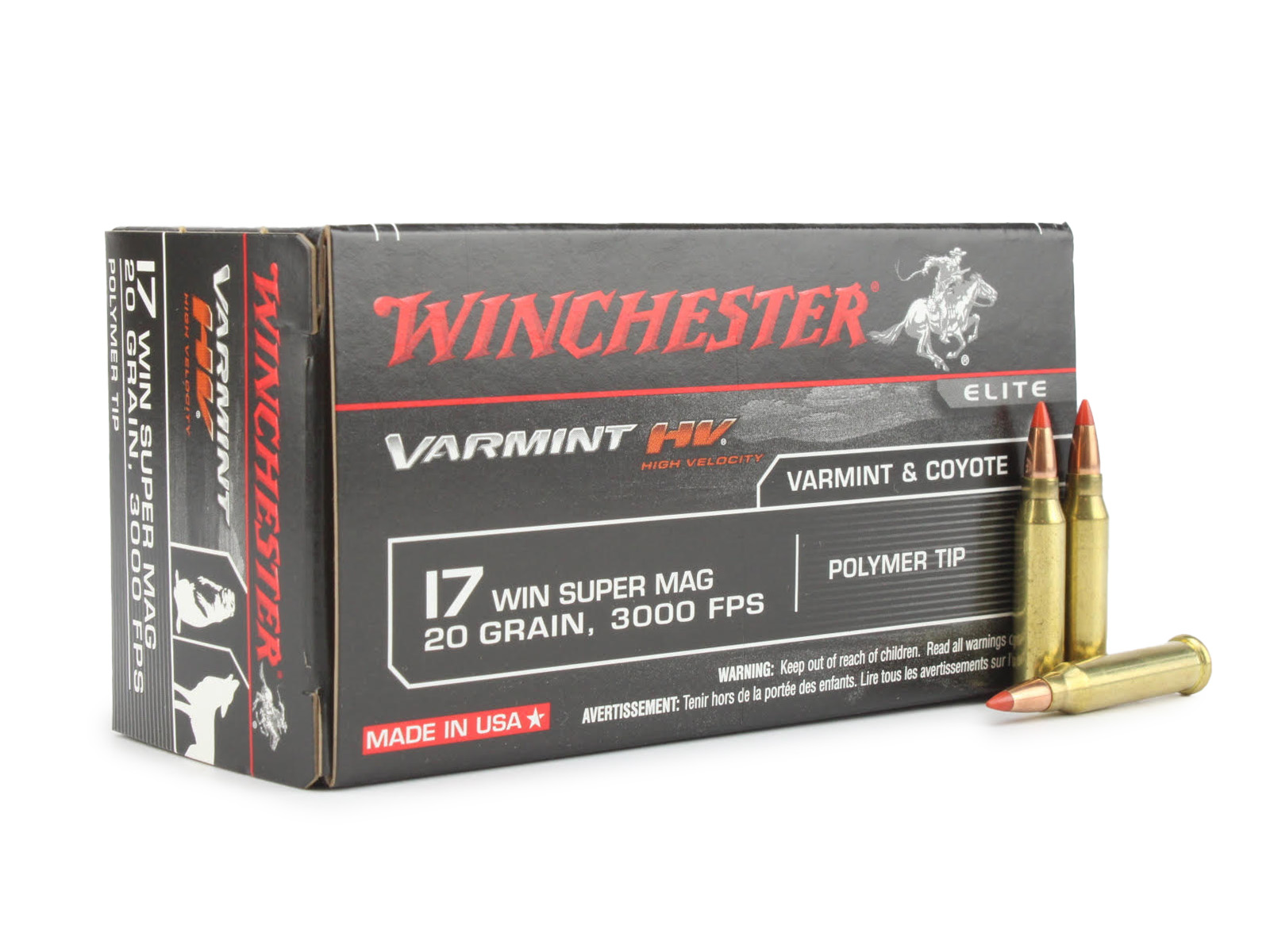
| Field | Detail |
|---|---|
| Primary Use | Varmint and small game hunting |
| Bullet Type | 20-grain polymer-tip (lead-core, boat-tail) |
| Bullet Weight | 20 gr |
| Case Material | Brass |
| Primer Type | Rimfire |
| Packaging | 50 rounds per box |
| Typical Price | $25.99/box · $0.52/round |
| Closest Competitors | Hornady Varmint Express 17 WSM 20 gr V-MAX · CCI TNT 17 WSM 20 gr HP · Federal Premium 17 WSM 20 gr Hornady V-MAX |
Official Specs
| Spec | Value | Source |
|---|---|---|
| Muzzle Velocity (fps) | — | Not published by Winchester for this listing |
| Muzzle Energy (ft-lbs) | — | Not published |
| Bullet Weight | 20 gr | Manufacturer |
| Bullet Type | Polymer-Tip | Manufacturer |
| BC G1 | — | Not published |
| BC G7 | — | Not published |
| Manufacturer SKU | — | Not published in available data |
| UPC | — | Not published in available data |
| Reloadable | No | Rimfire — not reloadable |
Note: Winchester does not publish muzzle velocity or muzzle energy in the available product listing for this specific load. The 17 WSM cartridge in 20-grain configuration is widely documented at approximately 3,000 fps from a standard 18–20″ barrel in other published Winchester 17 WSM data, but that figure is not confirmed for this specific SKU and has therefore been omitted from the specs table. The ballistics table below uses an estimated velocity and is clearly labeled as calculated. BC values are not published by Winchester for this load.
Ballistics Table
Calculated estimate. Real-world results vary by barrel length, temperature,altitude, and lot. Community submissions will provide measured muzzlevelocity for comparison.
Zeroed at 50 yards · Sight height 1.5″ above bore · Estimated MV ~3,000 fps · BC G1 ~0.140 (estimated, not manufacturer-published)
| Yards | Velocity (fps) | Energy (ft-lbs) | Trajectory (in) |
|---|---|---|---|
| 0 | ~3,000 | ~400 | -1.5 |
| 25 | ~2,858 | ~363 | +0.3 |
| 50 | ~2,720 | ~329 | 0.0 ← zero |
| 75 | ~2,586 | ~297 | -1.1 |
| 100 | ~2,456 | ~268 | -3.6 |
| 125 | ~2,330 | ~241 | -7.5 |
| 150 | ~2,207 | ~216 | -13.1 |
| 175 | ~2,089 | ~194 | -20.5 |
| 200 | ~1,974 | ~173 | -30.0 |
| 225 | ~1,863 | ~154 | -41.8 |
| 250 | ~1,757 | ~137 | -55.9 |
Note: All values marked ~ are calculated estimates based on an assumed muzzle velocity of approximately 3,000 fps and an estimated G1 BC of 0.140. Neither value is manufacturer-confirmed for this SKU. Do not use these figures for precision field applications without confirmed chronograph data.
Key takeaway: At a 50-yard zero, the 17 WSM stays within roughly ±3.5 inches of point of aim out to about 100 yards, making it a practical choice for close-to-mid-range varmint work without holdover adjustments. Beyond 150 yards, the relatively modest ballistic coefficient of a 20-grain bullet causes trajectory to drop steeply, so shooters should confirm actual drop at distance with their specific rifle. The flat trajectory inside 100 yards is the primary field advantage of this cartridge, and the high velocity at the muzzle delivers fast, clean energy transfer on small targets. Wind drift becomes a meaningful factor past 150 yards given the light bullet weight.
The 17 WSM Cartridge — Why It Exists
The .17 Winchester Super Magnum is the fastest rimfire cartridge in commercial production, developed by Winchester and introduced in 2013. It was derived from a .27-caliber nail-gun blank case necked down to accept a .17-caliber projectile — an unconventional origin that allowed Winchester to achieve pressures and velocities well beyond what traditional rimfire brass could support. The result is a rimfire round that competes with lower-end centerfire varmint cartridges in terms of raw velocity while retaining the lower cost and simpler platform requirements of the rimfire format. The 20-grain polymer-tip loading specifically targets the balance between high velocity and sufficient sectional density for reliable terminal performance on small varmints, distinguishing it from the lighter 15-grain and 16-grain loads in the 17 WSM family that prioritize maximum speed over retained energy at distance.
Best Uses
Good fit:
- Prairie dog and ground squirrel hunting at ranges inside 150 yards
- Coyote work at close range where rimfire-legal regulations apply
- Pest control on agricultural land where centerfire report and range are concerns
- Shooters wanting a flat-shooting rimfire without transitioning to a centerfire platform
- Small game hunting where rapid energy transfer and minimal pelt damage are priorities
Not the right tool for:
- Shots beyond 150 yards where wind drift and bullet drop become difficult to manage with a 20-grain projectile
- Predator hunting at extended ranges where retained energy is critical
- Any application requiring a reloadable case — rimfire brass is single-use
- Jurisdictions where rimfire cartridges are prohibited for certain game species — verify local regulations
- Situations where platform availability is a concern — 17 WSM rifles remain a smaller market than 17 HMR or 22 LR options
Reliability Notes
No structured submissions yet.
Based on manufacturer claims and open-source user reports, the Winchester Varmint High Velocity line in 17 WSM has a general reputation for consistent ignition across temperature ranges, which is a noted challenge for rimfire cartridges in cold-weather conditions. The polymer-tip bullet design is reported to feed reliably in semi-automatic 17 WSM platforms, though the cartridge’s tight dimensional tolerances mean chamber cleanliness has a meaningful effect on cycling. No pattern of misfires or lot-specific issues has been identified in publicly available sources as of this writing. All notes here come from manufacturer claims or open sources, not structured test data.
Competitors
| Load | Weight | Bullet | BC G1 | Adv. Velocity | Price/box | Notes |
|---|---|---|---|---|---|---|
| Hornady Varmint Express 17 WSM 20 gr V-MAX | 20 gr | V-MAX Polymer-Tip | 0.185 (published) | ~3,000 fps | ~$26–$30 | Higher published BC than Winchester load; same weight class |
| CCI TNT 17 WSM 20 gr HP | 20 gr | Hollow Point | ~0.120 (est.) | ~2,950 fps | ~$22–$25 | Budget alternative; no polymer tip; lower BC expected |
| Federal Premium 17 WSM 20 gr V-MAX | 20 gr | Hornady V-MAX | 0.185 (published) | ~3,000 fps | ~$27–$32 | Uses same Hornady projectile as Hornady load; premium pricing |
| Winchester Super-X 17 WSM 20 gr JHP | 20 gr | Jacketed Hollow Point | Not published | ~3,000 fps | ~$20–$24 | Budget alternative within Winchester’s own lineup; no polymer tip |
| Hornady Varmint Express 17 WSM 15.5 gr NTX | 15.5 gr | Lead-Free NTX | Not published | ~3,300 fps | ~$28–$34 | Lead-free option; higher velocity; reduced downrange energy vs. 20 gr |
| Browning BPR 17 WSM 20 gr Polymer-Tip | 20 gr | Polymer-Tip | Not published | ~3,000 fps | ~$24–$28 | Direct weight and design competitor; limited availability in some markets |
Price Reality
- At $25.99 per 50-round box, this load prices out at $0.52 per round, which sits in the mid-range for 17 WSM factory ammunition
- Case pricing (typically 10 boxes / 500 rounds) is not confirmed in available data; expect approximately $240–$270 if purchasing in bulk where available
- The Hornady V-MAX 20-grain load typically runs $1–$4 more per box with a meaningfully higher published BC, making it the premium alternative worth considering for longer-range work
- CCI’s TNT hollow-point 17 WSM offering can be found for $2–$4 less per box and represents the primary budget alternative, though without the polymer tip
- At prices above $32–$34 per box, this Winchester load would be considered overpriced relative to the current market for 17 WSM 20-grain ammunition
- The 17 WSM format as a whole carries a cost premium over 17 HMR and 22 WMR; buyers transitioning from those cartridges should factor per-round cost into their platform decision
Prices change. Check the Where to Buy block for current listings.
Where to Buy
Winchester Varmint High Velocity 17 WSM 20 Gr Polymer-Tip (Box)
Affiliate links. These do not influence ratings, data, or any editorial content on this page.
FAQ
Does the polymer tip on this load make a meaningful difference compared to a hollow-point 17 WSM round?
The polymer-tip serves two functions: it protects the hollow cavity during feeding and in the magazine, and it initiates expansion more reliably at lower impact velocities than a plain hollow-point. For a cartridge like the 17 WSM that is already losing velocity quickly at distance, consistent tip-initiated expansion can matter at the outer edge of practical range. At close range, the difference between a polymer-tip and a quality hollow-point in terminal effect on small varmints is minimal. The primary practical advantage shows up in semi-automatic feeding reliability and in shots taken at 100 yards or beyond.
How does this load compare to the Hornady Varmint Express 17 WSM 20 gr V-MAX?
Both loads use a 20-grain polymer-tip bullet at similar advertised velocities, but the Hornady V-MAX bullet carries a published G1 BC of 0.185, which is higher than what is typically estimated for the Winchester projectile. A higher BC means less wind drift and a flatter trajectory at longer distances. Winchester does not publish BC data for this load, making a precise comparison difficult without independent testing. If extended-range performance is the priority, the Hornady load’s published ballistic data provides more confidence; if price is the deciding factor, the Winchester load is typically comparable or slightly less expensive.
Is the 17 WSM legal for coyote hunting in most U.S. states?
The 17 WSM is a rimfire cartridge, and some states restrict rimfire use for certain predator species or during specific seasons. Most states that permit rimfire use for non-game pest species will allow 17 WSM for coyotes, but hunters should verify current regulations in their specific state before using this load for predator hunting. Energy retention at distance is also a practical concern — the 20-grain bullet at 17 WSM velocities is marginal for clean kills on coyotes beyond 100 yards. This load is better suited to smaller varmints where the high-velocity impact is decisive.
Can this ammunition be used in a 17 WSM semi-automatic rifle without reliability concerns?
The 17 WSM operates at higher pressures than most rimfire cartridges, and not all semi-automatic platforms chamber it. Rifles specifically chambered for 17 WSM — such as those produced by Savage, Franklin Armory, and Volquartsen — should handle this ammunition without issue when the action is clean. Polymer-tip bullets generally feed more smoothly than exposed hollow-points in semi-automatic actions. Dirty chambers and extractors are the most commonly cited cause of cycling problems with 17 WSM in semi-automatic platforms, not the ammunition itself.
What is the practical maximum effective range of this load for prairie dog hunting?
For a clean, ethical kill on prairie dogs, most experienced shooters treat 150 yards as the realistic maximum with a 20-grain 17 WSM load when wind is a factor. In calm conditions with a confirmed zero and known drop data, shots to 200 yards are achievable by skilled shooters. Beyond that distance, the combination of steep trajectory drop, increasing wind sensitivity, and reduced terminal velocity makes consistent, humane results difficult to guarantee. The flat trajectory inside 100 yards is where this cartridge genuinely excels, and most prairie dog colony shooting at moderate distances falls comfortably within that window.
Submit Your Data · Real-World Results
Manufacturer velocity figures are measured under controlled lab conditions – barrel length, temperature, and lot number all affect real-world performance. The data below comes from community submissions tied to specific test conditions and reviewed before publishing.
Once this page reaches 3 approved submissions, aggregate velocity and confidence level will appear here automatically.
| UPC # | Firearm | Barrel (in) | Avg Velocity (fps) | Shots | Temp (°F) | Chronograph | Lot | Notes |
|---|---|---|---|---|---|---|---|---|
| – | – | — | — | — | — | — | — | No data yet |
Shot this load? Share your results – firearm type, barrel length, average velocity, shots fired, temperature. No account required.
ES and SD data are especially valuable for this practice/match load – include them in Notes if your chronograph captures them.
All submissions are manually reviewed before appearing on this page.
You need to login first.Results vary by firearm, barrel condition, ammunition lot, and environmental factors. Submitted data is for reference only. Ammo Reports does not guar
Winchester Varmint High Velocity 17 WSM 20 Gr Polymer-Tip (Box)