
 Ammo Reports Team
| Official Spec | Value |
|---|---|
| Manufacturer | Federal Ammunition |
| Cartridge | 6.5 Creedmoor |
| Product Line | Terminal Ascent |
| Bullet Name / Bullet Type | Terminal Ascent |
| Bullet Weight | 130 gr |
| SKU / Part Number / Item Number | P65CRDTA1 |
| UPC | 604544659443 |
| Rounds per Box | 20 |
| Muzzle Velocity | 2,800 fps |
| Muzzle Energy | 2,263 ft-lb |
| Ballistic Coefficient G1 | 0.532 |
| Ballistic Coefficient G7 | 0.263 |
| Case Material | Not found |
| Primer | Not found |
| Reloadable | Not found |
| Test Barrel Length | Not found |
| Zero Distance | 200 yd |
| Sight Height | 1.5 in |
| Intended Use | Big Game; Long Range |
| Product Status | Current |
| Closest Competitors | Hornady Precision Hunter 6.5 Creedmoor 143 gr ELD-X; Nosler Trophy Grade 6.5 Creedmoor 130 gr AccuBond; Winchester Expedition Gold 6.5 Creedmoor 125 gr; Berger Hybrid Hunter 6.5 Creedmoor 130 gr; Sig Sauer Elite Hunter Tipped 6.5 Creedmoor 130 gr; HSM Trophy Gold 6.5 Creedmoor 130 gr Berger Hunting VLD |
Data is based on official manufacturer sources. Found an error? Send us the source link.
Product identity and ballistics were verified against Federal’s current exact-SKU product data. UPC was confirmed through an exact-SKU retail listing.
Affiliate links. These do not influence ratings, data, or editorial content on this page.
Official Ballistics
Federal publishes velocity, energy, and 10 mph crosswind drift for this exact load at 100-yard intervals. These are manufacturer-published values.
| Distance (yd) | Velocity (fps) | Energy (ft-lb) | 10 mph Wind Drift (in) |
|---|---|---|---|
| 0 | 2,800 | 2,263 | 0.0 |
| 100 | 2,629 | 1,995 | 0.7 |
| 200 | 2,464 | 1,752 | 2.5 |
| 300 | 2,305 | 1,533 | 5.8 |
| 400 | 2,152 | 1,337 | 10.7 |
| 500 | 2,005 | 1,160 | 17.2 |
Official Long-Range Trajectory
Federal’s long-range trajectory uses a 200-yard zero and sights 1.5 inches above the bore.
| Distance (yd) | Trajectory (in) |
|---|---|
| 50 | +0.7 |
| 100 | +1.8 |
| 200 | 0.0 |
| 300 | -7.5 |
| 400 | -21.6 |
| 500 | -43.1 |
Product Overview
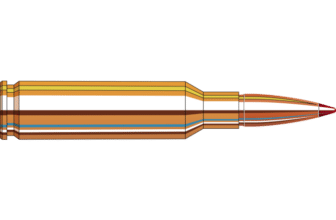
Federal Terminal Ascent combines a bonded lead core and copper shank with a Slipstream polymer tip and AccuChannel groove. Federal positions it as a high-BC hunting bullet intended to expand at lower impact velocity while retaining weight for penetration.
Best Uses
- Long-range big-game hunting within the shooter’s verified limits
- Hunters who want a bonded, polymer-tipped 130 gr load
- Rifles that perform well with Federal’s P65CRDTA1 load
Reliability Notes
- The current official muzzle velocity is 2,800 fps, G1 BC is 0.532, and G7 BC is 0.263.
- The official long-range trajectory uses a 200-yard zero and a 1.5-inch sight height.
- Terminal performance still depends on impact velocity, shot placement, game size, and the individual rifle’s verified ballistics.
Competitors
| Load | Bullet | Comparison |
|---|---|---|
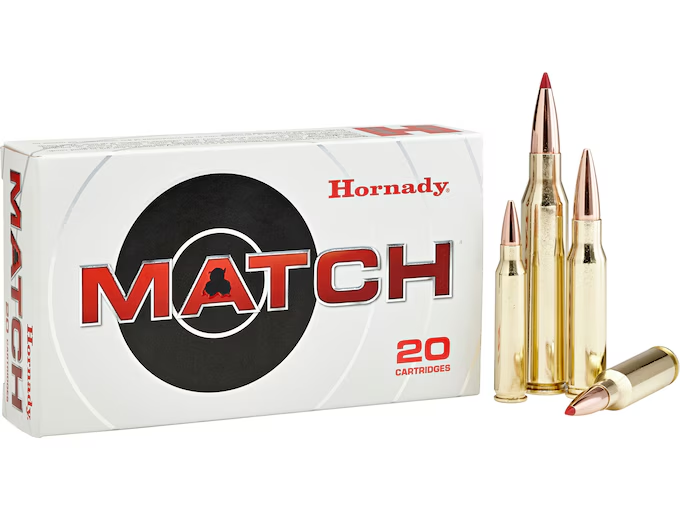
| Hornady Precision Hunter 6.5 Creedmoor 143 gr ELD-X | 143 gr ELD-X | High-BC hunting alternative |
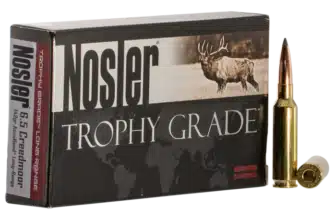
| Nosler Trophy Grade 6.5 Creedmoor 130 gr AccuBond | 130 gr AccuBond | Same-weight bonded alternative |
| Winchester Expedition Gold 6.5 Creedmoor 125 gr | 125 gr AccuBond | Lighter bonded alternative |
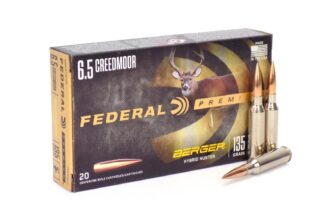
| Berger Hybrid Hunter 6.5 Creedmoor 130 gr | 130 gr Hybrid Hunter | High-BC nonbonded alternative |
| Sig Sauer Elite Hunter Tipped 6.5 Creedmoor 130 gr | 130 gr tipped hunting bullet | Same-weight hunting alternative |
| HSM Trophy Gold 6.5 Creedmoor 130 gr Berger Hunting VLD | 130 gr Berger Hunting VLD | High-BC nonbonded alternative |
FAQ
How does the Terminal Ascent bullet differ from Federal’s own Trophy Bonded Tip?
Both use bonded construction, but the Terminal Ascent is specifically engineered to expand reliably at the low impact velocities common at long range — a scenario where the older Trophy Bonded Tip was not optimized. The Terminal Ascent uses Federal’s SlipStream polymer tip and a modified nose cavity designed to initiate expansion at velocities as low as 1,400–1,500 fps. The Trophy Bonded Tip remains a capable close-to-mid-range hunting bullet, but the Terminal Ascent is the correct choice when shots beyond 400 yards are anticipated. Both bullets are bonded and will retain high mass percentages, but the expansion threshold difference is meaningful in the field.
Is 130 gr the best Terminal Ascent weight for 6.5 Creedmoor, or does Federal offer other options?
Federal offers the Terminal Ascent in 130 gr for 6.5 Creedmoor, which is the primary factory offering in this line for the cartridge. The 130 gr weight is a well-established choice for the 6.5 Creedmoor, balancing sectional density, BC, and muzzle velocity efficiently within the case capacity. Heavier bullets like the 143 gr ELD-X from competitors sacrifice some velocity but gain BC; lighter bullets gain velocity but may lose terminal performance at range. For most 6.5 Creedmoor hunting applications, the 130 gr Terminal Ascent represents a deliberate design choice rather than a limitation.
Can this load be used ethically on elk at distances beyond 300 yards?
The Terminal Ascent construction was specifically designed with larger game at extended range in mind. At 400 yards, this load retains approximately 1,333 ft-lbs of energy under standard conditions, which many experienced hunters and ballistic authorities consider sufficient for elk with precise shot placement. The bonded construction ensures the bullet will not fragment on heavy bone at these velocities, which is a critical failure mode for non-bonded bullets on large game. That said, ethical hunting at extended range requires confirmed zero, knowledge of actual drop at distance, and honest assessment of wind conditions — no ammunition substitutes for these fundamentals.
Does this ammunition comply with lead-free requirements in California or other restricted areas?
No. The Federal Terminal Ascent uses a lead core bonded to a copper jacket. It does not qualify as non-toxic or lead-free ammunition under California’s Condor Zone regulations or similar state-level requirements. Hunters who need to comply with these regulations should look at Federal’s own Terminal Ascent Copper line or alternatives such as the Barnes TTSX or Hornady CX, all of which use solid copper or copper-alloy construction. Using this load in a restricted zone would be a regulatory violation regardless of its terminal performance characteristics.
How does the Terminal Ascent compare to the Hornady ELD-X at long range for hunting?
The Hornady 143 gr ELD-X has a higher G1 BC (0.625 vs. 0.532) and a lower muzzle velocity, while the Terminal Ascent 130 gr launches faster and carries a bonded construction the ELD-X does not. At extended range, the ELD-X’s higher BC partially compensates for its velocity deficit, resulting in comparable retained energy figures past 400 yards. The critical difference is terminal construction: the ELD-X uses an interlock ring but is not a fully bonded bullet, meaning it may shed more mass on heavy bone impacts. For hunters prioritizing deep penetration on large or heavy-boned game at any distance, the Terminal Ascent’s bonded design offers a meaningful structural advantage. For deer-sized game at long range, both are capable options and the choice often comes down to price and rifle preference.
Submit Your Data · Real-World Results
Manufacturer velocity figures are measured under controlled lab conditions – barrel length, temperature, and lot number all affect real-world performance. The data below comes from community submissions tied to specific test conditions and reviewed before publishing.
Once this page reaches 3 approved submissions, aggregate velocity and confidence level will appear here automatically.
You need to login first.Results vary by firearm, barrel condition, ammunition lot, and environmental factors. Submitted data is for reference only. AmmoReports does not guarantee accuracy of user-submitted results.