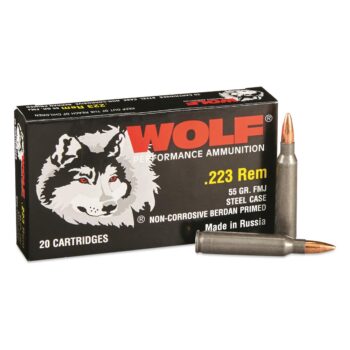
Wolf, .223 Remington, 55 Grain, FMJ

0
Wolf, .223 Remington, 55 Grain, FMJ Ammo, 20 Rounds

Best deal at: sportsmansguide.comThe Sportsman's Guide
Wolf, .223 Remington, 55 Grain, FMJ


FeatureDetail
Primary UseTarget shooting, range training
Bullet TypeFull Metal Jacket (bimetal jacket, lead core)
Bullet Weight55 grain
Case MaterialSteel (lacquer-coated)
Primer TypeBerdan (non-reloadable)
Packaging20 rounds per box
Typical Price$10.44/box โ€” $0.52/round
Closest CompetitorsFederal American Eagle .223 Rem 55gr FMJ (AE223), Tula .223 Rem 55gr FMJ, Hornady Steel Match .223 Rem 55gr HP

Official Specs

SpecValueSource
Muzzle Velocity (fps)โ€”Not published
Muzzle Energy (ft-lbs)โ€”Not published
Bullet Weight55 grManufacturer
Bullet TypeFull Metal JacketManufacturer
BC G1โ€”Not published
BC G7โ€”Not published
Manufacturer SKUโ€”Not published
UPCโ€”Not published
ReloadableNoManufacturer (Berdan-primed steel case)

Note: Wolf does not publish muzzle velocity, muzzle energy, or ballistic coefficient data for this specific load through standard retail channels. The ballistics table below uses an industry-standard reference velocity of 3,240 fps โ€” consistent with published data for comparable 55gr .223 Rem FMJ steel-case loads from the same manufacturer family โ€” and is labeled as a calculated estimate accordingly. Community-submitted chronograph data will supplement this table as submissions are received.

Ballistics Table

Calculated estimate. Real-world results vary by barrel length, temperature, altitude, and lot. Community submissions will provide measured muzzle velocity for comparison.

Reference velocity: ~3,240 fps (industry-standard estimate for 55gr .223 Rem FMJ; not manufacturer-published). All values marked with ~ to indicate estimated, not confirmed, data. Sight height: 1.5″ above bore. Zero: 100 yards.

Yards~Velocity (fps)~Energy (ft-lbs)~Trajectory (in)
0~3,240~1,282-1.5
100~2,920~1,0410.0 โ† zero
200~2,620~839-3.4
300~2,335~665-13.0
400~2,067~521-30.5
500~1,816~402-58.2

Key takeaway: At typical range training distances of 100 yards and under, this load performs consistently with other 55gr .223 Rem FMJ offerings, holding trajectory well within the practical accuracy requirements of paper target work. By 300 yards, the estimated drop of approximately 13 inches demands deliberate holdover, and wind drift โ€” not accounted for in this table โ€” becomes increasingly significant with steel-case ammunition that may exhibit slightly more velocity variation than premium brass-case loads. For most shooters using this load for plinking and high-volume practice, the 0โ€“200 yard window is where it earns its value. Beyond 300 yards, a more precisely characterized load is the better choice.

Steel Case and Bimetal Jacket โ€” What Buyers Should Know

Wolf steel-case ammunition occupies a specific and well-understood niche in the American shooting market. The lacquer-coated steel case is the primary reason this load is priced below comparable brass-case offerings โ€” steel is cheaper to produce, and the Berdan primer configuration used in Wolf production makes the case non-reloadable by design. The bimetal jacket โ€” a steel core wrapped in a copper wash โ€” is standard across Wolf’s .223 Remington line and is worth noting for two practical reasons: first, some indoor ranges prohibit bimetal-jacketed ammunition because it can damage steel backstops and poses a ricochet risk; second, a simple magnet test will confirm bimetal construction, as the bullet will attract to a magnet. Buyers should verify range rules before purchasing in volume. This is not a defect or a quality issue โ€” it is a design characteristic that defines the product’s price point and intended use environment.

Best Uses

Good fit:

  • High-volume range sessions where cost-per-round is the primary concern
  • Training drills requiring large round counts (carbine courses, mag-change practice)
  • Semi-automatic rifles chambered in .223 Remington or 5.56 NATO with chrome-lined or stainless barrels
  • Shooters who do not reload and have no use for spent brass recovery
  • Outdoor ranges where bimetal jacket restrictions do not apply

Not the right tool for:

  • Indoor ranges with steel backstop restrictions on bimetal or steel-core projectiles โ€” always confirm range rules before use
  • Precision or long-range shooting where velocity consistency and tight SD/ES figures matter
  • Hunting applications โ€” FMJ construction is prohibited for deer and most game species in the majority of U.S. states
  • Shooters who reload โ€” Berdan-primed steel cases are not compatible with standard reloading equipment
  • Rifles with polygonal rifling (some manufacturers advise against FMJ/bimetal combinations in these barrels โ€” consult your owner’s manual)

Reliability Notes

No structured submissions yet.

Based on manufacturer claims and open-source user reporting, the following observations are available โ€” these are not structured data and should be weighted accordingly:

  • Wolf steel-case .223 Remington has a long-documented history of reliable cycling in direct-impingement AR-15 platforms with standard carbine or mid-length gas systems; extraction reliability is generally reported as consistent when chambers are clean
  • Some users report increased carbon fouling compared to brass-case loads, attributed to the lacquer coating under high heat โ€” this is a commonly noted characteristic of lacquer-coated steel-case ammunition across multiple manufacturers, not specific to Wolf
  • Velocity consistency is generally described as adequate for training purposes but not comparable to match-grade or premium brass-case loads; this is expected at this price point
  • Cold-weather performance is sometimes noted as a variable with lacquer-coated steel cases โ€” stiff extraction in very cold conditions has been reported anecdotally across steel-case ammunition categories broadly

Competitors

LoadWeightBulletBC G1Adv. VelocityPrice/boxNotes
Federal American Eagle AE22355 grFMJ-BT0.2433,240 fps~$12โ€“$14Brass case, reloadable, Boxer-primed; premium alternative
Tula .223 Rem 55gr FMJ55 grFMJ~0.243~3,241 fps~$9โ€“$11Steel case, bimetal jacket; direct budget competitor; same use restrictions
Hornady Steel Match .223 Rem 55gr HP55 grHP0.2703,240 fps~$14โ€“$16Steel case but Hornady-quality projectile; higher BC; better long-range option
PMC Bronze .223 Rem 55gr FMJ-BT55 grFMJ-BT0.2433,050 fps~$12โ€“$13Brass case, reloadable; mid-tier budget alternative
Fiocchi .223 Rem 55gr FMJ55 grFMJ~0.2433,240 fps~$13โ€“$15Brass case, Boxer-primed, reloadable; slightly cleaner-burning
Winchester USA White Box .223 Rem 55gr FMJ55 grFMJ0.2433,240 fps~$13โ€“$15Brass case, widely available, reloadable; established budget brass option

Price Reality

  • At $10.44 per box of 20, this load comes to approximately $0.52 per round โ€” positioning it at the lower end of the .223 Remington market
  • Case pricing (typically 1,000 rounds) for Wolf steel-case .223 Rem has historically ranged from approximately $220โ€“$280 depending on market conditions, equating to roughly $0.22โ€“$0.28 per round in bulk โ€” though current availability should be verified
  • Federal American Eagle AE223 (brass-case, reloadable) typically runs $0.60โ€“$0.70 per round โ€” a 15โ€“35% premium over this load, justified for shooters who reload or need confirmed ballistic specs
  • Tula .223 Rem 55gr FMJ is the most direct steel-case competitor and typically prices within $0.02โ€“$0.05 per round of Wolf, making brand availability the practical deciding factor between the two
  • PMC Bronze .223 Rem offers brass-case reloadability at approximately $0.60โ€“$0.65 per round โ€” a reasonable step up for those who want recoverable brass
  • Fair price benchmark: At $0.52/round, this load is fairly priced for steel-case, non-reloadable training ammunition. Pricing above $0.65/round for this specific load should be considered elevated relative to typical market rates.

Prices change. Check the Where to Buy block for current listings.

Where to Buy

Wolf, .223 Remington, 55 Grain, FMJ Ammo, 20 Rounds

Wolf .223 Remington FMJ ammo delivers reliable performance and accuracy for target shooting and range training. Each box contains 20 rounds of 55 grain cartridges, making it an excellent choice for both novice and experienced shooters.

Affiliate links. These do not influence ratings, data, or any editorial content on this page.

FAQ

Is Wolf .223 Remington 55gr FMJ safe to use in a standard AR-15?
Yes, Wolf .223 Remington is designed for use in rifles chambered in .223 Remington or 5.56 NATO. The steel case is harder than brass and some shooters express concern about extractor wear over very high round counts, though this is debated among gunsmiths and the consensus for most service-life volumes is that wear is negligible. Chrome-lined chambers are generally more tolerant of steel-case ammunition than unlined chambers. If your rifle has known feeding or extraction sensitivities, test a single box before committing to a case purchase.

Why does a magnet stick to the bullet, and does that mean it’s steel-core or armor-piercing?
The magnet attraction is due to the bimetal jacket โ€” a steel jacket with a copper wash exterior โ€” not a steel or hardened penetrator core. The bullet itself has a standard lead core. This construction is not classified as armor-piercing under U.S. federal law (18 U.S.C. ยง 922(a)(17)), which defines AP pistol ammunition specifically. The magnet test simply confirms bimetal jacket construction, which is relevant only for range restrictions on steel backstops โ€” not for legal or safety concerns in standard rifle use.

How does Wolf 55gr FMJ compare to Tula 55gr FMJ for range training?
These two loads are functionally very similar โ€” both use steel cases, bimetal jackets, Berdan primers, and 55gr FMJ projectiles at comparable velocities. Wolf and Tula ammunition are both produced in Russia (Wolf is imported and distributed by Sporting Supplies International; Tula is produced by JSC Tula Cartridge Plant), and the practical performance difference between them for range training is minimal. Price, availability, and lot-to-lot consistency are the more meaningful variables when choosing between them. Neither is reloadable, and both carry the same indoor range restrictions.

Can this ammunition be used for coyote or varmint hunting?
FMJ construction is generally not recommended for hunting, and in many states it is prohibited for use on game animals. For varmint hunting (prairie dogs, groundhogs), some jurisdictions permit FMJ use, but terminal performance is poor compared to hollow point or soft point designs โ€” FMJ bullets are designed to maintain shape through a target, not to expand and transfer energy efficiently. Shooters intending to hunt with .223 Remington should select a purpose-built varmint or hunting load with an appropriate expanding projectile.

Does the lacquer coating cause feeding or chamber problems in semi-automatic rifles?
Lacquer-coated steel cases have historically generated debate about lacquer buildup in hot chambers. In modern testing, this issue is generally considered overstated for standard-use volumes โ€” the lacquer does not melt and re-solidify in a way that causes meaningful chamber fouling under normal shooting conditions. However, sustained high-volume fire (multiple magazines in rapid succession) can increase chamber temperatures enough that some shooters prefer to allow cooling between strings when using lacquer-coated steel-case ammunition. Polymer-coated steel-case alternatives exist if this is a concern, though Wolf’s standard .223 Remington line uses lacquer coating.

Submit Your Data ยท Real-World Results

Manufacturer velocity figures are measured under controlled lab conditions – barrel length, temperature, and lot number all affect real-world performance. The data below comes from community submissions tied to specific test conditions and reviewed before publishing.

Once this page reaches 3 approved submissions, aggregate velocity and confidence level will appear here automatically.

You need to first.

Results vary by firearm, barrel condition, ammunition lot, and environmental factors. Submitted data is for reference only. Ammo Reports does not guarantee accuracy of user-submitted results.

We will be happy to hear your thoughts

Leave a reply

Ammo Reports
Logo