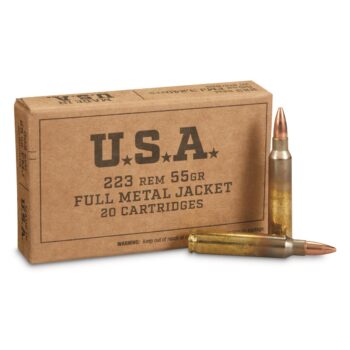
Winchester USA, .223 Remington, FMJ, 55 Grain

0
Winchester USA, .223 Remington, FMJ, 55 Grain, 20 Rounds

$14.24 $14.99

Best deal at: sportsmansguide.comThe Sportsman's Guide
Winchester USA, .223 Remington, FMJ, 55 Grain
$14.24 $14.99


FieldDetail
Primary UseTarget shooting, plinking, varmint hunting
Bullet TypeFull Metal Jacket (FMJ), lead core with gilding metal jacket
Bullet Weight55 grain
Case MaterialBrass
Primer TypeBoxer, centerfire
Packaging20 rounds per box
Typical Price$14.24/box โ€” $0.71/round
Closest CompetitorsFederal American Eagle AE223J 55gr FMJ, Hornady Steel Match 55gr FMJ, PMC Bronze .223A 55gr FMJ

Official Specs

SpecValueSource
Muzzle Velocity (fps)โ€”Not published for this SKU
Muzzle Energy (ft-lbs)โ€”Not published for this SKU
Bullet Weight55 grManufacturer
Bullet TypeFull Metal Jacket (FMJ)Manufacturer
BC G1โ€”Not published
BC G7โ€”Not published
Manufacturer SKUโ€”Not published in available data
UPCโ€”Not published in available data
ReloadableYesBrass case, Boxer primer

Note: Winchester does not publish muzzle velocity or muzzle energy for this specific USA White Box 55gr FMJ load in the product data provided. Velocity figures commonly cited in retail listings (typically 3,240 fps) appear to originate from secondary or aggregated retailer sources, not a Winchester factory ballistics sheet. Those figures are used below in the Ballistics Table and are labeled accordingly. BC values are not published by Winchester for this load; the ballistics table uses a commonly referenced G1 BC of 0.243 for a standard 55gr FMJ projectile, labeled as an industry estimate.

Ballistics Table

Calculated estimate. Muzzle velocity of 3,240 fps is drawn from commonly cited retailer data, not a Winchester-published factory spec. BC G1 of 0.243 is an industry estimate for a standard 55gr FMJ. Real-world results vary by barrel length, temperature, altitude, and lot. Community submissions will provide measured muzzle velocity for comparison.

Zero: 100 yards | Sight height: 1.5″ above bore

YardsVelocity (fps)Energy (ft-lbs)Trajectory (in)
0~3,240~1,282-1.5
100~2,854~9940.0 โ† zero
200~2,497~761-3.2
300~2,166~572-13.5
400~1,862~423-32.8
500~1,589~308-64.4

Key takeaway: At 100 yards, this load retains nearly 1,000 ft-lbs of energy, which is adequate for varmint-sized targets and comfortable for extended range sessions. By 300 yards, velocity has dropped below 2,200 fps and drop exceeds 13 inches, making precise holdover or dialing essential for accuracy at distance. The 55 grain FMJ is not a long-range specialist โ€” it is optimized for the 0โ€“200 yard window where drop remains manageable and terminal performance is predictable. Shooters using this load beyond 300 yards should verify their specific rifle’s zero and apply confirmed drop data rather than relying on these estimates.

Best Uses

Good fit:

  • High-volume target shooting and plinking at ranges up to 200 yards
  • Informal practice with AR-15 or bolt-action .223 Remington rifles
  • Varmint control on small animals such as prairie dogs, ground squirrels, and similar species at moderate distances
  • Training drills where consistent cycling and affordable per-round cost are priorities
  • Breaking in a new .223 or 5.56-chambered rifle where round count matters more than premium performance

Not the right tool for:

  • Hunting medium or large game โ€” FMJ bullets are not designed for controlled expansion and are prohibited for deer hunting in most U.S. states
  • Long-range precision shooting beyond 300 yards where a higher ballistic coefficient bullet is needed to resist wind drift and maintain energy
  • Jurisdictions or ranges that prohibit lead-core FMJ ammunition or require frangible or lead-free projectiles
  • Self-defense applications where terminal performance and reliable expansion are required
  • Competitive shooting formats that require specific bullet constructions such as open-tip match or hollow point

Reliability Notes

No structured submissions yet.

Based on manufacturer claims and open-source retailer information, the Winchester USA White Box line has a long-standing reputation for consistent primer ignition and reliable feeding in semi-automatic platforms. The brass case construction is noted by multiple sources as providing consistent neck tension and dimensional uniformity suitable for bolt guns and gas-operated rifles alike. Winchester’s USA line is positioned as a value-tier product manufactured to functional tolerances rather than match-grade standards; users should not expect bench-rest-level consistency from lot to lot. No active recalls or safety notices were identified for this load at the time of publication. All notes above reflect manufacturer claims or open-source data, not structured community submissions.

Competitors

LoadWeightBulletBC G1Adv. VelocityPrice/boxNotes
Federal American Eagle AE223J55 grFMJ-BT0.2433,240 fps~$13.99Same bullet weight; boat-tail base may offer marginal stability advantage
PMC Bronze .223A55 grFMJ-BT0.2433,050 fps~$12.99Budget alternative; slightly lower velocity; brass case, Boxer primed
Hornady American Gunner 55gr55 grHP0.2553,240 fps~$16.99Hollow point design; better terminal performance; not legal for all hunting uses
Fiocchi .223 Rem 55gr FMJ55 grFMJ0.2433,240 fps~$13.49Budget-tier alternative; European manufacture; brass case
Black Hills Ammunition 55gr FMJ55 grFMJ0.2433,200 fps~$21.99Premium alternative; tighter tolerances; remanufactured and new options available
Sig Sauer Elite Ball 55gr FMJ55 grFMJ0.2433,240 fps~$14.99Comparable price point; newer brand entrant to value-tier .223 market

Price Reality

  • Typical retail price for this load runs $13.00โ€“$16.00 per 20-round box, with $14.24 sitting near the middle of that range
  • Per-round cost at $14.24/box is approximately $0.71/round
  • A 1,000-round case, where available, typically prices out between $330โ€“$380, or roughly $0.33โ€“$0.38/round in bulk
  • PMC Bronze and Fiocchi 55gr FMJ are generally $1.00โ€“$2.00 cheaper per box, making them the strongest budget alternatives at comparable performance
  • Federal American Eagle 55gr FMJ is priced similarly and is widely considered a direct functional equivalent
  • Black Hills 55gr FMJ runs $6.00โ€“$8.00 more per box and is a premium alternative for shooters who prioritize tighter tolerances
  • A price above $18.00 per 20-round box for this load should be considered overpriced given current market conditions for value-tier .223 FMJ ammunition

Prices change. Check the Where to Buy block for current listings.

Where to Buy

Winchester USA, .223 Remington, FMJ, 55 Grain, 20 Rounds

The Winchester USA .223 Remington ammunition is designed for reliable performance with its 55 grain full metal jacket rounds, perfect for both target shooting and varmint hunting. Packaged in 20 rounds, it offers an excellent balance of power and accuracy at an affordable price.

Affiliate links. These do not influence ratings, data, or any editorial content on this page.


FAQ

Does the Winchester USA 55gr FMJ expand on impact?
No. A full metal jacket bullet is specifically constructed to resist deformation and expansion. The gilding metal jacket fully encloses the lead core, including the nose, which prevents the mushrooming effect associated with hollow point or soft point bullets. This makes the FMJ reliable for feeding and consistent in flight, but it means the bullet passes through soft tissue with minimal energy transfer compared to an expanding design. For any application where terminal performance matters โ€” hunting or defense โ€” an expanding bullet is the appropriate choice.

Is this load safe to use in a rifle chambered for 5.56 NATO?
Yes. A .223 Remington cartridge can be safely fired in a rifle with a 5.56 NATO chamber. The dimensional relationship runs one direction: 5.56 chambers are cut with slightly more headspace and a longer throat, which accommodates .223 Remington without issue. The reverse is not recommended โ€” firing 5.56 NATO ammunition in a chamber marked .223 Remington can generate elevated pressure and is generally advised against. This Winchester USA load is a standard .223 Remington commercial cartridge and is appropriate for both .223 Remington and 5.56 NATO-marked firearms.

How does this load compare to the Federal American Eagle 55gr FMJ for high-volume practice?
Both loads occupy the same performance tier and use comparable 55 grain FMJ projectiles at similar advertised velocities. The practical difference between them in a training context is negligible โ€” most shooters will not detect a functional difference in recoil, noise, or point of impact at typical practice distances. The decision typically comes down to price at time of purchase and availability. Neither load is manufactured to match-grade standards, and both are appropriate for the same range of applications: plinking, training, and informal target work.

Can this ammunition be used for coyote hunting?
The 55 grain FMJ can be used on coyotes in states where FMJ is not explicitly prohibited for hunting, and it will achieve lethal results at moderate distances. However, it is not the ideal choice. Because FMJ bullets do not expand, they rely on tissue disruption from velocity and hydrostatic shock rather than controlled expansion, which can result in inconsistent terminal performance. A soft point or varmint hollow point in the same caliber โ€” such as a Hornady V-MAX or Sierra BlitzKing โ€” will produce more reliable, humane kills on coyote-sized animals. Check local regulations before hunting with FMJ, as some states restrict or prohibit its use for taking game.

Why doesn’t Winchester publish velocity data for this specific load?
Winchester publishes detailed ballistics data for many of its product lines, but the USA White Box series โ€” being a high-volume, value-tier line โ€” has historically had less comprehensive published documentation than premium lines such as Deer Season XP or Power Point. Velocity figures of 3,240 fps are widely cited across retail platforms and are consistent with industry norms for a 55 grain .223 Remington load from a 24-inch test barrel, but AmmoReports.com cannot confirm these figures trace directly to a Winchester factory ballistics sheet. Buyers who require confirmed velocity data for precision applications should consider loads from manufacturers who publish full ballistics tables with stated barrel lengths and test conditions.

Submit Your Data ยท Real-World Results

Manufacturer velocity figures are measured under controlled lab conditions – barrel length, temperature, and lot number all affect real-world performance. The data below comes from community submissions tied to specific test conditions and reviewed before publishing.

Once this page reaches 3 approved submissions, aggregate velocity and confidence level will appear here automatically.

You need to first.

Results vary by firearm, barrel condition, ammunition lot, and environmental factors. Submitted data is for reference only. Ammo Reports does not guarantee accuracy of user-submitted results.

We will be happy to hear your thoughts

Leave a reply

Ammo Reports
Logo