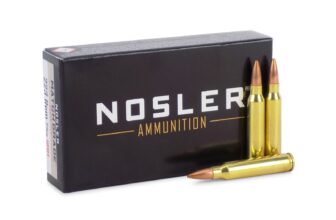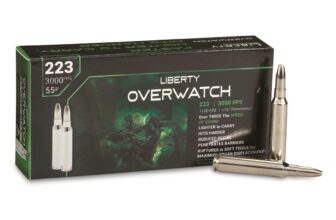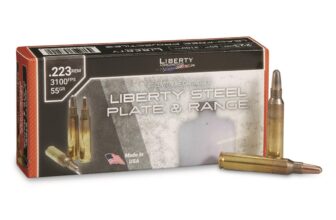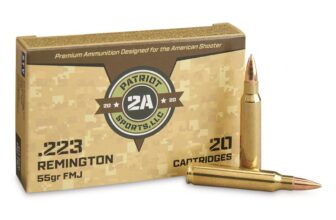
Ammo Inc. Signature, .223 Remington, FMJ, 55 Grain
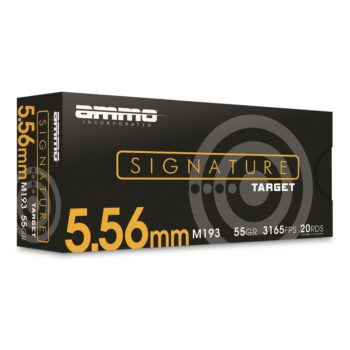
| Feature | Detail |
|---|---|
| Primary Use | Target shooting, training, plinking |
| Bullet Type | Full Metal Jacket (FMJ) |
| Bullet Weight | 55 grain |
| Case Material | Brass (standard for Signature line) |
| Primer Type | Boxer (standard for Signature line) |
| Packaging | 20 rounds per box |
| Typical Price | $11.39/box ยท ~$0.57/round |
| Closest Competitors | Federal American Eagle .223 Rem 55gr FMJ, PMC Bronze .223 Rem 55gr FMJ, Fiocchi .223 Rem 55gr FMJ |
Official Specs
| Spec | Value | Source |
|---|---|---|
| Muzzle Velocity (fps) | โ | Not published |
| Muzzle Energy (ft-lbs) | โ | Not published |
| Bullet Weight | 55 gr | Manufacturer |
| Bullet Type | Full Metal Jacket (FMJ) | Manufacturer |
| BC G1 | โ | Not published |
| BC G7 | โ | Not published |
| Manufacturer SKU | โ | Not published |
| UPC | โ | Not published |
| Reloadable | Yes | Brass/Boxer construction |
Note: Ammo Inc. does not publicly list velocity, energy, or ballistic coefficient data for this specific Signature line load at the time of publication. The ballistics table below uses a calculated estimate based on the industry-standard performance profile for a 55 grain FMJ projectile in .223 Remington from a 20-inch test barrel. Measured community submissions will be added as they become available.
Ballistics Table
Calculated estimate. Real-world results vary by barrel length, temperature, altitude, and lot. Community submissions will provide measured muzzle velocity for comparison.
Zero: 100 yards ยท Sight height: 1.5″ above bore ยท Estimated MV: ~3,240 fps (industry typical for 55gr .223 Rem FMJ)
| Yards | Velocity (fps) | Energy (ft-lbs) | Trajectory (in) |
|---|---|---|---|
| 0 | ~3,240 | ~1,282 | -1.5 |
| 100 | ~2,854 | ~994 | 0.0 โ zero |
| 200 | ~2,497 | ~762 | -3.6 |
| 300 | ~2,168 | ~574 | -14.0 |
| 400 | ~1,868 | ~426 | -33.4 |
| 500 | ~1,600 | ~313 | -65.2 |
Key takeaway: At the estimated muzzle velocity for a 55 grain .223 Remington FMJ, this load holds supersonic flight well past 400 yards, making it entirely practical for training and target work at typical range distances. The trajectory stays flat enough through 200 yards that most shooters will need no holdover correction within that window. Past 300 yards, drop becomes meaningful and wind drift โ not modeled here โ will have increasing influence on practical accuracy. For paper punching and drills inside 300 yards, the ballistic profile is a comfortable match for the load’s intended purpose.
Best Uses
Good fit:
- High-volume target shooting and range training where cost-per-round is the primary concern
- Zeroing and function-testing AR-platform rifles chambered in .223 Remington or 5.56 NATO
- Drills requiring consistent cycling where FMJ reliability outweighs terminal performance
- Introductory shooting instruction and new shooter familiarization at standard range distances
- Informal plinking and steel target practice where lead-core FMJ is permitted
Not the right tool for:
- Hunting โ FMJ projectiles are prohibited for deer and most game animals in the majority of U.S. states and are not designed for controlled expansion
- Self-defense or home protection, where terminal performance and controlled expansion are required
- Ranges or jurisdictions that prohibit lead-core or steel-jacketed projectiles (verify jacket material before use at indoor ranges)
- Long-range precision work where a published ballistic coefficient and verified velocity are necessary for accurate dope
Reliability Notes
No structured submissions yet.
Based on manufacturer claims and open-source retailer descriptions, the Ammo Inc. Signature line is positioned as a brass-cased, Boxer-primed training load intended for consistent cycling in semi-automatic rifles. The Signature series is marketed by Ammo Inc. as their standard-grade practice ammunition, distinct from their STREAK visual tracer and OPS defensive lines. No documented feed, extraction, or primer failures specific to this load appear in indexed public sources at the time of publication. All notes here reflect manufacturer claims or open-source retailer content, not structured performance data.
Competitors
| Load | Weight | Bullet | BC G1 | Adv. Velocity | Price/box | Notes |
|---|---|---|---|---|---|---|
| Federal American Eagle .223 Rem 55gr FMJ | 55 gr | FMJ-BT | ~0.243 | ~3,240 fps | ~$12โ$14 | Premium budget option; widely available; boat-tail base |
| PMC Bronze .223 Rem 55gr FMJ | 55 gr | FMJ-BT | ~0.243 | ~3,200 fps | ~$10โ$13 | Consistent budget alternative; brass-cased |
| Fiocchi .223 Rem 55gr FMJ | 55 gr | FMJ | ~0.240 | ~3,240 fps | ~$11โ$14 | Italian-manufactured; brass-cased; comparable price tier |
| Hornady American Gunner .223 Rem 55gr HP | 55 gr | HP | ~0.255 | ~3,240 fps | ~$16โ$19 | Premium alternative; hollow point; better terminal performance |
| Aguila .223 Rem 55gr FMJ | 55 gr | FMJ | ~0.235 | ~3,215 fps | ~$9โ$12 | Budget alternative; brass-cased; widely available |
| Winchester USA White Box .223 Rem 55gr FMJ | 55 gr | FMJ | ~0.243 | ~3,240 fps | ~$12โ$15 | Established brand; consistent quality; broad retailer availability |
Price Reality
- At $11.39 per 20-round box, the per-round cost is approximately $0.57/round
- Case pricing (typically 500 or 1,000 rounds) is not confirmed from the source data; expect case discounts to bring the per-round cost closer to $0.50โ$0.54/round if available
- Federal American Eagle 55gr FMJ typically runs $0.60โ$0.70/round, placing this load slightly below that benchmark
- PMC Bronze 55gr FMJ and Aguila 55gr FMJ often land in the $0.50โ$0.65/round range, making this load competitive within its tier
- At $0.57/round, this load sits in the middle of the budget training segment โ not the cheapest available, but within a reasonable range for brass-cased domestic production
- A price above $0.70/round for this load should be considered overpriced relative to the current market for 55 grain .223 Rem FMJ training ammunition
Prices change. Check the Where to Buy block for current listings.
Where to Buy
Ammo Inc. Signature, .223 Remington, FMJ, 55 Grain, 20 Rounds
Affiliate links. These do not influence ratings, data, or any editorial content on this page.
FAQ
Is the Ammo Inc. Signature .223 Remington 55gr FMJ safe to fire in a rifle marked 5.56 NATO?
Rifles marked 5.56 NATO are chambered to SAAMI/NATO specifications that accept both 5.56 NATO and .223 Remington cartridges. The Ammo Inc. Signature load is headstamped .223 Remington, which operates at lower maximum pressure than 5.56 NATO, so it is safe to fire in a 5.56 NATO chamber. The reverse โ firing 5.56 NATO ammunition in a rifle marked only .223 Remington โ requires more caution and should be verified with the firearm manufacturer. When in doubt, consult your rifle’s owner’s manual or contact the manufacturer directly.
How does this load compare to Federal American Eagle 55gr FMJ for training use?
Both loads use a 55 grain FMJ projectile and are positioned for high-volume training use. Federal American Eagle has published velocity data and a well-documented performance history, which makes it easier to build confirmed ballistic data for dope cards. The Ammo Inc. Signature load lacks published velocity specs at the time of writing, so shooters who need precise, documented performance data may prefer American Eagle for that reason alone. For general cycling, zeroing, and range drills where exact velocity is not critical, both loads occupy the same functional tier.
Can this ammunition be used for varmint or predator hunting?
Full metal jacket projectiles are not designed for hunting use. FMJ bullets are constructed to maintain their shape and pass through a target with minimal expansion, which is the opposite of what is needed for ethical, humane harvesting of game animals. Most U.S. states explicitly prohibit FMJ ammunition for hunting deer and many other species. For varmint hunting such as prairie dogs or groundhogs, where regulations may be more permissive, a purpose-built varmint projectile โ such as a hollow point or soft point โ will deliver far superior terminal performance. This load is a training cartridge, not a hunting cartridge.
Is the brass from this load worth saving for reloading?
The Ammo Inc. Signature line uses brass cases with Boxer primers, which means the spent brass is reloadable in principle. Brass condition after firing depends on the chamber dimensions of the host firearm and how many times the case has been fired. As a first-firing from a factory load, the brass should be in good condition for reloading after proper inspection and sizing. That said, this page covers factory ammunition only โ no reloading data, charge weights, or handload information is provided here.
Why doesn’t Ammo Inc. publish velocity data for the Signature line?
Some manufacturers โ particularly those focused on the budget and training segment โ do not publish full ballistic specifications for every load in their lineup. This is not unusual in the industry and does not necessarily indicate a quality problem. It does mean that shooters who need confirmed velocity figures for ballistic calculators or long-range dope will need to chronograph the load themselves or rely on community-submitted data. Published specs from comparable 55 grain .223 Remington FMJ loads from other manufacturers can serve as a reasonable planning baseline, as noted in the ballistics table above.
Submit Your Data ยท Real-World Results
Manufacturer velocity figures are measured under controlled lab conditions – barrel length, temperature, and lot number all affect real-world performance. The data below comes from community submissions tied to specific test conditions and reviewed before publishing.
Once this page reaches 3 approved submissions, aggregate velocity and confidence level will appear here automatically.
You need to login first.Results vary by firearm, barrel condition, ammunition lot, and environmental factors. Submitted data is for reference only. Ammo Reports does not guarantee accuracy of user-submitted results.