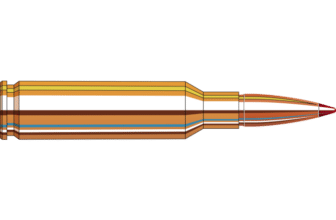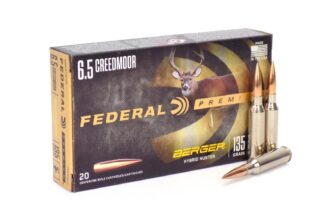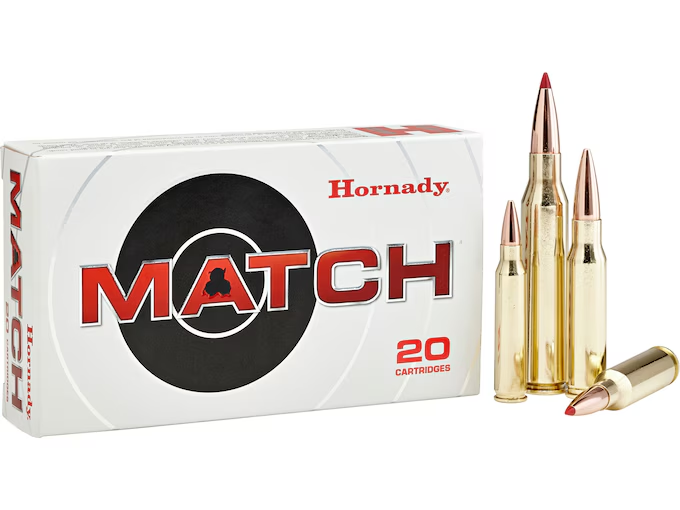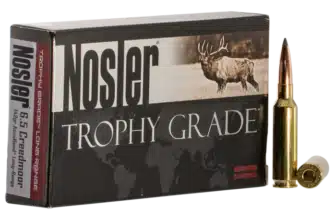
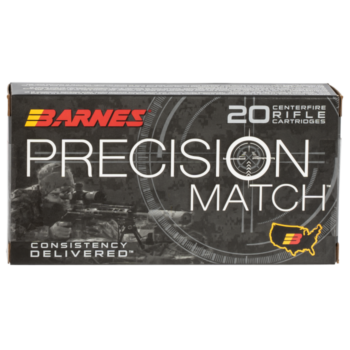
Barnes Precision Match 6.5 Creedmoor 140 gr OTM
| Primary Use | Precision rifle competition · Long-range target shooting |
| Bullet Type | OTM BT — Open Tip Match Boat-Tail (Barnes proprietary) |
| Bullet Weight | 140 gr |
| Case | Brass (reloadable, premium quality) |
| Primer | Boxer |
| Packaging | 20 rounds per box · 10 boxes per case (200 rounds) |
| Typical Price | ~$46–50 / box (~$2.30–2.50 per round) |
| Closest Competitors | Hornady Match 6.5 CM 140 gr ELD-M · Federal Gold Medal 6.5 CM 140 gr Sierra MatchKing · PPU Supreme 6.5 CM 140 gr Sierra MatchKing |
Official Specs
| Spec | Value | Source |
|---|---|---|
| Muzzle Velocity | 2,700 fps | Barnes / Ammunition Depot |
| Muzzle Energy | 2,266 ft-lbs | Barnes / Ammunition Depot |
| Bullet Weight | 140 gr | Barnes |
| Bullet Type | OTM BT — Open Tip Match Boat-Tail (Barnes proprietary) | Barnes |
| BC (G1) | ~0.540 | Barnes estimated |
| BC (G7) | ~0.270 | Barnes estimated |
| Manufacturer SKU | 30166 | Barnes |
| UPC | 716876022472 | — |
| Reloadable | Yes | Premium brass, Boxer-primed |
BC note: Barnes does not publish BC for the Precision Match OTM on retail listings. The ~0.540 (G1) estimate is based on the bullet’s weight, caliber, and OTM BT design class. Community submissions with velocity at multiple distances will help establish an empirical BC for this specific load.
ME verification: 140 gr × 2,700² ÷ 450,400 = 2,266 ft-lbs — matches the published figure exactly. Data is internally consistent.
Ballistics Table
Calculated. Zero: 100 yards. Sight height: 1.5″ above bore. BC (G1): ~0.540 (estimated for Barnes 140 gr OTM BT).
Calculated estimate — BC not published by Barnes. Real-world results vary by barrel length, temperature, altitude, and lot.
| Yards | Velocity (fps) | Energy (ft-lbs) | Trajectory (in) |
|---|---|---|---|
| 0 | 2,700 | 2,266 | +1.5 |
| 100 | 2,562 | 2,040 | 0.0 ← zero |
| 200 | 2,431 | 1,837 | -7.1 |
| 300 | 2,307 | 1,654 | -20.6 |
| 400 | 2,189 | 1,489 | -41.6 |
| 500 | 2,077 | 1,341 | -71.3 |
Key takeaway: at 2,700 fps this load runs slightly slower than some 140 gr competitors (Hornady ELD-M at 2,710 fps, Federal Gold Medal SMK at 2,650 fps) — the difference is marginal. The temperature-stable propellant is the defining feature: across temperature extremes from cold morning to midday heat, extreme spread (ES) and standard deviation (SD) stay tight — exactly what precision rifle competition demands. At 500 yards the load retains 1,341 ft-lbs — more than adequate for long-range target use.
The Temperature-Stable Propellant Advantage
Barnes explicitly calls out temperature-stable propellant as a core feature of the Precision Match line. This matters specifically for competition:
The problem with standard powders: most rifle propellants change their burn rate with temperature. A load that produces 2,700 fps at 70°F may produce 2,730 fps at 95°F and 2,670 fps at 35°F — a 60 fps spread just from ambient temperature. At 500 yards that translates to 3–4 inches of vertical dispersion from nothing but weather.
Why temperature-stable powders are different: powders like Hodgdon Extreme series (H4350, H4831) and similar formulations are designed to minimize this variation. Factory match loads that specify temperature stability — Barnes Precision Match, Federal Gold Medal, and a handful of others — use these powder families to keep velocity spreads tight regardless of whether the match is on a cold morning or a hot afternoon.
For competitive shooters who zero at one temperature and shoot at another, this is a genuine performance advantage over standard hunting loads or budget match ammunition.
Variants
This page covers Barnes Precision Match 30166 · 6.5 Creedmoor · 140 gr OTM BT only.
Barnes’s match ammunition line includes:
- Barnes Precision Match 6.5 CM 130 gr OTM BT — lighter/faster option (separate report page)
- Barnes Tactical 6.5 CM 130 gr Hybrid OTM — mil/LE oriented load
- Barnes Vor-Tx 6.5 CM 100 gr TTSX BT — hunting load, all-copper
Best Uses
Good fit:
- Precision rifle competition (PRS, NRL, tactical matches) where temperature-stable velocity reduces unexplained vertical dispersion between stages shot in different conditions
- Long-range target shooting at 300–600+ yards where consistent ES and SD matter more than raw velocity
- Shooters who compete across seasons or in locations with significant diurnal temperature swings
- Handloaders who want a factory baseline using Barnes’s own OTM bullet before developing custom loads
- Semi-automatic 6.5 CM platforms where the OTM BT feeds reliably from box magazines
Not the right tool for:
- Hunting — OTM is a match bullet not designed for terminal expansion on game
- Budget practice — at $2.40/round this is premium match ammunition pricing
- Shooters who only compete in consistent temperature environments where standard powder loads perform equivalently
- Self-defense — not designed or rated for it
Reliability Notes
No structured submissions yet.
General notes:
- Barnes Precision Match uses what Barnes describes as “first-quality, premium brass” — consistent case dimensions and primer pocket uniformity are standard claims for factory match ammunition at this price point
- The temperature-stable propellant claim is the load’s central marketing differentiator — whether this produces measurably lower ES/SD than competitors like Hornady Match in real-world field conditions is something community submissions with SD/ES data will help quantify
- Barnes’s OTM bullet is their own design — not a Sierra MatchKing or Berger Hybrid; independent accuracy testing comparing it to SMK or ELD-M loaded to the same velocity in the same rifle would be valuable data
- At 2,700 fps this load is essentially identical in velocity to the PPU Supreme 140 gr SMK (2,690 fps) — making it a direct speed-comparable test case for the temperature-stability claim
Competitors
| Load | Weight | Bullet | BC (G1) | Adv. Velocity | Temp-Stable Powder | Price / box |
|---|---|---|---|---|---|---|
| Hornady Match 6.5 CM 140 gr ELD-M | 140 gr | ELD-M | ~0.646 | 2,710 fps | Not specified | ~$38–45 |
| Federal Gold Medal 6.5 CM 140 gr SMK | 140 gr | Sierra MatchKing | ~0.617 | 2,650 fps | Yes (GM powder) | ~$38–42 |
| PPU Supreme 6.5 CM 140 gr Sierra MatchKing | 140 gr | Sierra MatchKing | ~0.617 | 2,690 fps | Not specified | ~$28–32 |
| Fiocchi Exacta 6.5 CM 142 gr Sierra MatchKing | 142 gr | Sierra MatchKing | ~0.595 | 2,675 fps | Not specified | ~$40–44 |
| Berger Tactical 6.5 CM 130 gr Hybrid OTM | 130 gr | Hybrid OTM | ~0.523 | 2,921 fps | Not specified | ~$50–54 |
Temperature stability note: Federal Gold Medal is the most widely cited factory match load with temperature-stable powder (Federal’s Gold Medal propellant). Barnes Precision Match makes the same claim with their own powder selection. Both are legitimate in the “temp-stable match load” category — community ES/SD data would directly compare them.
Price Reality
- Typical retail range: $46–50 per box of 20 (~$2.30–2.50/round)
- vs. Hornady Match ELD-M: Barnes runs $6–8/box more — Hornady has higher BC (0.646 vs ~0.540) and is the dominant competition load; Barnes’s advantage is the temperature-stable powder claim
- vs. Federal Gold Medal SMK: comparable pricing — both claim temperature-stable powder; Federal uses the proven Sierra MatchKing bullet; Barnes uses their own OTM
- vs. PPU Supreme SMK: Barnes runs $16–18/box more for temperature-stable powder and US manufacturing vs Serbian production; PPU offers no temp-stable claim
- Fair price benchmark: under $48/box is reasonable for a temperature-stable match load; above $54/box loses ground against Federal Gold Medal
Where to Buy
Affiliate links. These do not influence ratings, data, or any editorial content on this page.
- MidwayUSA
- Brownells
- Palmetto State Armory
- Natchez Shooters Supplies
FAQ
What makes temperature-stable powder important for competition?
Standard rifle powders change their burn rate with ambient temperature — a load zeroed at 70°F may shoot 1–2 MOA high on a hot afternoon and 1–2 MOA low on a cold morning. In precision rifle competition where stages are shot over several hours in changing conditions, this vertical dispersion from temperature adds unexplained misses that are hard to diagnose and impossible to compensate for in real time. Temperature-stable propellants minimize this effect, keeping velocity — and therefore point of impact — consistent across a 50–60°F temperature range. For hunters who zero at home and hunt in different weather, this matters less. For competitive shooters, it is a genuine performance advantage.
Barnes OTM vs Sierra MatchKing vs Hornady ELD-M — which is most accurate?
No universal answer — accuracy in precision loads is rifle-dependent. The Sierra MatchKing has the longest competition track record and most independent data. The Hornady ELD-M has the highest published BC (0.646 vs ~0.540 for Barnes OTM) and has become the dominant load in PRS competition. The Barnes OTM is less extensively benchmarked in published reviews. For a new rifle setup, testing all three at 100 yards and selecting the one that groups tightest in your specific barrel is the only way to determine preference. The temperature-stable powder is Barnes’s differentiation, not the bullet design.
Is this load the same bullet as the Barnes Tactical 130 gr Hybrid OTM?
No — different bullet, different weight, different line. The Tactical 130 gr Hybrid OTM uses Barnes’s Hybrid ogive design (tangent-plus-secant profile) at 130 gr, optimized for tactical and semi-auto platforms. The Precision Match 140 gr OTM uses a standard OTM BT design at 140 gr, optimized for precision competition accuracy. The Tactical load is 221 fps faster; the Precision Match load is heavier with higher estimated BC. They serve different use cases within Barnes’s lineup.
Does temperature-stable powder mean the same thing as “low ES”?
Related but not identical. Temperature stability means velocity doesn’t change much with ambient temperature. Low ES (Extreme Spread) means shot-to-shot velocity variation is tight within a session. Both contribute to consistent point of impact, but from different sources of variation. A load can have temperature-stable powder but mediocre lot-to-lot ES, or excellent ES with a standard powder that drifts with temperature. The best match loads — Federal Gold Medal, Barnes Precision Match — aim to minimize both. Community chronograph submissions with ES and SD data will help establish whether this load delivers on both fronts in practice.
Submit Your Data · Real-World Results
Manufacturer velocity figures are measured under controlled lab conditions — barrel length, temperature, and lot number all affect real-world performance. The data below comes from community submissions tied to specific test conditions and reviewed before publishing.
Once this page reaches 3 approved submissions, aggregate velocity and confidence level will appear here automatically.
| UPC # | Firearm | Barrel (in) | Avg Velocity (fps) | Shots | Temp (°F) | Chronograph | Lot | Notes |
|---|---|---|---|---|---|---|---|---|
| 716876022472 | — | — | — | — | — | — | — | No data yet |
Shot this load? Share your results — firearm type, barrel length, average velocity, shots fired, temperature. No account required.
For this load specifically, ES and SD data are especially valuable — include them in the Notes field if your chronograph captures them. Submissions from different temperatures (below 40°F and above 80°F) would directly test the temperature-stability claim.
All submissions are manually reviewed before appearing on this page.
You need to login first.Results vary by firearm, barrel condition, ammunition lot, and environmental factors. Submitted data is for reference only. AmmoReports does not guarantee accuracy of user-submitted results.
Last updated: April 2026 · Data confidence: Low (0 submissions) · BC estimated — community velocity data will refine the ballistics table.