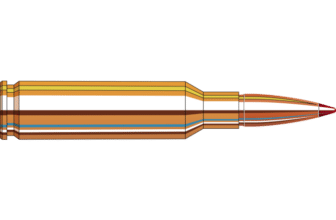
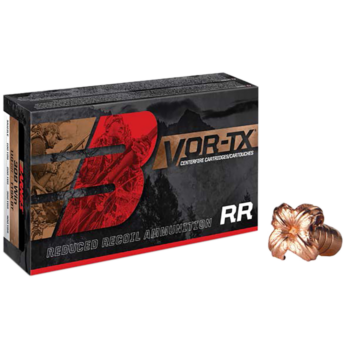
Barnes Vor-Tx 6.5 Creedmoor 100 gr TTSX Boat-Tail
| Primary Use | Pronghorn antelope · Varmints · Open-country thin-skinned game |
| Bullet Type | TTSX BT — Tipped Triple-Shock X, all-copper monolithic, boat-tail |
| Bullet Weight | 100 gr |
| Case | Brass (reloadable) |
| Primer | Boxer |
| Packaging | 20 rounds per box |
| Typical Price | ~$50–54 / box (~$2.50–2.70 per round) |
| Closest Competitors | Hornady Outfitter 6.5 CM 120 gr CX · Fiocchi Hyperformance 6.5 CM 120 gr Barnes TTSX · Nosler E-Tip 6.5 CM 120 gr Lead-Free |
Official Specs
| Spec | Value | Source |
|---|---|---|
| Muzzle Velocity | 3,300 fps | Barnes Bullets (estimated from Barnes published data for 100gr TTSX 6.5 CM) |
| Muzzle Energy | 2,418 ft-lbs | Calculated |
| Bullet Weight | 100 gr | Barnes |
| Bullet Type | Barnes TTSX BT — all-copper monolithic, polymer tip, boat-tail | Barnes Bullets |
| BC (G1) | ~0.397 | Barnes Bullets published data |
| BC (G7) | ~0.200 | Barnes Bullets published data |
| Weight Retention | 95–99% | Barnes published specification |
| Manufacturer SKU | 32235 | Barnes |
| UPC | 716876605118 | — |
| Lead-Free | Yes | All-copper TTSX construction |
| Reloadable | Yes | Brass, Boxer-primed |
Velocity note: The Ammunition Depot listing does not publish muzzle velocity. The 3,300 fps figure is sourced from Barnes’s own published data for the 100 gr TTSX in 6.5 Creedmoor. This is among the highest factory velocities in the 6.5 CM category. Community submissions will verify real-world velocity from actual hunting barrels.
Ballistics Table
Calculated. Zero: 100 yards. Sight height: 1.5″ above bore. BC (G1): 0.397 (Barnes TTSX 100 gr BT, published).
Calculated from Barnes published BC and velocity. Real-world results vary by barrel length, temperature, altitude, and lot.
| Yards | Velocity (fps) | Energy (ft-lbs) | Trajectory (in) |
|---|---|---|---|
| 0 | 3,300 | 2,418 | +1.5 |
| 100 | 3,079 | 2,105 | 0.0 ← zero |
| 200 | 2,873 | 1,832 | -5.4 |
| 300 | 2,680 | 1,595 | -15.6 |
| 400 | 2,501 | 1,389 | -31.5 |
| 500 | 2,333 | 1,209 | -54.3 |
Key takeaway: at 3,300 fps this is the fastest factory 6.5 Creedmoor load in this report series — by a significant margin. The result is a laser-flat trajectory: only 5.4 inches low at 200 yards and 15.6 inches at 300 yards from a 100-yard zero. For pronghorn antelope hunting on open plains where ranges can stretch to 300+ yards without warning, this trajectory dramatically simplifies holdover decisions. At 500 yards the load still carries 1,209 ft-lbs — more than sufficient for pronghorn and deer-sized game.
Why 100 gr for Pronghorn and Open-Country Game
Pronghorn antelope are lightweight animals — mature bucks typically weigh 100–130 lbs — with relatively thin skin and light bone structure. They do not require the deep penetration and heavy construction designed for elk or moose. What they do require is flat trajectory at extended range, because pronghorn country is open — shots at 250–350 yards are common, and misjudging range by 50 yards can mean a clean miss.
The 100 gr TTSX is purpose-built for this scenario:
- 3,300 fps — highest velocity in the 6.5 CM class; minimizes the effect of range estimation error
- All-copper monolithic — on a lightweight animal the TTSX expands reliably and exits cleanly; no lead fragmentation in the meat
- Lead-free — California and other regulated zones where lead-free is mandated for pronghorn hunting on public land
- 15.6″ drop at 300 yards — compared to 19–22″ for 129–140 gr loads; a meaningful practical difference in field conditions
The trade-off for all this speed is the lower BC of 0.397 — the lightest bullet in this series sheds velocity faster than heavier alternatives. At 500 yards the 100 gr is slower than a 140 gr load started at 2,750 fps. For pronghorn inside 400 yards, this is irrelevant. For elk at 400+ yards, use the heavier loads.
The Barnes TTSX Bullet
The Barnes TTSX (Tipped Triple-Shock X) is Barnes’s premium all-copper monolithic hollow point with a polymer tip:
- All-copper construction — no lead core; fully lead-free and California-compliant
- Polymer tip — initiates reliable expansion at a wide range of impact velocities; the “Tipped” upgrade over the original TSX improves long-range terminal performance
- Double-diameter expansion — expands to approximately twice the original diameter on impact
- 95–99% weight retention — Barnes published spec; virtually all bullet mass transfers energy to the target
- Boat-tail base — reduces base drag; BC improvement over the flat-base TSX version
- Three copper driving bands — reduce bore friction vs a solid shank design; lower pressure, cleaner barrel, reliable feeding
Variants
This page covers Barnes Vor-Tx 32235 · 6.5 Creedmoor · 100 gr TTSX BT only.
Barnes loads the TTSX in 6.5 Creedmoor at multiple weights under their Vor-Tx factory ammunition line:
- Barnes Vor-Tx 6.5 CM 120 gr TTSX — heavier option for deer and elk (also loaded by Fiocchi Hyperformance)
- Barnes Vor-Tx 6.5 CM 127 gr LRX BT — Long Range X, higher BC for extended distance work
The 100 gr is the speed-specialist in Barnes’s 6.5 CM lineup — choose it for pronghorn, varmints, and open-country hunting where maximum velocity and flat trajectory are the priority.
Best Uses
Good fit:
- Pronghorn antelope — this is the premier use case; lightweight animal, open terrain, extended ranges, lead-free often required on western public land
- Varmint and predator at 200–400 yards where the flat trajectory and all-copper construction minimize range estimation errors
- California deer hunting and other lead-restricted jurisdictions where a fast, accurate lead-free load is needed
- Thin-skinned game (deer, antelope, sheep, goats) where violent expansion and pass-through performance are desirable
- Western hunters who regularly shoot at 250–350 yards in open terrain
Not the right tool for:
- Elk and large game where penetration depth on heavy bone is the priority — the lighter 120 gr or 127 gr TTSX or heavier bonded bullets are more appropriate
- Timber hunting at close range where bullet speed is irrelevant and a heavier, harder-hitting bullet is preferred
- Ranges beyond 500 yards where the lower BC starts to work against the speed advantage
- Budget hunting — at $2.60/round this is premium ammunition pricing
- Self-defense — not designed or rated for it
Reliability Notes
No structured submissions yet.
General notes:
- Barnes Bullets has manufactured all-copper hunting bullets since the 1980s — their TTSX design has an extensive track record on North American and African game across virtually every caliber; the 6.5 CM 100 gr version applies the same engineering to a flat-shooting speed load
- All-copper bullets can produce higher chamber pressures than lead-core bullets of the same weight due to the harder material — Barnes’s loading accounts for this within SAAMI limits; no reported pressure issues in standard 6.5 CM chambers
- At 3,300 fps this load generates significant muzzle blast — more noticeable than heavier loads; hearing protection is essential, and muzzle brake users may find the concussion more pronounced
- The polymer tip protects the cavity during magazine feeding and flight; Barnes TTSX is semi-auto compatible in standard 6.5 CM platforms
Competitors
| Load | Weight | Bullet | Lead-Free | BC (G1) | Adv. Velocity | Price / box |
|---|---|---|---|---|---|---|
| Fiocchi Hyperformance 6.5 CM 120 gr Barnes TTSX | 120 gr | Barnes TTSX | ✓ | ~0.453 | 2,900 fps | ~$54–58 |
| Barnes Vor-Tx 6.5 CM 120 gr TTSX | 120 gr | Barnes TTSX | ✓ | ~0.453 | 2,910 fps | ~$56–62 |
| Hornady Outfitter 6.5 CM 120 gr CX | 120 gr | CX copper | ✓ | ~0.458 | 2,910 fps | ~$48–52 |
| Nosler E-Tip 6.5 CM 120 gr Lead-Free | 120 gr | E-Tip | ✓ | ~0.458 | 2,900 fps | ~$58–64 |
| Barnes Vor-Tx 6.5 CM 127 gr LRX BT | 127 gr | LRX BT | ✓ | ~0.510 | 2,825 fps | ~$54–58 |
The 100 gr niche: no direct competitor matches the 3,300 fps velocity of this load. All lead-free alternatives in 6.5 CM use 120–127 gr bullets at 2,900–2,910 fps. The 100 gr trades 400 fps over these alternatives for a lower BC — the right trade-off for pronghorn inside 400 yards, the wrong one for elk at distance.
Price Reality
- Typical retail range: $50–54 per box of 20 (~$2.50–2.70/round)
- vs. Barnes 120 gr TTSX (same bullet, heavier): similar pricing — the 100 gr is not cheaper for its lighter weight; lead-free premium applies regardless
- vs. Hornady Outfitter CX (comparable lead-free): Hornady runs $2–4/box less for a heavier bullet with higher BC — correct choice for elk; wrong choice for pronghorn where speed is the priority
- Lead-free premium: consistent $15–25/box over equivalent lead-core loads — unavoidable for all-copper designs
- Fair price benchmark: under $53/box is competitive; above $58/box is overpriced relative to the Fiocchi-loaded Barnes TTSX alternatives
Where to Buy
Affiliate links. These do not influence ratings, data, or any editorial content on this page.
- MidwayUSA — add link
- Brownells — add link
- Palmetto State Armory — add link
- Natchez Shooters Supplies — add link
FAQ
Why choose 100 gr over 120 gr for pronghorn?
Speed — 3,300 fps vs ~2,900 fps. On pronghorn in open terrain the most common hunting error is range misjudgment. A 50-yard error at 300 yards with a 140 gr load produces 4–5 inches of trajectory difference; with the 100 gr TTSX that same error produces 2–3 inches. The flatter the trajectory, the more forgiving the shot. Pronghorn are light-boned animals that don’t require the penetration depth designed for elk — the 100 gr’s explosive performance is ideal for the species. For deer in timber or elk, the 120 gr+ options are more appropriate.
Is this load California-legal for deer and pronghorn hunting?
Yes. The Barnes TTSX is an all-copper, fully lead-free bullet — it qualifies as nonlead ammunition under California’s nonlead hunting regulation which applies to all licensed hunting statewide. Always verify current California DFW requirements before your hunt as regulations can change.
At 3,300 fps, will this load damage too much meat on pronghorn?
This is a legitimate consideration. The TTSX expands to double diameter and exits cleanly — it does not fragment like a varmint bullet. The wound channel is larger than a soft point but not destructive in the way that thin-jacketed varmint bullets can be. On a pronghorn at typical hunting distances, meat loss from the TTSX is comparable to any quality expanding bullet. The exit wound is clean, which actually minimizes secondary blood-shot damage to surrounding meat compared to a bullet that stays in the animal and transfers all energy internally.
Does 6.5 Creedmoor with 100 gr make sense or should I use a faster caliber?
6.5 Creedmoor with the 100 gr TTSX produces a trajectory and terminal performance profile that rivals .243 Win and approaches .25-06 in the pronghorn hunting role — while keeping you in a caliber you can also use for deer and elk with heavier loads. The versatility argument is real: one rifle, one caliber, two bullet weights covers pronghorn (100 gr) and elk (120–127 gr TTSX or 140 gr bonded). Purpose-built pronghorn calibers like .243 or .25-06 are faster, but 6.5 CM with the right load is a fully capable and practical choice.
Submit Your Data · Real-World Results
Manufacturer velocity figures are measured under controlled lab conditions — barrel length, temperature, and lot number all affect real-world performance. The data below comes from community submissions tied to specific test conditions and reviewed before publishing.
Once this page reaches 3 approved submissions, aggregate velocity and confidence level will appear here automatically.
| UPC # | Firearm | Barrel (in) | Avg Velocity (fps) | Shots | Temp (°F) | Chronograph | Lot | Notes |
|---|---|---|---|---|---|---|---|---|
| 716876605118 | — | — | — | — | — | — | — | No data yet |
Shot this load? Share your results — firearm type, barrel length, average velocity, shots fired, temperature. No account required.
All submissions are manually reviewed before appearing on this page.
You need to login first.Results vary by firearm, barrel condition, ammunition lot, and environmental factors. Submitted data is for reference only. AmmoReports does not guarantee accuracy of user-submitted results.
Last updated: April 2026 · Data confidence: Low (0 submissions) · Velocity (3,300 fps) sourced from Barnes published data — community verification needed.