 Ammo Reports Team
| Official Spec | Value |
|---|---|
| Manufacturer | Remington |
| Cartridge | 22 LR |
| Product Line | Thunderbolt |
| Bullet Name / Bullet Type | Lead Round Nose |
| Bullet Weight | 40 gr |
| SKU / Part Number / Item Number | 21238 / TB22A |
| UPC | 047700002507 – retailer-listed |
| Rounds per Box | 50 |
| Muzzle Velocity | 1,255 fps |
| Muzzle Energy | 140 ft-lbs |
| Ballistic Coefficient G1 | .116 |
| Ballistic Coefficient G7 | Not found |
| Case Material | Not found |
| Primer | Not found |
| Reloadable | Not found |
| Test Barrel Length | Not found |
| Zero Distance | 50 yards |
| Sight Height | 1.5" |
| Intended Use | Small-game shooting, target practice, and plinking |
| Product Status | Current – available |
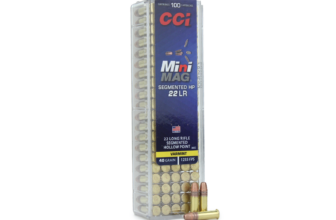
| Closest Competitors | CCI Mini-Mag 22 LR 40 gr RN, Federal Champion 22 LR 40 gr RN, Winchester Super-X 22 LR 40 gr RN, Winchester Wildcat 22 LR 40 gr LRN, Aguila Super Extra 22 LR 40 gr RN |
Data is based on official manufacturer sources. Found an error? Send us the source link.
Official Ballistics
Manufacturer-published values. “Not published” means the manufacturer does not provide a value at that distance.
| Yards | Velocity (fps) | Energy (ft-lbs) | Trajectory (in) | 10 mph Wind Drift (in) |
|---|---|---|---|---|
| 0 | 1,255 | 140 | -1.5 | 0.0 |
| 50 | 1,091 | 106 | 0.0 | 1.6 |
| 100 | 988 | 87 | -5.7 | 6.1 |
| 150 | 915 | 74 | -20.3 | 12.9 |
Product Overview
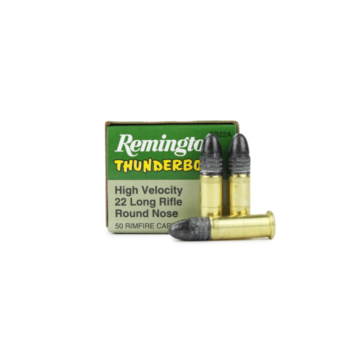
Remington Thunderbolt part 21238 is the current 50-round package corresponding to the legacy TB22A identifier and UPC shown in retailer listings. It uses a 40-grain lead round-nose bullet at a published muzzle velocity of 1,255 fps.
Remington positions Thunderbolt as a general-purpose high-velocity 22 LR load for small game, target shooting, and plinking.
Best Uses
Good fit:
- High-volume plinking and informal target practice
- Small-game use at appropriate distances
- Bolt-action, single-shot, and compatible semi-automatic firearms
Not the right tool for:
- Use where a plated bullet is preferred for reduced lead fouling
- Applications requiring an expanding projectile
Reliability Notes
Remington describes tighter tolerances and updated primer mixes in the current Thunderbolt production. Function and accuracy remain firearm- and lot-dependent.
Competitors
The complete existing competitor set is retained. Specifications remain “Not verified” unless they were confirmed for the exact linked product.
| Competitor | Bullet Weight | Bullet Type | Muzzle Velocity | BC G1 |
|---|---|---|---|---|
| CCI Mini-Mag 22 LR 40 gr RN | Not verified | Not verified | Not verified | Not verified |
| Federal Champion 22 LR 40 gr RN | Not verified | Not verified | Not verified | Not verified |
| Winchester Super-X 22 LR 40 gr RN | Not verified | Not verified | Not verified | Not verified |
| Winchester Wildcat 22 LR 40 gr LRN | Not verified | Not verified | Not verified | Not verified |
| Aguila Super Extra 22 LR 40 gr RN | Not verified | Not verified | Not verified | Not verified |
FAQ
Is Remington Thunderbolt reliable enough for a semi-automatic .22 LR?
It functions in most semi-auto .22 LR platforms, but it is not the most reliable option available. Lead round nose bullets without copper plating produce more fouling than plated alternatives, and budget rimfire loads carry higher misfire rates than premium production. For semi-auto use — especially in pistols that are more feeding-sensitive than rifles — CCI Mini-Mag or Federal Champion are more commonly recommended for consistent cycling. The Thunderbolt is fine for bolt-action and single-shot rifles where a misfire simply requires re-cocking.
What is the practical range of this load for plinking?
The ballistics table above shows the trajectory reality: at 100 yards the bullet is 9 inches below the line of sight (zeroed at 50 yards), and at 150 yards it is nearly 28 inches low. For informal plinking at steel targets or paper, 25–75 yards is the practical sweet spot where holdover is manageable without significant Kentucky windage. Beyond 100 yards the .22 LR at this velocity becomes a challenging proposition for consistent hits on small targets.
Why does .22 LR drop so much more than .17 HMR at distance?
Two factors: velocity and ballistic coefficient. The Thunderbolt leaves the muzzle at 1,255 fps vs 2,550–2,650 fps for .17 HMR loads. Lower velocity means more time in the air covering the same distance, and gravity acts on the bullet for that entire time — resulting in more drop. Additionally, .22 LR round-nose bullets have lower BCs (~0.138) than the polymer-tipped .17 HMR bullets (~0.185 for V-Max), meaning they lose velocity faster. The combination produces dramatically steeper trajectories than any .17 HMR load.
Is the 5,000-round case worth buying?
For dedicated plinkers and range regulars, the case format typically saves $0.01–0.02/round over box pricing — roughly $50–100 on a full case. The tradeoff is storage space and commitment to a single lot. Given Thunderbolt’s lot-to-lot consistency reputation, buying a case means accepting whatever quality that specific production run delivers. If you find a lot that shoots well in your rifle, the case is good value; if the lot has quality issues, you have 5,000 rounds of them.
Remington Thunderbolt vs Federal Champion — which is better?
Both are budget LRN .22 LR at similar price points. Federal Champion generally receives higher consistency ratings in online community discussions — fewer misfires, tighter velocity spreads. Thunderbolt is more widely available in big-box retail (Walmart, sporting goods stores) and often slightly cheaper per round. For plinking where an occasional misfire is a minor inconvenience, either works. For training where reliability matters more, Federal Champion edges ahead. Community submission data on both pages will eventually provide velocity spread comparisons.
Submit Your Data · Real-World Results
Manufacturer velocity figures are measured under controlled lab conditions — barrel length, temperature, and lot number all affect real-world performance. The data below comes from community submissions tied to specific test conditions and reviewed before
publishing.
Once this page reaches 3 approved submissions, aggregate velocity
and confidence level will appear here automatically.
| UPC # | Firearm | Barrel (in) | Avg Velocity (fps) | Shots | Temp (°F) | Chronograph | Lot | Notes |
|---|---|---|---|---|---|---|---|---|
Shot this load? Share your results — firearm type, barrel length, average velocity, shots fired, temperature. No account required.
All submissions are manually reviewed before appearing on this page.
You need to login first.
Results vary by firearm, barrel condition, ammunition lot, and environmental factors.
Submitted data is for reference only.
AmmoReports does not guarantee accuracy of user-submitted results.
Last updated: April 2026 · Data confidence: Low (0 submissions) ·