
 Ammo Reports Team
| Official Spec | Value |
|---|---|
| Manufacturer | Remington |
| Cartridge | 260 Remington |
| Product Line | Premier Match |
| Bullet Name / Bullet Type | MatchKing Hollow Point |
| Bullet Weight | 140 gr |
| SKU / Part Number / Item Number | 26852 |
| UPC | 047700486307 – retailer-listed |
| Rounds per Box | 20 |
| Muzzle Velocity | 2,750 fps |
| Muzzle Energy | 2,351 ft-lbs |
| Ballistic Coefficient G1 | 0.611 |
| Ballistic Coefficient G7 | Not found |
| Case Material | Brass – retailer-listed |
| Primer | Boxer – retailer-listed |
| Reloadable | Yes – retailer-listed |
| Test Barrel Length | Not found |
| Zero Distance | 200 yards |
| Sight Height | 1.5″ |
| Intended Use | Target shooting; competition |
| Product Status | Current – available |
| Closest Competitors | Federal Gold Medal Match 260 Rem 142 gr SMK, Barnes Precision Match 260 Rem 140 gr OTM BT, Lapua Scenar-L 260 Rem 139 gr HPBT, HSM Trophy Gold 260 Rem 140 gr Berger Hybrid, Nosler Match Grade 260 Rem 140 gr CC HPBT |
Data is based on official manufacturer sources. Found an error? Send us the source link.
Official Ballistics
Official Remington ballistics for part 26852. Zero: 200 yards. Sight height: 1.5 inches. Wind drift is the manufacturer-published value for a 10 mph crosswind.
| Yards | Velocity (fps) | Energy (ft-lbs) | Trajectory (in) | 10 mph Wind Drift (in) |
|---|---|---|---|---|
| 0 | 2,750 | 2,351 | -1.5 | 0 |
| 100 | 2,602 | 2,105 | +1.8 | 0.6 |
| 200 | 2,459 | 1,880 | 0 | 2.2 |
| 300 | 2,320 | 1,674 | -7.5 | 5.1 |
| 400 | 2,187 | 1,486 | -21.7 | 9.4 |
| 500 | 2,057 | 1,315 | -43.0 | 15.1 |
The Sierra MatchKing Bullet
The Sierra MatchKing is among the most widely used match projectiles in long-range competition — its inclusion in this load is the defining characteristic. Sierra manufactures the MatchKing to extremely tight dimensional tolerances with particular attention to jacket concentricity and base geometry, two factors that directly affect in-flight stability and shot-to-shot consistency at extended range.
The boat tail hollow point design serves two purposes: the boat tail reduces base drag during the transition from the muzzle blast environment, while the hollow point is a manufacturing feature — not an expansion mechanism. Sierra seats the lead core from the tip of the jacket, improving concentricity compared to other production methods. Sierra explicitly does not warrant the MatchKing for hunting use due to unpredictable terminal behavior on game.
The 140 gr weight sits at the heavier end of the practical spectrum for 260 Remington, offering a high BC relative to lighter alternatives and excellent resistance to wind deflection — a primary reason this combination is favored in F-Class and PRS-style competition.
Best Uses
Good fit:
- Precision rifle competitions — F-Class, PRS, NRL — where match-grade consistency and the Sierra MatchKing’s documented accuracy are required
- Long-range target shooting at 300–600 yards where wind deflection resistance matters
- Bolt-action rifles with 1:8 or 1:8.5 twist capable of stabilizing 140 gr projectiles
- Accuracy testing and load development baseline for 260 Rem platform shooters
Not the right tool for:
- Hunting — Sierra does not recommend the MatchKing for terminal performance on game; expansion is unreliable
- Rifles with twist rates slower than 1:9 — 140 gr may not fully stabilize
- Jurisdictions that restrict hollow point ammunition — verify local regulations
Reliability Notes
No structured submissions yet.
Remington’s Premier Match line historically uses tighter dimensional tolerances than their standard hunting or practice lines, with consistent powder charges and Sierra MatchKing projectiles. Post-2020 production is under Vista Outdoor ownership — some community reports note variable lot-to-lot consistency compared to pre-bankruptcy production. The Sierra MatchKing bullet itself has well-documented production consistency regardless of who loads it. No active recalls or publicly documented lot-specific issues were identified for this load. All notes reflect manufacturer claims and open-source community observations, not structured data.
Competitors
The full comparison set is preserved. Exact published AmmoReports reviews are linked where available; unverified competitor specifications are not presented as official data.
| Load | Weight | Bullet | BC G1 | Advertised Velocity | Notes |
|---|---|---|---|---|---|
| Federal Gold Medal Match 260 Rem 142 gr SMK | 142 gr | Sierra MatchKing BTHP | Not verified | Not verified | Heavier MatchKing alternative |
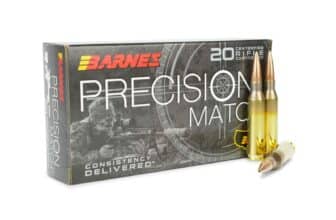
| Barnes Precision Match 260 Rem 140 gr OTM BT | 140 gr | Match Burner OTM BT | Not verified | Not verified | Factory match alternative with Barnes trajectory data |
| Lapua Scenar-L 260 Rem 139 gr HPBT | 139 gr | Scenar-L HPBT | Not verified | Not verified | Premium match alternative |
| HSM Trophy Gold 260 Rem 140 gr Berger Hybrid | 140 gr | Berger Hybrid OTM | Not verified | Not verified | Berger-bullet match alternative |
| Nosler Match Grade 260 Rem 140 gr CC HPBT | 140 gr | Custom Competition HPBT | Not verified | Not verified | Match alternative loaded with Nosler brass |
FAQ
Does the hollow point in the Sierra MatchKing mean this is suitable for hunting?
No. The hollow point cavity in the Sierra MatchKing is a manufacturing feature, not a terminal performance design. Sierra seats the lead core from the tip of the jacket to improve concentricity, but the resulting cavity does not reliably initiate expansion on game tissue. Sierra explicitly states in product documentation that the MatchKing is not recommended for hunting. Hunters should use expanding hunting bullets — see Barnes VOR-TX TTSX or Hornady Precision Hunter ELD-X for 260 Remington hunting loads.
How does this compare to Federal Gold Medal Match 260 Rem 142 gr?
Both use Sierra MatchKing projectiles for the same competition market. The Federal load’s 142 gr bullet has a significantly higher BC (~0.617 vs ~0.535 for 140 gr) — a meaningful difference beyond 500 yards for wind resistance. Federal Gold Medal Match has a longer documented track record in competition. Price difference is typically under $10/box. For competition inside 400–500 yards, the Remington load’s lower price is the stronger argument; for 600+ yard stages, Federal’s higher BC is worth the premium.
What twist rate stabilizes a 140 gr bullet in 260 Remington?
The 140 gr MatchKing BTHP generally requires a minimum of 1:8.5 twist for reliable stabilization, with 1:8 being the most commonly recommended. Many factory 260 Rem rifles are produced with 1:8 or 1:8.5 twist barrels specifically to accommodate heavier match bullets. Shooters with older rifles should verify their twist rate — a 140 gr bullet in a slower-twist barrel will keyhole and produce degraded accuracy regardless of ammunition quality.
What does “Premier Match” mean for Remington’s quality control?
The Premier Match designation historically indicates tighter case preparation tolerances, more consistent powder charges, and use of premium third-party projectiles (Sierra MatchKing) rather than Remington’s standard in-house bullets. Post-2020 production is under Vista Outdoor ownership — community reports on consistency compared to pre-bankruptcy Premier Match are mixed. The Sierra MatchKing bullet itself has independent manufacturing quality that does not depend on Remington’s production standards.
Why is the published ME (2,384 ft-lbs) higher than the calculated value at 2,750 fps?
The standard kinetic energy formula (weight × velocity² ÷ 450,400) produces 2,351 ft-lbs at 2,750 fps and 140 gr — 33 ft-lbs below Remington’s published 2,384 ft-lbs. This discrepancy likely reflects a slightly higher actual test velocity than the rounded 2,750 fps figure, or a different internal calculation methodology. The difference is not material for practical purposes. Community velocity submissions will clarify the actual muzzle velocity from different barrel lengths.
Submit Your Data · Real-World Results
Manufacturer velocity figures are measured under controlled lab conditions — barrel length, temperature, and lot number all affect real-world performance. The data below comes from community submissions tied to specific test conditions and reviewed before publishing.
Once this page reaches 3 approved submissions, aggregate velocity and confidence level will appear here automatically.
| UPC # | Firearm | Barrel (in) | Avg Velocity (fps) | Shots | Temp (°F) | Chronograph | Lot | Notes |
|---|---|---|---|---|---|---|---|---|
| 047700486307 | — | — | — | — | — | — | — | No data yet |
Shot this load? Share your results — firearm type, barrel length, average velocity, shots fired, temperature. No account required.
All submissions are manually reviewed before appearing on this page.
You need to login first.Results vary by firearm, barrel condition, ammunition lot, and environmental factors. Submitted data is for reference only. AmmoReports does not guarantee accuracy of user-submitted results.