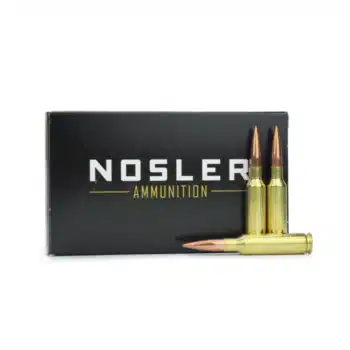
Nosler Match Grade 6.5 Creedmoor 140 gr RDF HPBT

0
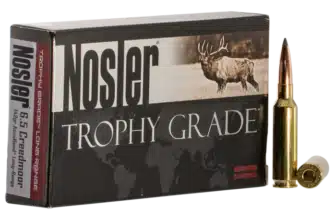
Alt text: Nosler ammunition box featuring three cartridges, ideal for hunting and shooting enthusiasts.
Primary UsePRS competition · Long-range precision target · ELR
Bullet TypeRDF — Reduced Drag Factor HPBT, compound ogive, Nosler proprietary
Bullet Weight140 gr
CaseBrass (Nosler premium, USA)
PrimerBoxer
Packaging20 rounds per box · case available (~200 rounds)
Typical Price~$62–65 / box (~$3.10–3.25 per round) · ~$2.72/round by case
Closest CompetitorsHornady Match 6.5 CM 140 gr ELD-M · Federal Gold Medal 6.5 CM 140 gr SMK · Berger Target 6.5 CM 156 gr Hybrid

Official Specs

SpecValueSource
Muzzle Velocity2,650 fpsNosler / Ammunition Depot
Muzzle Energy2,183 ft-lbsNosler / Ammunition Depot
Bullet Weight140 grNosler
Bullet TypeRDF HPBT — Reduced Drag Factor, compound ogive, long boat-tailNosler
BC (G1)0.658Nosler published
Made inUSA (Nosler, Inc.)Nosler
Manufacturer SKU60115Nosler
UPC054041601153
ReloadableYesNosler premium brass

Ballistics Table

Calculated. Zero: 100 yards. Sight height: 1.5″ above bore. BC (G1): 0.658 (Nosler RDF 140 gr, published).

YardsVelocity (fps)Energy (ft-lbs)Trajectory (in)
02,6502,183+1.5
1002,5492,0200.0 ← zero
2002,4521,869-7.1
3002,3581,729-20.3
4002,2691,600-40.5
5002,1821,480-68.5

Key takeaway: the BC of 0.658 is the second highest in this entire 6.5 CM report series — virtually tied with the Berger 156 gr (0.659) and higher than every other 140 gr match load including the Hornady ELD-M (0.646) and Sierra MatchKing (0.617). Despite a moderate 2,650 fps muzzle velocity, the RDF retains 1,480 ft-lbs at 500 yards and drops only 68.5 inches from a 100-yard zero. The RDF’s defining advantage is long-range consistency — at 800+ yards the BC gap vs SMK and ELD-M translates to several inches less wind drift per crosswind mph.


The RDF Design — Reduced Drag Factor Explained

RDF (Reduced Drag Factor) is Nosler’s premium match bullet technology — engineered specifically to minimize aerodynamic drag while maintaining magazine-compatible seating depths:

  • Compound ogive — a multi-radius nose profile that transitions from a tangent section (magazine-compatible, reduces seating depth sensitivity) to a secant section (high aerodynamic efficiency); same philosophy as Berger’s Hybrid ogive — practical accuracy with high BC
  • Long boat-tail — longer than standard boat-tails; contributes significantly to the BC of 0.658 vs typical 0.580–0.617 for similar weight bullets
  • Consistent meplats — Nosler specifically notes meplat consistency as a design goal; the tip diameter uniformity contributes to shot-to-shot BC consistency; inconsistent meplats are a known source of vertical dispersion at long range
  • Hollow point — open tip for manufacturing precision (concentricity), not for terminal expansion; same principle as MatchKing and ELD-M
  • Nosler’s own tolerances — RDF is produced to Nosler’s internal match bullet standards

The RDF competes directly with Hornady’s ELD-M (0.646) as a high-BC 140 gr match bullet for 6.5 CM. At BC 0.658 vs 0.646, the RDF has a slight mathematical edge — whether it translates to measurable accuracy differences in a given rifle is load- and barrel-dependent.


BC Comparison — Where RDF Stands Among All 6.5 CM Loads

LoadBulletBC (G1)
Berger Target 156 gr HybridBerger Hybrid0.659
Nosler RDF 140 gr (this)Nosler RDF0.658
Hornady Match 140 gr ELD-MELD-M0.646
Winchester Expedition 142 gr AccuBond LRAccuBond LR~0.625
Nosler RDF / SMK 140 grSierra MatchKing~0.617
Fiocchi Exacta 142 gr SMKSierra MatchKing 142 gr~0.595

The Nosler RDF 140 gr achieves the second highest BC in the entire series — remarkable for a 140 gr bullet, matching the much heavier Berger 156 gr.


Best Uses

Good fit:

  • PRS and NRL competition where BC 0.658 produces less wind drift and drop at extended distances than SMK or ELD-M alternatives
  • Long-range target shooting at 500–1,000 yards where the compound ogive and consistent meplats minimize vertical dispersion
  • ELR (Extreme Long Range) applications where the highest possible BC at 140 gr is the primary requirement
  • Handloaders who want a factory baseline using the Nosler RDF before developing custom loads with the same bullet
  • Shooters who prefer Nosler’s own match bullet over Sierra MatchKing or Hornady ELD-M

Not the right tool for:

  • Hunting — RDF is a match bullet not designed for terminal expansion on game
  • Casual range practice — at $3.15/round (box) or $2.72/round (case), this is premium match ammunition
  • Inside 400 yards where BC differences between RDF and SMK/ELD-M are minimal
  • Self-defense — not designed or rated for it

Reliability Notes

No structured submissions yet.

General notes:

  • Nosler RDF is a relatively newer match bullet compared to Sierra MatchKing — less independent benchmarking data exists across specific rifle/barrel combinations; the MatchKing has over 60 years of documented accuracy across thousands of rifles
  • The consistent meplat design goal addresses a known precision shooting concern — even small variations in bullet tip diameter affect BC and create vertical stringing at long range; Nosler’s attention to this is a genuine engineering differentiator
  • Nosler Match Grade loading process (weighed powder, flash hole inspection, visual inspection) applies here as with the Custom Competition load — tighter ES/SD than standard factory loads
  • At $3.15/round box or $2.72/round case, the case pricing represents meaningful savings for high-volume competition shooters

Competitors

LoadBulletBC (G1)Adv. VelocityPrice / boxNotes
Hornady Match 6.5 CM 140 gr ELD-MELD-M0.6462,710 fps~$38–4560 fps faster, slightly lower BC, $17–27/box less
Federal Gold Medal 6.5 CM 140 gr SMKSierra MatchKing~0.6172,650 fps~$38–42Lower BC, same velocity, $22–24/box less
PPU Supreme 6.5 CM 140 gr SMKSierra MatchKing~0.6172,690 fps~$28–32Lower BC, same velocity, $32–34/box less
Berger Target 6.5 CM 156 gr HybridBerger Hybrid0.6592,680 fps~$50–54Marginally higher BC, heavier bullet, requires 1:8″ twist
Nosler Match Grade 6.5 CM 140 gr CC HPBTNosler Custom Competition~0.5352,650 fps~$53–57Nosler’s own lower-BC option, $7–10/box less

The ELD-M comparison: Hornady Match ELD-M runs 60 fps faster with a BC of 0.646 — 0.012 lower than RDF — for $17–27/box less. At 500 yards the drop difference between BC 0.658 and 0.646 at the same muzzle velocity is approximately 1 inch. Whether 1 inch at 500 yards is worth $17–27/box is the central question for RDF buyers. For top-tier PRS competition, arguably yes; for recreational long-range shooting, the ELD-M is likely sufficient at significantly lower cost.


Price Reality

  • Box pricing: ~$62–65 per box of 20 (~$3.10–3.25/round)
  • Case pricing: ~$545 / 200 rounds (~$2.72/round) — significant savings for competition shooters who burn volume
  • vs. Hornady Match ELD-M: Nosler runs $17–27/box more for 0.012 higher BC and 60 fps less velocity
  • vs. Federal Gold Medal SMK: Nosler runs $22–24/box more for significantly higher BC at same velocity — the strongest value argument for the RDF
  • vs. PPU Supreme SMK: Nosler runs $32–34/box more for the highest BC in the 140 gr class with Nosler’s own brass
  • Case value: at $2.72/round the case price reduces the premium to approximately $0.50–0.70/round over ELD-M — more defensible for volume shooters
  • Fair price benchmark: under $64/box or $2.75/round by case is competitive for the highest-BC 140 gr 6.5 CM factory load; box pricing at $3.15/round is premium for all but the most BC-sensitive applications

Where to Buy

Nosler Match Grade 6.5 Creedmoor 140 Gr RDF HPBT (Box)

Nosler Match Grade 6.5 Creedmoor 140 grain RDF ammunition delivers exceptional precision for competitive shooting and long-range applications. Featuring Nosler's proprietary RDF (Reduced Drag Factor) bullet technology with a Hollow Point Boat-Tail design, this premium ammunition achieves a muzzle...

Affiliate links. These do not influence ratings, data, or any editorial content on this page.


FAQ

Nosler RDF vs Hornady ELD-M — which is better for PRS competition?

The RDF’s BC of 0.658 edges the ELD-M’s 0.646 — a difference of 0.012. At 500 yards with a 10 mph full-value crosswind, the RDF drifts approximately 0.3 inches less than the ELD-M from the same muzzle velocity. At 1,000 yards that gap widens to roughly 0.6–0.8 inches. Whether this is meaningful in competition depends on the stage distances. The ELD-M runs 60 fps faster (2,710 vs 2,650 fps) which partially compensates by giving flatter near-range trajectory. For most PRS stages inside 600 yards, both perform equivalently. For stages at 800–1,200 yards, the RDF’s BC advantage becomes progressively more meaningful.

What is “compound ogive” and how does it help?

A compound ogive combines two different nose profile radii in one bullet — Nosler uses a tangent section at the base of the nose (which reduces seating depth sensitivity for magazine feeding) transitioning to a secant section toward the tip (which is more aerodynamically efficient). The tangent section makes the bullet practical in standard factory rifles without custom throat dimensions; the secant section maximizes BC. This is the same philosophy as Berger’s Hybrid ogive — practical accuracy combined with aerodynamic performance. The compound ogive is a key reason the RDF achieves BC 0.658 while remaining SAAMI-compatible.

Why does the RDF have the same velocity as the Custom Competition at 2,650 fps?

Both Nosler match loads for 6.5 CM are loaded to 2,650 fps — Nosler’s standard match velocity for this caliber. The RDF achieves its higher BC (0.658 vs ~0.535) through bullet design, not higher velocity. Nosler could potentially achieve higher velocity with the RDF, but 2,650 fps is within the optimal accuracy window for this bullet in 6.5 CM barrel lengths; maximizing velocity is not the goal — maximizing consistency and BC-driven accuracy is. The Hornady Match ELD-M at 2,710 fps achieves higher velocity through a different powder charge — both approaches are valid, with different BC/velocity trade-offs.

Is BC 0.658 meaningfully different from 0.617 (Sierra MatchKing) in practice?

At 500 yards with a 10 mph crosswind, the difference between BC 0.658 and 0.617 is approximately 1.5–2 inches of wind drift. At 1,000 yards that gap grows to 3–4 inches. For recreational long-range shooting, this difference is small. For top-tier PRS competition where stages have narrow target zones at 500–1,000 yards, 2–4 inches can be the difference between a hit and a miss. The RDF’s BC advantage is real and measurable; whether it’s worth the premium depends entirely on the shooting context.


Submit Your Data · Real-World Results

Manufacturer velocity figures are measured under controlled lab conditions — barrel length, temperature, and lot number all affect real-world performance. The data below comes from community submissions tied to specific test conditions and reviewed before publishing.

Once this page reaches 3 approved submissions, aggregate velocity and confidence level will appear here automatically.

UPC #FirearmBarrel (in)Avg Velocity (fps)ShotsTemp (°F)ChronographLotNotes
054041601153No data yet

Shot this load? Share your results — firearm type, barrel length, average velocity, shots fired, temperature. No account required.

ES and SD data are especially valuable for this premium match load — include them in Notes if your chronograph captures them.

All submissions are manually reviewed before appearing on this page.

You need to first.

Results vary by firearm, barrel condition, ammunition lot, and environmental factors. Submitted data is for reference only. AmmoReports does not guarantee accuracy of user-submitted results.


Last updated: April 2026 · Data confidence: Low (0 submissions) · Page will update automatically as submissions are approved.

Ammo Reports
Logo