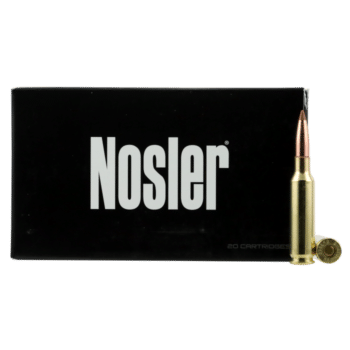
 Ammo Reports Team
| Official Spec | Value |
|---|---|
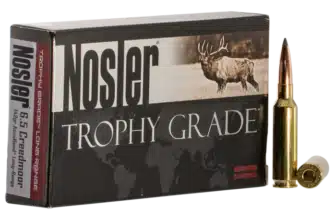
| Manufacturer | Nosler |
| Cartridge | 6.5 Creedmoor |
| Product Line | Ballistic Tip Hunting Ammunition |
| Bullet Name / Bullet Type | 140 gr Spitzer Ballistic Tip Hunting |
| Bullet Weight | 140 gr |
| SKU / Part Number / Item Number | 40064 |
| UPC | 054041400640 |
| Rounds per Box | 20 |
| Muzzle Velocity | 2,650 fps |
| Muzzle Energy | 2,183 ft-lbs |
| Ballistic Coefficient G1 | Not found |
| Ballistic Coefficient G7 | Not found |
| Case Material | Nosler Premium Brass |
| Primer | Not found |
| Reloadable | Not found |
| Test Barrel Length | 24 in (1:8 in twist) |
| Zero Distance | 100 yd |
| Sight Height | 1.5 in |
| Intended Use | Deer-sized game |
| Product Status | Current Nosler catalog |
| Closest Competitors | Winchester Power-Point 6.5 Creedmoor 140 gr SP Federal Power-Shok 6.5 Creedmoor 140 gr SP Fiocchi Hyperformance 6.5 Creedmoor 129 gr Hornady SST Nosler Trophy Grade 6.5 Creedmoor 120 gr Ballistic Tip Nosler Trophy Grade 6.5 Creedmoor 140 gr AccuBond |
Data is based on official manufacturer sources. Found an error? Send us the source link.
Overview
This 140-grain Ballistic Tip Hunting load is built with Nosler Premium Brass and is listed for deer-sized game. Nosler publishes official velocity, energy, and trajectory data through 800 yards. Official product page: Nosler.
Official Ballistics
Manufacturer-published data from a 24-inch, 1:8-inch-twist test barrel. Trajectory is Nosler’s 100-yard-zero table with a 1.5-inch sight height. Nosler does not publish wind-drift values for this load, so no wind column is shown.
| Distance (yd) | Velocity (fps) | Energy (ft-lbs) | Trajectory (in) |
|---|---|---|---|
| Muzzle | 2650 | 2183 | -1.5 |
| 100 | 2477 | 1907 | 0 |
| 200 | 2310 | 1659 | -4.2 |
| 300 | 2150 | 1437 | -14.9 |
| 400 | 1997 | 1240 | -33.1 |
| 500 | 1851 | 1065 | -60.1 |
| 600 | 1711 | 910 | -97.2 |
| 700 | 1581 | 777 | -146.2 |
| 800 | 1460 | 663 | -209.2 |
Bullet Design and Intended Use
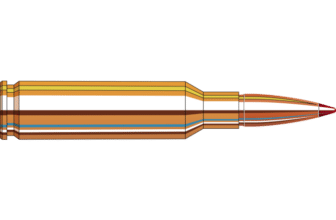
The 140-grain Spitzer Ballistic Tip Hunting bullet combines a polymer tip, a boat-tail profile, and a heavily jacketed base. Nosler positions the load for deer, antelope, and hogs rather than as a general-purpose large-game load.
- Deer-sized game is the manufacturer’s stated use.
- The heavier 140 gr bullet is paired with a 2,650 fps published muzzle velocity.
- Lead-core construction – not lead-free.
- No official wind-drift table is published for this SKU.
Competitors
| Load | Positioning |
|---|---|
| Winchester Power-Point 6.5 Creedmoor 140 gr SP | Traditional 140 gr soft-point hunting option. |
| Federal Power-Shok 6.5 Creedmoor 140 gr SP | Traditional 140 gr soft-point hunting option. |
| Fiocchi Hyperformance 6.5 Creedmoor 129 gr Hornady SST | Lighter polymer-tipped hunting load. |
| Nosler Trophy Grade 6.5 Creedmoor 120 gr Ballistic Tip | Faster 120 gr load from the same Nosler family. |
| Nosler Trophy Grade 6.5 Creedmoor 140 gr AccuBond | Bonded 140 gr Nosler hunting alternative. |
Internal-linking note: Published AmmoReports reviews are linked above; competitors without an existing published review remain plain text.
Current Store Offers
Availability changes by retailer. The offer block below is intentionally shown without fixed prices.
FAQ
Why is the Nosler 140 gr Ballistic Tip listed at 2,650 fps?
That is Nosler’s published muzzle velocity from a 24-inch test barrel. Different factory loads use different components and pressure-tested recipes, so velocity should be compared by exact SKU rather than bullet weight alone.
Nosler Ballistic Tip vs Nosler AccuBond – when does the difference matter?
Ballistic Tip Hunting is a lead-core polymer-tipped deer-sized-game design. AccuBond adds bonded construction for controlled expansion and retained integrity. Choose according to game, shot angle, distance, and the manufacturer’s use guidance.
Is 140 gr or 120 gr Ballistic Tip better for deer?
Both are listed by Nosler for deer-sized game. The 120 gr load starts faster; the 140 gr load is heavier. Rifle accuracy and expected impact distance are more useful selection factors than weight alone.
Does Nosler publish a ballistic coefficient for SKU 40064?
The current official ammunition page does not display G1 or G7 ballistic coefficients, so this review lists both as Not found rather than importing values from an unverified secondary listing.
What are the official test conditions?
Nosler lists a 24-inch barrel with a 1:8-inch twist. Its published trajectory table uses a 100-yard zero and a 1.5-inch sight height.
Submit Your Data – Real-World Results
Manufacturer figures are measured under controlled conditions. Barrel length, chamber, temperature, ammunition lot, and chronograph setup can change real-world velocity.
| UPC # | Firearm | Barrel (in) | Avg Velocity (fps) | Shots | Temp (°F) | Chronograph | Lot | Notes |
|---|---|---|---|---|---|---|---|---|
| 054041400640 | – | – | – | – | – | – | – | No data yet |
Shot this load? Share the firearm, barrel length, average velocity, shot count, temperature, chronograph, lot number, and notes.
You need to login first.All submissions are manually reviewed. Results vary by firearm, barrel condition, ammunition lot, and environmental factors; AmmoReports does not guarantee user-submitted data.
Last verified against the current Nosler product page: September 20, 2026. Data confidence: High for manufacturer-published specifications and trajectory.