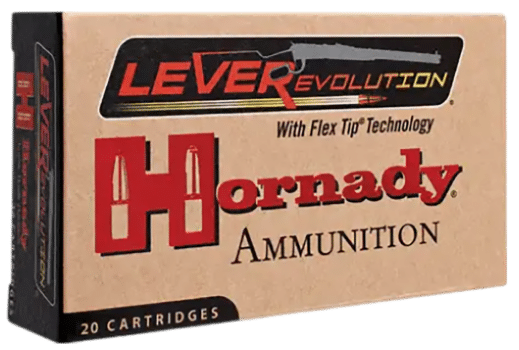

| Official Spec | Value |
|---|---|
| Manufacturer | Hornady |
| Cartridge | 45-70 Government |
| Product Line | LEVERevolution |
| Bullet Name / Bullet Type | MonoFlex, copper alloy, Flex Tip |
| Bullet Weight | 250 gr |
| SKU / Part Number / Item Number | 82741 |
| UPC | Not found |
| Rounds per Box | 20 |
| Muzzle Velocity | 2,025 fps |
| Muzzle Energy | 2,276 ft-lb |
| Ballistic Coefficient G1 | 0.175 |
| Ballistic Coefficient G7 | Not found |
| Case Material | Not found |
| Primer | Not found |
| Reloadable | Not found |
| Test Barrel Length | 24 in |
| Zero Distance | 200 yd (manufacturer table); 100 yd (calculated reference below) |
| Sight Height | 1.5 in |
| Intended Use | Medium and large game; lead-free projectile |
| Product Status | Current manufacturer listing |
| Closest Competitors | Winchester Super-X 45-70 Government 300 gr JHP; Federal Power-Shok .45-70 300 gr SP; Buffalo Bore .45-70 +P 430 gr LFN |
Data is based on official manufacturer sources. Found an error? Send us the source link.

Ballistics Table – 100-Yard Zero
Calculated reference – not manufacturer data. G1 point-mass reference using BC 0.175, 2,025 fps muzzle velocity, 250 gr bullet, 100-yard zero and 1.5-inch sight height. Atmosphere: sea level, 59 F, 29.92 inHg, dry air, no wind. The manufacturer publishes a 200-yard zero; the values here are adjusted to the requested 100-yard zero, and 25-yard rows use shape-preserving interpolation between calculated 50-yard outputs.
| Range (yd) | Velocity (fps) | Energy (ft-lb) | Trajectory (in) |
|---|---|---|---|
| 0 | 2,025 | 2,276 | -1.5 |
| 25 | 1,915 | 2,035 | -0.1 |
| 50 | 1,809 | 1,816 | +0.6 |
| 75 | 1,707 | 1,617 | +0.4 |
| 100 | 1,609 | 1,437 | 0.0 |
| 125 | 1,516 | 1,276 | -1.4 |
| 150 | 1,429 | 1,134 | -4.0 |
| 175 | 1,348 | 1,009 | -7.5 |
| 200 | 1,275 | 902 | -12.2 |
| 225 | 1,209 | 811 | -18.2 |
| 250 | 1,151 | 735 | -25.8 |
| 275 | 1,101 | 673 | -34.9 |
| 300 | 1,059 | 623 | -45.9 |
Key takeaway: This table is a trajectory reference under the stated conditions, not a terminal-performance test or a recommended maximum hunting range.
The MonoFlex Flex Tip – Why It Exists
This article covers the 250 gr MonoFlex, not the 325 gr FTX. MonoFlex uses a one-piece copper-alloy bullet with Hornady’s flexible elastomer tip. The lead-core FTX is a different projectile.
Hornady describes Flex Tip as suitable for tubular magazines. The tip also initiates expansion on impact. The manufacturer attributes LEVERevolution velocity performance to its complete ammunition design and modern propellants; bullet shape alone does not create a more efficient powder burn.
Hornady lists G1 BC 0.175 and sectional density 0.170 for this exact load. Claims for other FTX weights or calibers are not substituted.
LEVERevolution vs Traditional 45-70 Factory Loads
| Specification | Hornady 82741 – 250 gr MonoFlex | Winchester X4570H – 300 gr JHP |
|---|---|---|
| Bullet weight | 250 gr | 300 gr |
| Muzzle velocity | 2,025 fps | 1,880 fps |
| Muzzle energy | 2,276 ft-lb | 2,355 ft-lb |
| BC G1 | 0.175 | Official sources conflict: 0.283 / 0.184 |
| Bullet construction | Copper alloy with Flex Tip | Jacketed lead-core hollow point |
These are different factory products. The earlier comparison used 325 gr FTX data and does not describe the MonoFlex load in this article.
Best Uses
Good fit: Hornady identifies this lead-free MonoFlex load for medium and large game. Firearm compatibility and applicable hunting requirements still need to be satisfied.
Not the right tool for: Handguns or any firearm without manufacturer approval for this ammunition. Hornady does not recommend the load for handguns and marks it not for revolvers. A tabulated distance is not a guaranteed effective hunting range.
Reliability Notes
No structured submissions yet.
Hornady specifies a 24-inch test barrel. The previous shorter-barrel velocity estimates and field anecdotes concerned the 325 gr FTX and cannot verify this 250 gr MonoFlex product. No SKU-specific shorter-barrel series or reliability test was established in this audit.
Follow the firearm and ammunition manufacturers’ compatibility instructions.
Competitors
| Load | Weight | Bullet | MV | Energy @ 100 yd |
|---|---|---|---|---|
| Winchester Super-X 45-70 Government 300 gr JHP | 300 gr | Jacketed Hollow Point | 1,880 fps | Not verified |
| Federal Power-Shok .45-70 300 gr SP | 300 gr | SP | Not verified | Not verified |
| Buffalo Bore .45-70 +P 430 gr LFN | 430 gr | Hard cast | Not verified | Not verified |
This article concerns the 250 gr MonoFlex. The former 325 gr FTX retained-energy comparison did not describe this product.
FAQ
Does the 300-yard table establish a maximum hunting range?
Published velocity and energy do not establish a universal hunting range or guarantee expansion. The table is a reference under stated conditions, not a terminal-performance test or a recommended maximum range. Hornady publishes a 200-yard zero for 82741, with -27.2 inches at 300 yards. A 300-yard table is not a 300-yard hunting recommendation.
Can I use LEVERevolution in my Ruger No. 1 single-shot in 45-70?
This page covers Hornady 82741, the 250 gr MonoFlex load. Hornady says it is not recommended for handguns, and the catalog marks it not for revolvers. Cartridge designation alone does not establish firearm compatibility. Follow the ammunition and firearm manufacturers’ instructions for the exact load and firearm; a low advertised velocity is not proof of a low pressure rating.
How does barrel length affect velocity in the real world?
Hornady lists 2,025 fps from a 24-inch test barrel. No verified shorter-barrel velocity series for this exact 250 gr MonoFlex load was found. The former figures for 325 gr FTX do not apply.
LEVERevolution FTX vs MonoFlex — which should I choose?
This page is for the 250 gr MonoFlex, a lead-free copper-alloy bullet with a flexible tip. The 325 gr FTX is a separate lead-core product with different ballistics. Both use Hornady’s Flex Tip concept; neither product’s data should be substituted for the other.
Submit Your Data · Real-World Results
Manufacturer velocity figures are measured under controlled lab conditions — barrel length, temperature, and lot number all affect real-world performance. The data below comes from community submissions tied to specific test conditions and reviewed before publishing.
Once this page reaches 3 approved submissions, aggregate velocity and confidence level will appear here automatically.
| UPC # | Firearm | Barrel (in) | Avg Velocity (fps) | Shots | Temp (°F) | Chronograph | Lot | Notes |
|---|---|---|---|---|---|---|---|---|
| – | — | — | — | — | — | — | — | No data yet |
Shot this load? Share your results — firearm type, barrel length, average velocity, shots fired, temperature. No account required.
Please include the exact firearm, barrel length and ammunition lot with any submitted results.
All submissions are manually reviewed before appearing on this page.
You need to login first.Results vary by firearm, barrel condition, ammunition lot, and environmental factors. Submitted data is for reference only. AmmoReports does not guarantee accuracy of user-submitted results.
Manufacturer reference: Hornady 82741, 250 gr MonoFlex, 2,025 fps from a 24-inch test barrel. No structured submissions are recorded.