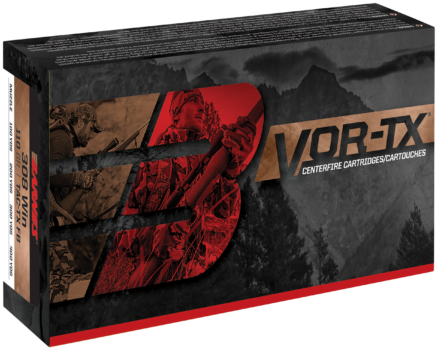
 Ammo Reports Team
| Field | Detail |
|---|---|
| Primary Use | Deer / hog hunting; lead-free bullet |
| Bullet Type | LRX BT (all-copper, polymer-tipped boat-tail) |
| Bullet Weight | 77 grains |
| Case Material | Brass |
| Primer Type | Boxer; exact factory primer specification not verified |
| Packaging | 20 rounds per box |
| Typical Price | $54.49/box — $2.72/round |
| Closest Competitors | Federal Fusion MSR 224 Valkyrie 90 gr Soft Point; Federal Premium 224 Valkyrie 78 gr Barnes TSX |
Official Specs
| Spec | Value | Source |
|---|---|---|
| Manufacturer | Barnes | Barnes |
| Cartridge | 224 Valkyrie | Barnes |
| Product | Barnes VOR-TX 224 Valkyrie 77 gr LRX BT | Barnes |
| Muzzle Velocity (fps) | 2900 | Barnes product data |
| Muzzle Energy (ft-lbs) | 1438 | Barnes ballistics |
| Bullet Weight | 77 gr | Barnes |
| Bullet Type | LRX BT (all-copper, polymer-tipped boat-tail) | Barnes |
| BC G1 | 0.404 | Barnes product data |
| BC G7 | – | Not found in verified official manufacturer sources |
| Manufacturer SKU | 32161 | Barnes |
| UPC | 716876772247 | Barnes product page |
| Case Material | – | Not found in verified official manufacturer sources |
| Reloadable | – | Not found in verified official manufacturer sources |
| Primer | – | Not found in verified official manufacturer sources |
Source note: Verified Barnes product data and manufacturer ballistics for this exact load. Missing official fields remain unfilled. Manufacturer: Barnes.


Ballistics Table
Official manufacturer data: Barnes, 32161; 200-yard zero; 2.5-inch sight height. 24-inch test barrel. The factory table ends at 500 yards. Values below are reproduced without extending the manufacturer data.
| Yards | Velocity (fps) | Energy (ft-lbs) | Trajectory (in) |
|---|---|---|---|
| Muzzle | 2900 | 1438 | -2.5 |
| 100 | 2671 | 1220 | 1.2 |
| 200 | 2453 | 1029 | 0.0 |
| 300 | 2245 | 862 | -7.0 |
| 400 | 2048 | 717 | -20.9 |
| 500 | 1861 | 592 | -43.1 |
Calculated comparison – not manufacturer data: Muzzle to 700 yards in 100-yard steps. Inputs: 2900 fps, 77 gr, G1 BC 0.404; 200-yard zero; 2.5-inch sight height. Assumed atmosphere: 59°F, 29.92 inHg station pressure, sea level, 0% humidity; level fire, no wind. Point-mass G1 model, py-ballisticcalc 2.3.1; spin drift and Coriolis excluded. Factory and calculated rows may differ because their models and conditions differ.
| Yards | Calculated velocity (fps) | Calculated energy (ft-lbs) | Calculated trajectory (in) |
|---|---|---|---|
| Muzzle | 2900 | 1438 | -2.5 |
| 100 | 2667 | 1216 | 1.2 |
| 200 | 2446 | 1023 | -0.0 |
| 300 | 2235 | 854 | -7.0 |
| 400 | 2035 | 708 | -21.0 |
| 500 | 1846 | 583 | -43.5 |
| 600 | 1669 | 476 | -76.1 |
| 700 | 1507 | 388 | -121.3 |
Key takeaway: The manufacturer lists 2,900 fps at the muzzle and 1,861 fps at 500 yards. Its 200-yard-zero trajectory is -43.1 inches at 500 yards. The separate 700-yard calculation is an illustrative model, not a measured result or a guarantee of hunting performance. Actual velocity and point of impact depend on the rifle, ammunition lot and conditions.
The Barnes LRX BT Bullet and Why It Matters in 224 Valkyrie
The Long-Range X Boat Tail (LRX BT) is Barnes’s purpose-built hunting projectile for extended-range engagements. Unlike the original TSX or TTSX designs, the LRX BT is engineered with a longer bearing surface, a more aggressive boat tail for improved BC, and a polymer tip that initiates expansion reliably at the lower impact velocities common at long range. The all-copper, lead-free construction means the bullet retains virtually all of its original weight through the target — a meaningful advantage over conventional bonded or cup-and-core designs that may shed jacket material.
Barnes pairs 224 Valkyrie with a 77 gr LRX hunting bullet. The copper construction is lead-free; legal certification and hunt-specific requirements need separate verification. It is a distinct product from Federal’s 78 gr TSX load.
Best Uses
Good fit:
- Predator hunting (coyote, fox) at moderate to extended range where lead-free construction is required or preferred
- Light deer-class hunting in states where 224 Valkyrie is legal for deer and terminal performance requirements are met
- Hunting in California and other jurisdictions with lead-free bullet mandates
- Shooters running a dedicated AR-15 in 224 Valkyrie who want a hunting load that mirrors the platform’s long-range capability
- Situations where deep penetration and high weight retention are prioritized over rapid fragmentation
Not the right tool for:
- High-volume varmint shooting or prairie dog towns — the per-round cost makes this impractical for bulk use
- Competitive target shooting where a match-grade open-tip bullet (such as the Sierra MatchKing or Hornady ELD-M) would provide more consistent long-range precision
- Rifles whose barrel twist is unsuitable for this bullet; a load-specific minimum twist was not verified in the official sources checked.
- Applications requiring rapid fragmentation rather than the LRX design’s controlled expansion and weight retention
Reliability Notes
No structured submissions yet.
Barnes describes VOR-TX as hunting ammunition using all-copper bullets with expansion and weight-retention design goals. A minimum expansion velocity specific to item 32161 was not verified. These are manufacturer design claims; no structured AmmoReports test submissions are available.
Competitors
| Load | Weight | Bullet | BC G1 | Muzzle Velocity | Price/Box | Notes |
|---|---|---|---|---|---|---|
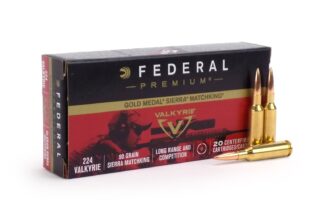
| Federal Gold Medal 224 Valkyrie 90 gr Sierra MatchKing | 90 gr | Sierra MatchKing HPBT | 0.563 | 2,700 fps | ~$32–$40 | Verified factory load; target / match design |
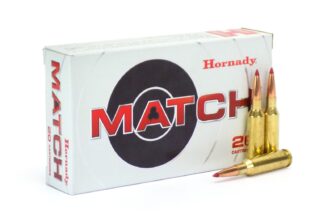
| Hornady Match 224 Valkyrie 88 gr ELD Match | 88 gr | ELD Match (lead core, Heat Shield polymer tip) | 0.545 | 2,675 fps | ~$28–$36 | Verified factory load; target / match design |
| Federal American Eagle 224 Valkyrie 75 Gr TMJ | 75 gr | Total Metal Jacket | 0.400 | 3,000 fps | ~$18–$24 | AE224VLK1; 75 gr TMJ in Federal catalog, FMJ on current product page |
| Nosler 224 Valkyrie 70 Gr RDF | 70 gr | RDF (BTHP) | – | – | ~$35–$45 | Exact factory-load identity not verified; excluded from factual performance comparison |
| Federal Premium 224 Valkyrie 78 gr Barnes TSX | 78 gr | Barnes TSX (all-copper hollow point) | 0.383 | 2,850 fps | ~$45–$55 | Verified factory load; different bullet construction and intended use |
| Sig Sauer Elite Copper 224 Valkyrie 70 Gr | 70 gr | All-copper HP | – | – | ~$30–$40 | Exact factory-load identity not verified; excluded from factual performance comparison |
Comparison data are shown only for verified factory loads. Rows without a verified exact product retain their original labels for transparency; their performance claims are withdrawn. A component bullet does not establish the existence of a factory load.
Price Reality
- Typical retail: $54.49 per 20-round box based on current source data; case pricing not confirmed
- Per-round cost: $2.72
- The Federal Premium 224 Valkyrie 78 Gr Barnes TSX — the most direct competitor using the same manufacturer’s bullet family — retails in a similar $45–$55 range, making the VOR-TX load competitively positioned within the premium lead-free segment
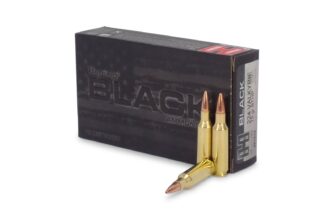
- Hornady BLACK and Federal American Eagle loads in 224 Valkyrie are available for $18–$36 per box, representing a significant savings for shooters who do not require lead-free or hunting-grade construction
- At $2.72 per round, this load is priced appropriately for a premium hunting load with all-copper construction; paying more than $65 per 20-round box for this specific load would be above fair market value under normal supply conditions
Prices change. Check the Where to Buy block for current listings.
Where to Buy
Barnes VOR-TX 224 Valkyrie 77 Gr LRX BT 20 Rounds (Box)
Affiliate links. These do not influence ratings, data, or any editorial content on this page.
FAQ
Does the Barnes LRX BT bullet comply with California’s lead-free hunting regulations?
This load uses a lead-free copper bullet. Bullet material alone does not establish legal approval for a particular hunt; check the exact product against current certification and hunting requirements.
What barrel twist rate is required to stabilize the 77-grain LRX BT in 224 Valkyrie?
Bullet stability depends on the specific bullet, velocity, barrel twist and atmospheric density. A universal minimum twist for this exact factory load was not verified in the manufacturer sources checked. Follow the rifle and ammunition manufacturers’ guidance; bullet weight alone does not establish compatibility.
How does the LRX BT differ from Barnes’s TTSX bullet, and why does it matter for this caliber?
The LRX uses a polymer tip and an all-copper body, while TSX uses a hollow-point design. The manufacturer describes the bullet’s intended hunting behavior, but a minimum expansion velocity specific to this factory load was not verified in the official sources checked. The ballistics table describes flight and does not guarantee terminal performance at a particular distance.
Is this load appropriate for deer hunting, and if so, at what distances?
Barnes identifies this as hunting ammunition with an all-copper LRX bullet. Its official table gives 862 ft-lbs at 300 yards, but retained energy alone cannot establish an ethical hunting distance or guarantee expansion. Suitability also depends on bullet behavior, conditions and shot placement; verify applicable hunting requirements.
How does the VOR-TX 77 Gr LRX BT compare to the Federal Premium 224 Valkyrie 78 Gr Barnes TSX load?
Both loads use Barnes all-copper bullets and are positioned as premium hunting ammunition for 224 Valkyrie, but they use different bullet designs. The Federal load uses the TSX (Triple-Shock X), which is a more established design with a broad effective velocity range but a lower BC than the LRX BT. The VOR-TX load uses the LRX BT, which is designed specifically for longer-range hunting where higher BC and reliable low-velocity expansion are priorities. The price difference between the two is modest. Shooters prioritizing maximum downrange performance and lead-free compliance at extended range will find the LRX BT design theoretically advantageous; those making shots inside 200 yards may see little practical difference in terminal results.