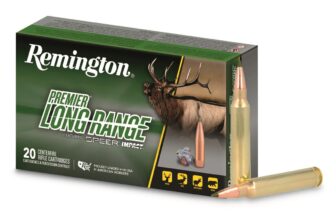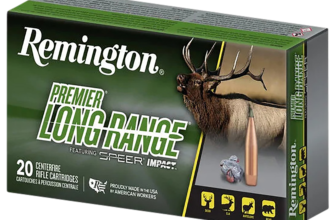
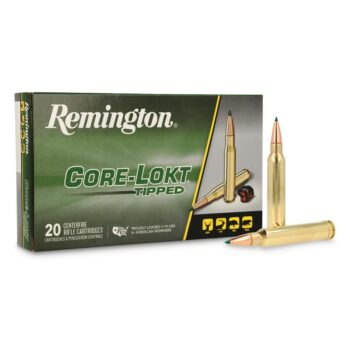
Remington Core-Lokt Tipped, .300 Win. Mag., Polymer Tip, 180 Grain
 Ammo Reports Team


Remington Core-Lokt Tipped .300 Win. Mag. 180 Grain — Ammunition Reference
At a Glance
| Field | Detail |
|---|---|
| Primary Use | Big game hunting (deer, elk, bear, moose) |
| Bullet Type | Polymer-Tipped Bonded Core-Lokt Soft Point |
| Bullet Weight | 180 grain |
| Case Material | Brass |
| Primer Type | Boxer (centerfire) |
| Packaging | 20 rounds per box |
| Typical Price | $45.59/box — $2.28/round |
| Closest Competitors | Federal Trophy Bonded Tip .300 Win. Mag. 180 gr, Hornady Precision Hunter .300 Win. Mag. 178 gr ELD-X, Winchester Deer Season XP .300 Win. Mag. 180 gr |
Official Specs
| Spec | Value | Source |
|---|---|---|
| Muzzle Velocity (fps) | — | Not published in available product data |
| Muzzle Energy (ft-lbs) | — | Not published in available product data |
| Bullet Weight | 180 gr | Manufacturer |
| Bullet Type | Polymer-Tipped Core-Lokt | Manufacturer |
| BC G1 | — | Not published |
| BC G7 | — | Not published |
| Manufacturer SKU | — | Not published in available product data |
| UPC | — | Not published in available product data |
| Reloadable | Yes | Brass case, Boxer primer |
Note on missing velocity and energy data: Remington does not publish muzzle velocity or muzzle energy for this specific Core-Lokt Tipped load in the product data available at time of writing. The ballistics table below uses a calculated estimate based on published performance of comparable 180 gr .300 Win. Mag. loads. Community-submitted chronograph data will be incorporated as it becomes available.
Note on BC: Neither G1 nor G7 ballistic coefficient values are published by Remington for this load in available sources. The polymer tip design is consistent with a G1 BC in the range of 0.480–0.507 for 180 gr .300 Win. Mag. projectiles of this class, but no specific figure can be confirmed. No BC value has been assumed in the ballistics table.


Ballistics Table
Calculated estimate. Muzzle velocity of 2,960 fps used as a reference figure consistent with industry-standard performance for 180 gr .300 Win. Mag. factory loads; this figure is not manufacturer-published. Real-world results vary by barrel length, temperature, altitude, and lot. Community submissions will provide measured muzzle velocity for comparison.
Zero: 200 yards | Sight height: 1.5" above bore | G1 BC estimate: 0.490
| Yards | Velocity (fps) | Energy (ft-lbs) | Trajectory (in) |
|---|---|---|---|
| 0 | ~2,960 | ~3,501 | -1.5 |
| 100 | ~2,756 | ~3,035 | +1.8 |
| 200 | ~2,560 | ~2,619 | 0.0 ← zero |
| 300 | ~2,372 | ~2,249 | -7.6 |
| 400 | ~2,192 | ~1,921 | -21.8 |
| 500 | ~2,019 | ~1,630 | -44.5 |
| 600 | ~1,854 | ~1,374 | -77.6 |
| 700 | ~1,697 | ~1,150 | -123.5 |
| 800 | ~1,550 | ~960 | -184.8 |
Key takeaway: With a 200-yard zero, the Core-Lokt Tipped 180 gr .300 Win. Mag. stays within roughly ±2 inches of line of sight from the muzzle out to approximately 230 yards, making it a practical field zero for most North American big game hunting distances. By 400 yards the bullet has dropped nearly 22 inches, which demands precise range estimation and hold-over correction. Energy remains above 1,500 ft-lbs through 500 yards, a commonly cited threshold for ethical elk-sized game, though real-world terminal performance depends heavily on impact velocity and bullet construction at those ranges. Hunters planning shots beyond 400 yards should verify actual drop with a chronograph and confirmed BC before relying on these calculated figures.
The Core-Lokt Tipped Bullet Design
The Remington Core-Lokt lineage dates to 1939, making it one of the longest-running controlled-expansion hunting bullet lines in American ammunition history. The original Core-Lokt used a tapered copper jacket mechanically locked to a lead core to control expansion and retain weight. The Core-Lokt Tipped variant adds a polymer tip to the classic construction, serving two functions: it initiates expansion more consistently at lower impact velocities, and it improves the bullet’s ballistic coefficient compared to the traditional soft-point profile.
Unlike fully bonded designs such as the Federal Trophy Bonded or Swift A-Frame, the Core-Lokt Tipped relies on the mechanical interlock between jacket and core rather than a chemical or fusion bond. This distinction matters at the extreme velocities generated by the .300 Winchester Magnum cartridge — at close range, high-velocity impacts can stress the jacket-core junction more than a chemically bonded bullet would experience. At moderate hunting distances of 100–350 yards, the design has a well-documented track record across multiple generations of hunters. The polymer tip also reduces tip deformation during magazine feeding, a practical advantage in bolt-action hunting rifles.
Best Uses
Good fit:
- White-tailed deer and mule deer at ranges from 50 to 400 yards where the flat trajectory of the .300 Win. Mag. is an asset
- Elk hunting at moderate ranges (100–350 yards) where the 180 gr weight delivers sufficient sectional density for penetration through heavy muscle and bone
- Open-country hunting in the American West where wind drift and long shots are possible but not routine
- Hunters who want a recognizable, widely available factory load and do not require a fully bonded or lead-free option
- Hunters transitioning from the classic Core-Lokt soft point who want improved long-range performance from the same platform
Not the right tool for:
- Jurisdictions with lead-free ammunition requirements (California condor zones, certain national parks) — this is a lead-core bullet
- Extreme long-range shooting beyond 500 yards where a higher published and verified BC is needed for confident ballistic solutions
- Dangerous game (cape buffalo, hippo, elephant) where controlled-expansion soft points are inadequate and solid construction is required
- Hunters who require a fully bonded bullet for maximum weight retention on tough, large-bodied game like brown bear at close quarters
- Situations where the shooter needs manufacturer-published ballistic data for precise long-range dialing — BC and velocity are not confirmed for this specific load
Reliability Notes
No structured submissions yet.
Based on manufacturer claims and open-source information: Remington describes the Core-Lokt Tipped as delivering controlled expansion with high weight retention relative to the classic Core-Lokt soft point, though specific retention percentages are not published for this load. The polymer tip is intended to initiate expansion reliably across a broader range of impact velocities than the original flat-base soft point design. The brass case and Boxer primer construction are consistent with Remington’s standard production tolerances for centerfire rifle ammunition. No active recalls or documented lot-specific issues have been identified for this load at time of writing. All notes above come from manufacturer product descriptions and open sources, not structured chronograph or terminal performance testing data.
Competitors
| Load | Weight | Bullet | BC G1 | Muzzle Velocity | Price/box (approx.) | Notes |
|---|---|---|---|---|---|---|
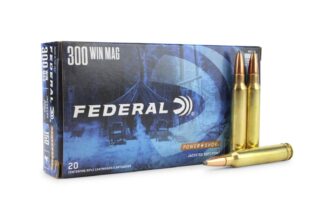
| Federal Trophy Bonded Tip .300 Win. Mag. | 180 gr | Polymer-tip bonded | 0.480 | 2,960 fps | ~$65–$75 | Fully bonded; higher weight retention at close range |
| Hornady Precision Hunter .300 Win. Mag. | 178 gr | ELD-X | 0.536 | 2,960 fps | ~$55–$65 | Higher BC; excellent long-range option; premium price |
| Winchester Deer Season XP .300 Win. Mag. | 180 gr | Polymer tip | 0.474 | 2,950 fps | ~$35–$45 | Budget alternative; thinner jacket; deer-focused design |
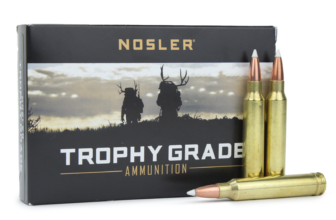
| Nosler Trophy Grade .300 Win. Mag. AccuBond | 180 gr | Bonded polymer tip | 0.507 | 2,960 fps | ~$65–$80 | Fully bonded; premium tier; widely respected terminal performance |
| Barnes Vor-TX .300 Win. Mag. | 180 gr | TTSX (lead-free) | 0.459 | 2,960 fps | ~$60–$70 | Lead-free; California-legal; monolithic copper construction |
| Remington Core-Lokt SP .300 Win. Mag. | 180 gr | Soft point (no tip) | ~0.383 | 2,960 fps | ~$35–$42 | Budget baseline; same Core-Lokt lineage; lower BC than Tipped version |
Price Reality
- At $45.59 per box of 20, the Core-Lokt Tipped lands in the mid-tier segment for .300 Win. Mag. factory ammunition — above budget soft points and below premium bonded loads.
- Per-round cost works out to $2.28/round, which is reasonable for a polymer-tipped hunting load in this caliber.
- The classic Remington Core-Lokt SP in the same caliber and weight typically runs $35–$42/box, making the Tipped version a roughly $5–$10/box premium for the improved tip and marginally better BC.
- Hornady Precision Hunter (178 gr ELD-X) and Nosler Trophy Grade AccuBond run $55–$80/box, placing the Core-Lokt Tipped as a meaningful savings over those premium options while still offering a modern polymer-tip design.
- Federal Trophy Bonded Tip at $65–$75/box offers full bonding for hunters who prioritize maximum weight retention — that premium is justified for close-range dangerous game or heavy-boned animals; for standard deer and elk hunting the Core-Lokt Tipped is competitive.
- A fair price for this load is under $50/box. Prices above $55/box for a single box should prompt comparison shopping.
Prices change. Check the Where to Buy block for current listings.
Where to Buy
Remington Core-Lokt Tipped, .300 Win. Mag., Polymer Tip, 180 Grain, 20 Rounds
Affiliate links. These do not influence ratings, data, or any editorial content on this page.
FAQ
Does the polymer tip on the Core-Lokt Tipped actually improve performance over the classic Core-Lokt soft point?The polymer tip serves two documented mechanical purposes: it initiates expansion more consistently at lower impact velocities (relevant for longer shots where the bullet has slowed), and it improves the aerodynamic profile of the bullet, raising the ballistic coefficient compared to the exposed-lead soft point. For hunters shooting inside 200 yards at normal .300 Win. Mag. velocities, the expansion difference between the two designs is likely minimal in practical terms. The BC improvement becomes more meaningful at distances beyond 300 yards where retained velocity — and therefore energy and expansion behavior — diverges between the two designs. Hunters who regularly shoot at 300 yards or beyond have a legitimate reason to choose the Tipped version over the classic soft point.
Is the Core-Lokt Tipped a fully bonded bullet?No. The Core-Lokt Tipped uses Remington’s traditional mechanical interlock system, where the jacket is crimped or locked to the lead core rather than chemically bonded or fused throughout. This means that at very high impact velocities — common at close range with the .300 Win. Mag. — there is a greater possibility of jacket-core separation than with fully bonded designs like the Federal Trophy Bonded Tip or Nosler AccuBond. For the vast majority of deer and elk hunting scenarios at practical distances, this distinction rarely affects outcome. Hunters pursuing large, dangerous, or heavily muscled game at close range where maximum weight retention is critical may prefer a fully bonded alternative.
Is this load legal for hunting in California or other lead-free zones?No. The Core-Lokt Tipped uses a lead core and is not compliant with California’s lead-free ammunition regulations, which apply to all hunting statewide. Hunters in California condor range or any jurisdiction with lead-free requirements must use a monolithic copper or copper-alloy bullet such as the Barnes TTSX or similar non-lead construction. Always verify current state and federal regulations before selecting ammunition for a specific hunt, as lead-free requirements are expanding in some jurisdictions.
How does the Core-Lokt Tipped compare to the Hornady Precision Hunter 178 gr ELD-X for elk hunting at 400 yards?The Hornady ELD-X carries a higher published G1 BC (0.536 vs. an unconfirmed estimate for the Core-Lokt Tipped), which translates to less wind drift and a flatter trajectory at 400 yards under identical muzzle velocity conditions. Both bullets use a polymer tip to initiate expansion, but the ELD-X is designed with a heat-resistant tip specifically engineered to resist deformation in flight — a concern Hornady identified with standard polymer tips at high velocities. For elk at 400 yards, both loads can be effective in the hands of a shooter who has confirmed their actual drop data; the ELD-X provides more published ballistic data to work with, while the Core-Lokt Tipped offers a lower price point. The Core-Lokt Tipped is a reasonable choice for hunters who zero carefully and keep shots within their confirmed data range.
What barrel length is assumed for .300 Win. Mag. velocity ratings, and does it matter for this load?Industry standard for .300 Winchester Magnum velocity testing is a 24-inch test barrel, which is longer than the 22-inch or 22.5-inch barrels found on many hunting rifles. As a practical rule, expect a loss of approximately 25–50 fps per inch of barrel shorter than the test barrel. Since Remington has not published a muzzle velocity for this specific load, this barrel-length consideration applies equally to any calculated or estimated figures used on this page. Hunters using a 22-inch barrel should anticipate velocities roughly 50–100 fps below the 24-inch reference figure, which shifts the ballistic table modestly but does not change the fundamental performance character of the load at hunting distances.