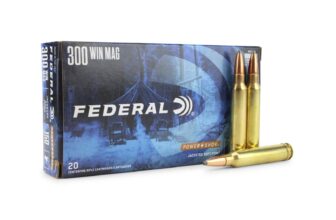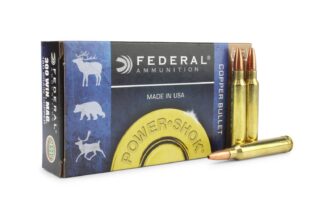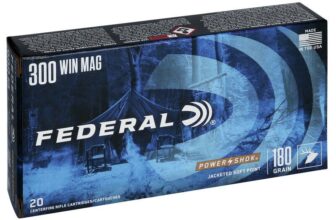
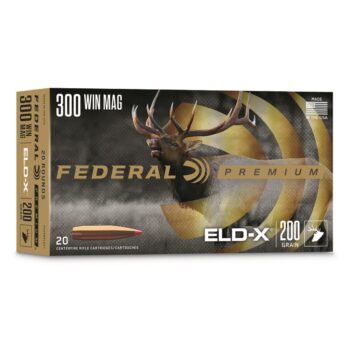
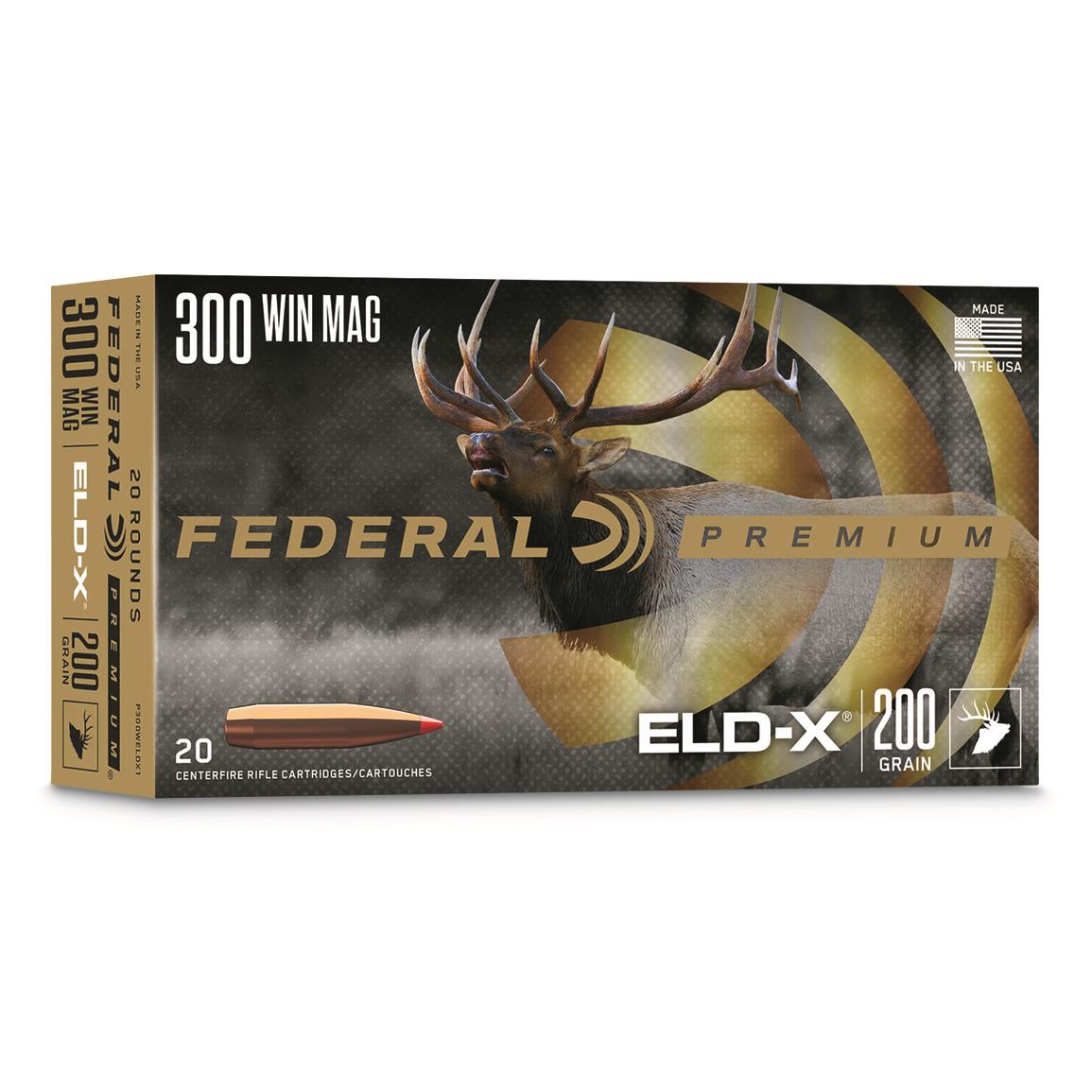
Federal Premium, .300 Win. Mag., ELD-X, 200 Grain
 Ammo Reports Team


At a Glance
| Field | Detail |
|---|---|
| Primary Use | Big game hunting (elk, moose, large deer) |
| Bullet Type | Hornady ELD-X (Extremely Low Drag – eXpanding) |
| Bullet Weight | 200 grain |
| Case Material | Brass |
| Primer Type | Boxer |
| Packaging | 20 rounds per box |
| Typical Price | $54.14/box — $2.71/round |
| Closest Competitors | Hornady Precision Hunter .300 Win. Mag. 200 gr. ELD-X, Nosler Trophy Grade .300 Win. Mag. 200 gr. AccuBond, Winchester Expedition Big Game .300 Win. Mag. 200 gr. Nosler AccuBond |
Official Specs
| Spec | Value | Source |
|---|---|---|
| Muzzle Velocity (fps) | — | Not published |
| Muzzle Energy (ft-lbs) | — | Not published |
| Bullet Weight | 200 gr. | Manufacturer |
| Bullet Type | Hornady ELD-X | Manufacturer |
| BC G1 | — | Not published |
| BC G7 | — | Not published |
| Manufacturer SKU | — | Not published |
| UPC | — | Not published |
| Reloadable | Yes | Brass case, Boxer primer |
Note: Federal Premium has not published muzzle velocity, muzzle energy, or ballistic coefficient data for this specific load in the product data available at time of writing. The ballistics table below uses Hornady’s published data for the 200 gr. ELD-X bullet in .300 Win. Mag. as a calculated estimate. Hornady’s own Precision Hunter load in this weight and caliber lists a muzzle velocity of 2,850 fps from a 24" test barrel; that figure is used as the basis for trajectory calculations below and is labeled accordingly. Buyers should confirm specs directly with Federal Premium or through independent chronograph testing.

Ballistics Table
Calculated estimate. Real-world results vary by barrel length, temperature,altitude, and lot. Community submissions will provide measured muzzlevelocity for comparison. Muzzle velocity of 2,850 fps sourced from Hornadypublished data for the 200 gr. ELD-X in .300 Win. Mag. (G7 BC: 0.315).Federal has not published independent velocity data for this load.All values below are approximate.
Zero: 200 yards | Sight height: 1.5" above bore
| Yards | Velocity (fps) | Energy (ft-lbs) | Trajectory (in) |
|---|---|---|---|
| 0 | ~2,850 | ~3,609 | -1.5 |
| 100 | ~2,659 | ~3,140 | +1.8 |
| 200 | ~2,476 | ~2,723 | 0.0 ← zero |
| 300 | ~2,301 | ~2,350 | -7.7 |
| 400 | ~2,133 | ~2,020 | -22.3 |
| 500 | ~1,971 | ~1,726 | -45.5 |
| 600 | ~1,817 | ~1,467 | -79.2 |
| 700 | ~1,671 | ~1,241 | -125.8 |
| 800 | ~1,533 | ~1,044 | -188.3 |
Key takeaway: With a 200-yard zero, this load carries enough velocity and energy to cleanly take large-bodied game like elk well past 400 yards under field conditions. The ELD-X bullet’s high sectional density and controlled-expansion design help retain energy effectively at longer ranges. Drift and drop become significant beyond 500 yards, and precise range estimation is critical. Hunters should confirm their specific rifle’s point of impact rather than relying solely on these calculated figures.
The Hornady ELD-X Bullet in Federal Premium Brass
Federal Premium’s decision to load the Hornady ELD-X projectile is notable because it pairs one of the most aerodynamically refined hunting bullets available with Federal’s own brass and primer combination. The ELD-X (Extremely Low Drag – eXpanding) uses Hornady’s Heat Shield tip, a polymer insert engineered to resist aerodynamic heating during flight — a real phenomenon that can deform standard polymer tips at high velocity and degrade the ballistic coefficient over distance. The result is a bullet that maintains its published BC more consistently from muzzle to target than many competitors.
The InterLock-style jacket-core construction of the ELD-X is replaced here by a mechanically bonded design that promotes controlled expansion across a wide velocity range. At close range, where impact velocity is highest, the bullet is designed to expand rapidly without fragmenting. At extended range, where velocity has dropped, the secant ogive profile and high sectional density of the 200 gr. projectile help sustain enough energy for reliable terminal performance. This makes the combination particularly well-suited to shots taken at varying distances in open or mountain terrain.
Best Uses
Good fit:
- Hunting elk, moose, and large mule deer at ranges from 50 to 400+ yards
- Open-country and mountain hunting where shots may vary widely in distance
- Hunters who want a premium terminal performance bullet without handloading
- Situations where a single load must perform reliably at both close and extended range
- Shooters whose rifles are already zeroed and tuned for 200 gr. .300 Win. Mag. loads
Not the right tool for:
- Deer-sized game at close range where a lighter, faster .300 Win. Mag. load would reduce meat damage
- Target shooting or long-range practice — cost per round makes this impractical for volume use
- Jurisdictions with lead-free bullet requirements (ELD-X is a lead-core bullet)
- Hunters seeking the absolute flattest trajectory, where a 180 gr. load may outperform at distance
- Semi-automatic platforms where feeding reliability with high-BC, long-ogive bullets has not been confirmed
Reliability Notes
No structured submissions yet.
Based on manufacturer claims and open-source information: Federal Premium is known for consistent primer seating and case quality, and the ELD-X bullet is a factory Hornady component with well-documented performance in other manufacturers’ loads. Users of Hornady’s own Precision Hunter line — which uses the identical bullet — have reported consistent accuracy and terminal performance on large game across multiple independent hunting forums and field reports. No patterns of feeding issues, misfires, or accuracy inconsistency specific to Federal’s loading of this bullet have been identified in available open sources. All notes here reflect open-source observation, not structured data submissions.
Competitors
| Load | Weight | Bullet | BC G1 | Muzzle Velocity | Price/box | Notes |
|---|---|---|---|---|---|---|
| Hornady Precision Hunter .300 Win. Mag. | 200 gr. | ELD-X | 0.597 | 2,850 fps | ~$52–$60 | Same bullet; Hornady’s own loading |
| Nosler Trophy Grade .300 Win. Mag. | 200 gr. | AccuBond | 0.588 | 2,850 fps | ~$65–$75 | Premium bonded alternative |
| Winchester Expedition Big Game .300 Win. Mag. | 200 gr. | Nosler AccuBond | 0.588 | 2,850 fps | ~$60–$70 | Premium; same AccuBond projectile |
| Federal Power-Shok .300 Win. Mag. | 180 gr. | Soft Point | ~0.383 | 2,960 fps | ~$30–$38 | Budget alternative; lower BC, proven design |
| Berger Hybrid Hunter .300 Win. Mag. | 185 gr. | Hybrid Hunter | 0.640 | 3,080 fps | ~$65–$80 | Premium alternative; higher BC, open-country focus |
| Barnes VOR-TX .300 Win. Mag. | 180 gr. | TTSX | 0.452 | 2,960 fps | ~$55–$65 | Lead-free option; copper construction |
Price Reality
- At $54.14 per box, this load sits in the mid-to-upper tier of factory .300 Win. Mag. ammunition
- Per-round cost of $2.71 is consistent with other premium hunting loads in this caliber
- Hornady’s own Precision Hunter with the identical ELD-X bullet typically runs $52–$60/box, making it the most direct price comparison — Federal’s load is essentially price-competitive
- Budget alternatives like Federal Power-Shok run $30–$38/box, saving roughly $16–$24 per box at the cost of a lower-BC, non-bonded bullet
- Premium options like Berger Hybrid Hunter or Nosler Trophy Grade can reach $65–$80/box, placing this Federal load at a reasonable midpoint
- A fair price benchmark for this load is $50–$60/box; prices above $65 represent a meaningful premium over the competition without a clear performance advantage
Prices change. Check the Where to Buy block for current listings.
Where to Buy
Federal Premium, .300 Win. Mag., ELD-X, 200 Grain, 20 Rounds
Affiliate links. These do not influence ratings, data, or any editorial content on this page.
FAQ
Does Federal Premium use the exact same ELD-X bullet as Hornady Precision Hunter in this load?Yes — the Hornady ELD-X is a commercially available component bullet, and Federal Premium loads it in their own brass with their own primer and powder charge. The projectile itself is identical in design and construction to what Hornady uses in their Precision Hunter line. However, the powder charge, primer selection, and resulting velocity may differ between the two loads, which can affect point of impact and terminal performance. Buyers who have experience with Hornady Precision Hunter should not assume zero will be identical without verifying at the range.
Is the 200 gr. ELD-X a good choice for elk at ranges beyond 400 yards?The 200 gr. ELD-X is specifically designed for extended-range terminal performance, with a high sectional density and a secant ogive profile that retains velocity and energy well past 400 yards. At 400 yards, the bullet is estimated to carry over 2,000 ft-lbs of energy, which exceeds the commonly cited 1,500 ft-lbs minimum for elk-sized game. That said, ethical hunting at extended range requires the shooter to have confirmed their rifle’s actual point of impact at those distances, not just calculated trajectory. Wind drift, which is not shown in the table above, becomes a significant factor beyond 400 yards and must be accounted for in the field.
Why doesn’t Federal publish muzzle velocity for this load?This is an unusual gap for a premium factory load. Federal Premium publishes velocity data for the majority of their product line, and the absence here may reflect a newer SKU, a product still being updated in their catalog, or a data gap in the retail listing. Buyers who need confirmed velocity data should contact Federal Premium directly or chronograph the load from their specific barrel. Barrel length has a significant effect on velocity in .300 Win. Mag. — a 24" barrel will typically produce meaningfully higher velocity than a 22" barrel.
Is this load legal for hunting in states or areas with lead-free bullet requirements?No. The ELD-X is a lead-core bullet with a gilding metal jacket. It does not qualify as a non-toxic or lead-free projectile under California’s Condor Zone regulations or similar requirements in other jurisdictions. Hunters who need a lead-free .300 Win. Mag. option should look at copper-construction alternatives such as the Barnes TTSX or Hornady CX. Always verify local regulations before selecting ammunition for hunting.
How does the 200 gr. load compare to a 180 gr. .300 Win. Mag. load for general big game use?The 200 gr. bullet sacrifices some muzzle velocity compared to a 180 gr. load but gains sectional density, which improves penetration on large or heavily built animals like elk, moose, and large bears. For deer-sized game at typical hunting distances, the 180 gr. load is often considered more than adequate and produces a flatter trajectory. The 200 gr. ELD-X is most justified when the hunter expects to engage large-bodied game, anticipates longer shots in open terrain, or wants maximum retained energy at distance. For mixed-use hunting where both deer and elk may be encountered, the 200 gr. load is a reasonable single-load choice.