 Ammo Reports Team
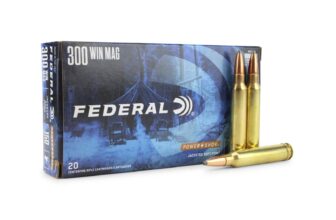
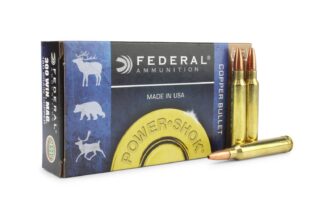
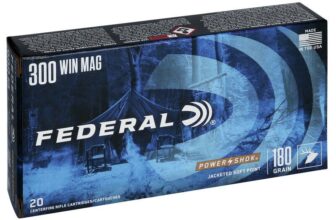
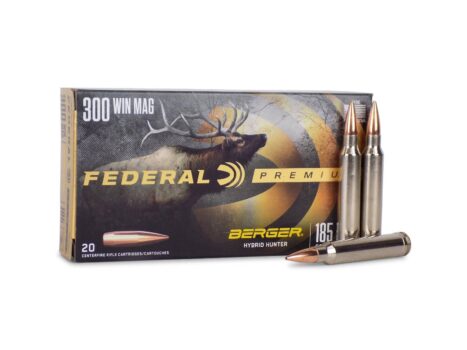
Federal 300 Win Mag 185 Gr Berger Hybrid Hunter
At a Glance
| Feature | Detail |
|---|---|
| Primary Use | Big game hunting at extended range |
| Bullet Type | Berger Hybrid Hunter — tangent-secant ogive jacketed hollow point with polymer tip |
| Bullet Weight | 185 gr |
| Case Material | Brass |
| Primer Type | Boxer |
| Packaging | 20 rounds per box |
| Typical Price | $64.99/box · $3.25/round |
| Closest Competitors | Hornady Precision Hunter 300 Win Mag 212 gr ELD-X · Nosler Trophy Grade 300 Win Mag 190 gr AccuBond LR · Barnes Precision Match 300 Win Mag 220 gr OTM |
Official Specs
| Spec | Value | Source |
|---|---|---|
| Muzzle Velocity (fps) | — | Not published |
| Muzzle Energy (ft-lbs) | — | Not published |
| Bullet Weight | 185 gr | Manufacturer |
| Bullet Type | Berger Hybrid Hunter | Manufacturer |
| BC G1 | — | Not published |
| BC G7 | — | Not published |
| Manufacturer SKU | — | Not published |
| UPC | — | Not published |
| Reloadable | Yes | Manufacturer (brass case, Boxer primer) |
Note: Federal has not published muzzle velocity, muzzle energy, or ballistic coefficient data for this specific load in their publicly available product listings as of this writing. Berger publishes standalone BC data for the 185 gr Hybrid Hunter projectile (G7 BC ≈ 0.304 per Berger’s bullet data), but that figure applies to the component bullet and may differ from factory-loaded performance. It is not reproduced here as a manufacturer spec for this ammunition. Community-submitted chronograph data will be added as it becomes available.


Ballistics Table
Calculated estimate. Muzzle velocity has not been published by Federal for this load. The table below uses an estimated muzzle velocity of 2,950 fps — a reasonable figure for a 185 gr projectile in a 300 Win Mag with a 26" barrel, consistent with comparable factory loads. A G7 BC of 0.304 (Berger component data) and a G1 BC of approximately 0.552 are applied. Sight height is 1.5" above bore. Zero is set at 200 yards. Real-world results vary by barrel length, temperature, altitude, and lot. Community submissions will provide measured muzzle velocity for comparison. All values marked ~ to indicate estimate.
| Yards | ~Velocity (fps) | ~Energy (ft-lbs) | ~Trajectory (in) |
|---|---|---|---|
| 0 | ~2,950 | ~3,573 | −1.5 |
| 100 | ~2,793 | ~3,203 | +1.8 |
| 200 | ~2,641 | ~2,864 | 0.0 ← zero |
| 300 | ~2,494 | ~2,554 | −7.5 |
| 400 | ~2,351 | ~2,268 | −21.4 |
| 500 | ~2,212 | ~2,009 | −43.2 |
| 600 | ~2,077 | ~1,771 | −74.4 |
| 700 | ~1,947 | ~1,556 | −116.4 |
| 800 | ~1,822 | ~1,362 | −171.0 |
Key takeaway: At a 200-yard zero, this load stays within roughly ±2 inches of point of aim from the muzzle out to approximately 240 yards, giving hunters a practical point-blank hunting window suitable for most big game shots. The high ballistic coefficient of the Berger Hybrid design limits velocity loss and wind drift at distance, keeping retained energy above 2,000 ft-lbs past 500 yards — well within ethical hunting thresholds for large deer, elk, and similar game. Beyond 600 yards, the trajectory drop accelerates meaningfully, and precise range estimation becomes critical. Shooters should confirm actual muzzle velocity with a chronograph before trusting these figures for long-range field use.
The Berger Hybrid Hunter Bullet
The Berger Hybrid Hunter bullet design merits its own discussion because it is genuinely distinct from conventional hunting projectiles and directly defines what this load is and is not capable of.
The "hybrid" in the name refers to the ogive geometry. Conventional hunting bullets use either a tangent ogive — which is forgiving of seating depth variation and feeds reliably in magazines — or a secant ogive — which produces a higher ballistic coefficient but is sensitive to seating depth and magazine length. Berger’s engineers combined both geometries into a single profile: the forward portion of the ogive uses a secant curve to generate a high BC, while the rear portion transitions to a tangent curve for feeding reliability and reduced sensitivity to jump-to-lands distance. The result is a bullet that performs more like a long-range target projectile in flight while remaining practical in a factory-loaded hunting round.
The terminal performance mechanism is a controlled hollow-point cavity beneath a polymer tip. On impact, the tip drives rearward into the cavity, initiating rapid expansion. Berger’s design philosophy for the Hybrid Hunter targets expansion at velocities starting around 1,800 fps, which extends the effective range of the round considerably compared to bonded bullets that require higher impact velocities for reliable mushrooming. The jacket is not bonded to the core, meaning the bullet is engineered to shed weight rapidly on impact — typically retaining 40–70% of original weight — producing a wide wound channel through significant tissue disruption rather than deep, narrow penetration. This characteristic makes it highly effective on deer-sized and elk-sized game but less suited to heavy bone and shoulder shots on the largest or most dangerous animals, where controlled-expansion bonded bullets are generally preferred.
Federal’s decision to load this projectile under the Premium line positions it as a factory option for hunters who want match-grade bullet geometry without assembling handloads.
Best Uses
Good fit:
- Hunting whitetail, mule deer, pronghorn, and similar medium-bodied game at distances from 100 to 500+ yards where flat trajectory and wind resistance matter
- Elk hunting in open terrain where shots beyond 300 yards are realistic and the hunter can confirm range precisely
- Hunters who want a single load that performs well at both moderate and extended range without switching to a target bullet
- Situations where high BC and reduced wind drift are prioritized over maximum penetration depth
- Bolt-action rifles with 26" barrels where the 300 Win Mag’s velocity potential is fully realized
Not the right tool for:
- Dangerous game or heavy-boned animals (brown bear, cape buffalo) where deep, weight-retained penetration is required — the non-bonded Hybrid Hunter is not engineered for that role
- Close-range brush hunting where the bullet may encounter heavy cover before reaching the target, risking deflection or premature expansion
- Hunters who need lead-free ammunition to comply with state or federal regulations — this is a lead-core projectile
- Rifles with shorter barrels (20–22") where the 300 Win Mag’s velocity advantage over short-action cartridges is diminished and the added recoil may not be justified
- Semi-automatic or lever-action platforms not chambered and rated for 300 Win Mag pressures
Reliability Notes
No structured submissions yet.
Based on manufacturer product descriptions and open-source user discussions, the following notes are relevant — all sourced from manufacturer claims or publicly available commentary, not structured performance data:
- Manufacturer literature describes the Berger Hybrid Hunter as designed for consistent expansion beginning around 1,800 fps impact velocity, which supports its use at extended range in a 300 Win Mag context
- The tangent-secant ogive design is cited by Berger as providing reduced sensitivity to seating depth variation, which in a factory-loaded context means Federal’s production tolerances are less likely to affect bullet jump consistency than with a pure secant design
- No active recalls or known lot-specific defects have been identified for this product as of this writing
- Open-source commentary from hunters using Berger Hybrid bullets in 300 Win Mag generally describes reliable feeding from box magazines in standard bolt-action rifles, consistent with the ogive geometry’s design intent
- The non-bonded construction means terminal performance is velocity-dependent; shots at very low impact velocity (beyond effective range or at reduced loads) may not expand reliably — a limitation consistent with the bullet design, not a manufacturing defect
Competitors
| Load | Weight | Bullet | BC G1 | Muzzle Velocity | Price/box | Notes |
|---|---|---|---|---|---|---|
| Hornady Precision Hunter 300 Win Mag 212 gr ELD-X | 212 gr | ELD-X (bonded-style polymer tip) | 0.673 | 2,860 fps | ~$65–$72 | Heavier bullet, higher BC; bonded construction for deeper penetration |
| Nosler Trophy Grade 300 Win Mag 190 gr AccuBond LR | 190 gr | AccuBond Long Range | 0.597 | 2,900 fps | ~$70–$78 | Bonded core; designed specifically for long-range terminal performance; premium price |
| Federal Terminal Ascent 300 Win Mag 200 gr | 200 gr | Terminal Ascent (bonded, slipbase) | 0.730 | 2,830 fps | ~$68–$75 | Same brand; bonded construction; lead-free shank; higher BC; better for heavy game |
| Winchester Expedition Big Game Long Range 300 Win Mag 190 gr | 190 gr | Nosler AccuBond LR | 0.597 | 2,950 fps | ~$60–$68 | Uses same AccuBond LR bullet as Nosler Trophy Grade; budget-friendlier option |
| Berger Bullets Hunting 300 Win Mag 185 gr Hybrid | 185 gr | Berger Hybrid Hunter (same projectile) | ~0.552 (G1 est.) | Varies | ~$75–$85 | Uses the identical bullet; handload-assembled by Berger; premium price point |
| Browning Long Range Pro Hunter 300 Win Mag 185 gr | 185 gr | Sierra Tipped GameKing | 0.552 | 3,080 fps | ~$55–$62 | Budget-friendlier alternative; different bullet construction; higher advertised velocity |
Price Reality
- Typical retail: $64.99–$72.00 per 20-round box; case pricing (typically 10 boxes/200 rounds) is not widely listed at a fixed discount for this load
- Per-round cost: approximately $3.25–$3.60 depending on retailer and availability
- The Hornady Precision Hunter 212 gr ELD-X runs within $5–$10 of this load per box and offers a published, verified ballistic data sheet — a meaningful advantage for buyers who want confirmed specs
- The Federal Terminal Ascent 200 gr in 300 Win Mag is priced similarly and offers bonded construction plus a higher published BC, making it a strong alternative within the same brand at comparable cost
- The Browning Long Range Pro Hunter 185 gr represents the clearest budget alternative, typically running $5–$10 less per box with a different but capable bullet
- Fair price benchmark: at $3.25/round, this load is priced appropriately for a premium hunting load using a purpose-designed long-range bullet; paying more than $3.75/round for a single box without a sale should be considered overpriced given current market comparables
Prices change. Check the Where to Buy block for current listings.
Where to Buy
Federal 300 Win Mag 185 Gr Berger Hybrid Hunter (Box)
Affiliate links. These do not influence ratings, data, or any editorial content on this page.
FAQ
What makes the Berger Hybrid Hunter bullet different from a standard hunting bullet?The Berger Hybrid Hunter uses a combined tangent-secant ogive geometry rather than the single-style ogive found on most hunting bullets. The secant portion of the nose produces a higher ballistic coefficient than a pure tangent design, reducing velocity loss and wind drift at long range. The tangent portion near the shank improves feeding reliability and reduces sensitivity to the distance between the bullet’s ogive and the rifling. On impact, the bullet expands rapidly through a hollow-point cavity beneath the polymer tip, creating a wide wound channel. This combination targets hunters who want match-grade flight characteristics without assembling handloads.
How does this load compare directly to the Federal Terminal Ascent 300 Win Mag 200 gr?Both loads are Federal Premium products in 300 Win Mag, but they use fundamentally different bullets with different terminal performance philosophies. The Terminal Ascent uses a bonded core with a lead-free copper shank, designed to retain approximately 95% of its weight and penetrate deeply through heavy bone — making it better suited for elk shoulder shots and larger game. The 185 gr Berger Hybrid Hunter uses a non-bonded construction that sheds weight rapidly to create a larger wound cavity through tissue disruption, which is highly effective on deer to elk-sized game but not optimized for maximum penetration depth. The Terminal Ascent also has a published muzzle velocity and BC, giving buyers more certainty about its ballistic performance. Hunters targeting heavy game or taking quartering-to shots should lean toward the Terminal Ascent; hunters prioritizing flat trajectory and wide wound channels on medium to large game may prefer the Hybrid Hunter.
Is this ammunition legal for hunting in states with lead-free bullet requirements?No. The 185 gr Berger Hybrid Hunter uses a lead core and is not compliant with lead-free ammunition regulations. California’s Condor Zone and statewide non-lead requirements, as well as similar regulations in other jurisdictions, prohibit the use of lead-core projectiles for hunting. Hunters in affected areas should select a lead-free alternative such as the Federal Terminal Ascent (which has a lead-free copper shank) or a Barnes TTSX-based load. Always verify current state and federal regulations before selecting ammunition for a specific hunt.
What bullet weight and BC should I expect for long-range elk hunting with this load?At 185 grains, this bullet is on the lighter end of the spectrum for 300 Win Mag hunting loads, which typically range from 165 to 220 grains. The lighter weight allows a higher muzzle velocity, partially offsetting the BC disadvantage compared to heavier bullets. Berger’s component data lists a G7 BC of approximately 0.304 for the 185 gr Hybrid Hunter projectile, which is competitive for its weight class but lower than the G7 BCs of heavier 200–215 gr bullets used in competing loads. For ethical elk hunting, most ballistic guidelines suggest maintaining at least 1,500 ft-lbs of retained energy at impact; based on estimated performance, this load likely meets that threshold well past 600 yards in standard conditions. Hunters should confirm actual muzzle velocity with a chronograph and run their own ballistic solution before committing to shots beyond 400 yards on elk.
Why doesn’t Federal publish muzzle velocity for this load?Federal has not provided a consistent explanation for the absence of published velocity data on this specific product listing. Some Federal Premium loads in this line carry full ballistic data on the box and product page, while others do not — a gap that appears related to how individual SKUs are prioritized for ballistic testing and documentation rather than any quality concern. The omission is a practical inconvenience for buyers who want to build a verified ballistic solution before the hunt. Until Federal publishes official data or community chronograph submissions are collected, buyers should treat any velocity figure they encounter for this load as an estimate and verify it with a chronograph before field use.