 Ammo Reports Team
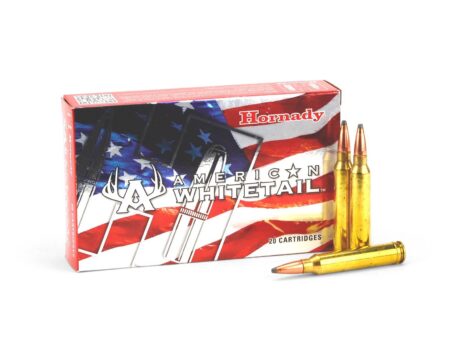
Hornady American Whitetail .300 Win Mag 150 Grain SP
At a Glance
| Feature | Detail |
|---|---|
| Primary Use | White-tailed deer hunting |
| Bullet Type | Hornady InterLock Soft Point |
| Bullet Weight | 150 grain |
| Case Material | Brass |
| Primer Type | Boxer |
| Packaging | 20 rounds per box |
| Typical Price | $47.49/box — $2.37/round |
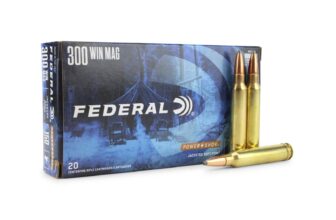
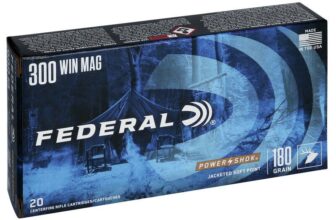
| Closest Competitors | Federal Power-Shok .300 Win Mag 150 gr SP, Winchester Super-X .300 Win Mag 150 gr PP, Remington Core-Lokt .300 Win Mag 150 gr PSP |
Official Specs
| Spec | Value | Source |
|---|---|---|
| Muzzle Velocity (fps) | Not published by manufacturer for this SKU | — |
| Muzzle Energy (ft-lbs) | Not published by manufacturer for this SKU | — |
| Bullet Weight | 150 gr | Manufacturer |
| Bullet Type | InterLock Soft Point | Manufacturer |
| BC G1 | Not published | — |
| BC G7 | Not published | — |
| Manufacturer SKU | 8196 | Manufacturer |
| UPC | 090255381962 | Manufacturer |
| Reloadable | Yes | Manufacturer |
Note: Hornady does not publish muzzle velocity or muzzle energy on their product page for this specific American Whitetail load. The ballistics table below uses a calculated estimate based on industry-standard performance data for a 150 gr .300 Win Mag load at approximately 3,275 fps from a 24" test barrel — consistent with comparable loads in this class. All ballistic values in the table below are calculated estimates, not manufacturer-stated data.
Note: BC G1 and BC G7 are not published by Hornady for the American Whitetail line. Hornady reserves detailed BC data primarily for their Precision Hunter and ELD-X product lines.


Ballistics Table
Calculated estimate. Real-world results vary by barrel length, temperature, altitude, and lot. Community submissions will provide measured muzzle velocity for comparison.
Assumptions: 150 gr SP, estimated G1 BC ≈ 0.338, estimated muzzle velocity 3,275 fps, 1.5" sight height, 200 yd zero, sea level, standard atmosphere.
| Yards | Velocity (fps) | Energy (ft-lbs) | Trajectory (in) |
|---|---|---|---|
| 0 | ~3,275 | ~3,572 | -1.5 |
| 100 | ~3,022 | ~3,044 | +1.8 |
| 200 | ~2,782 | ~2,579 | 0.0 ← zero |
| 300 | ~2,554 | ~2,173 | -7.5 |
| 400 | ~2,337 | ~1,819 | -21.9 |
| 500 | ~2,130 | ~1,511 | -45.1 |
| 600 | ~1,933 | ~1,244 | -79.4 |
| 700 | ~1,747 | ~1,017 | -127.4 |
| 800 | ~1,572 | ~823 | -192.8 |
Key takeaway: Zeroed at 200 yards, this load stays within roughly ±2 inches of point of aim from the muzzle out to approximately 230 yards — a practical maximum point-blank range well suited to most whitetail hunting scenarios. The trajectory stays manageable to 300 yards, where roughly 7.5 inches of holdover is required. Beyond 400 yards, wind drift and drop become significant enough that this hunting load — with its unverified BC and traditional soft point construction — is better reserved for ranges where ethical shot placement on deer-sized game is reliably achievable. For most hunters, 300 yards represents a sensible practical ceiling.
The Hornady InterLock Bullet
The InterLock is one of the oldest continuously produced hunting bullet designs in the Hornady lineup, and understanding its construction helps set accurate expectations for this load. The defining feature is a physical InterLock ring — a raised band inside the jacket that mechanically interlocks with the lead core. This prevents core-jacket separation during impact, a failure mode that plagued earlier cup-and-core designs when driven at high velocity through tough tissue or bone.
At .300 Win Mag velocities, core retention matters. The InterLock is not a bonded bullet in the modern sense — the core and jacket are not chemically or pressure-bonded — but the mechanical ring provides meaningful retention that distinguishes it from a plain lead-core soft point. At 150 grains in this caliber, the bullet is on the lighter end of the .300 Win Mag weight spectrum, which means higher velocity and a flatter trajectory but a somewhat thinner jacket cross-section compared to a 180 gr projectile. At close range on large-bodied deer, this can result in more aggressive expansion and a larger wound channel, which is generally a terminal performance advantage for clean kills.
This bullet design has been used successfully on white-tailed deer for decades and remains a proven choice within its intended purpose and range envelope.
Best Uses
Good fit:
- White-tailed deer hunting at ranges from close timber shots out to approximately 300 yards
- Hunters who want a proven, traditional soft point design with a long field record
- Situations where budget matters and premium bonded or polymer-tipped bullets are not required
- Hunters shooting a rifle already zeroed and load-tested with this specific ammunition
- Areas or seasons where lead projectiles are permitted and preferred
Not the right tool for:
- Long-range hunting beyond 350–400 yards, where BC limitations and unverified ballistic data make precise holdover calculations unreliable
- Large or dangerous game such as elk, moose, or bear, where deeper penetration and heavier bullet weights are strongly preferred
- Lead-free zones or jurisdictions with non-toxic ammunition requirements
- Hunters seeking a bonded or monolithic bullet for maximum weight retention on quartering shots through heavy bone
- Precision long-range target shooting or competition applications
Reliability Notes
No structured submissions yet.
Based on manufacturer claims and open-source hunting community discussion, the following observations are worth noting — all sourced from manufacturer marketing or publicly available hunting forums, not structured performance data:
- Hornady states that American Whitetail ammunition is loaded to consistent pressure and velocity specifications using the same quality controls applied across their product line, though specific lot-to-lot velocity data is not published.
- The InterLock bullet design has a documented history of reliable expansion on whitetail-sized game at moderate impact velocities (above approximately 1,800 fps), which is achievable with this load well past 400 yards based on calculated estimates.
- Some hunters report that 150 gr .300 Win Mag loads can produce aggressive fragmentation on close-range shots through light-boned deer, occasionally resulting in significant jacket/core separation — a known characteristic of high-velocity soft points, not specific to this product alone.
- Brass cases are Boxer-primed and reloadable, which experienced handloaders note as a secondary value consideration — though this page covers factory ammunition only.
Competitors
| Load | Weight | Bullet | BC G1 | Adv. Velocity | Price/box | Notes |
|---|---|---|---|---|---|---|
| Federal Power-Shok .300 Win Mag 150 gr SP | 150 gr | Soft Point | ~0.338 | ~3,300 fps | ~$38–$44 | Budget alternative; similar plain SP construction; no bonding |
| Winchester Super-X .300 Win Mag 150 gr PP | 150 gr | Power-Point | ~0.341 | ~3,290 fps | ~$40–$46 | Comparable price tier; notched jacket for controlled expansion |
| Remington Core-Lokt .300 Win Mag 150 gr PSP | 150 gr | PSP Core-Lokt | ~0.338 | ~3,290 fps | ~$38–$45 | Classic budget competitor; tapered jacket bonding; long field record |
| Hornady Precision Hunter .300 Win Mag 178 gr ELD-X | 178 gr | ELD-X | 0.552 | ~2,960 fps | ~$58–$68 | Premium alternative; same brand; dramatically higher BC; bonded; better for long range |
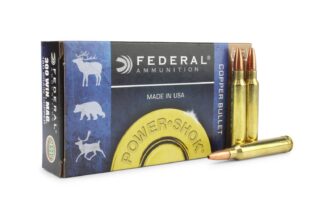
| Federal Trophy Bonded Tip .300 Win Mag 150 gr | 150 gr | Trophy Bonded Tip | ~0.470 | ~3,300 fps | ~$55–$65 | Premium alternative; bonded core; better penetration on tough shots |
| Barnes VOR-TX .300 Win Mag 150 gr TTSX | 150 gr | TTSX (lead-free) | ~0.401 | ~3,290 fps | ~$58–$70 | Lead-free; all-copper; required in some California hunting zones |
Price Reality
- Typical retail range: $44–$52 per 20-round box; case pricing (10 boxes/200 rounds) typically runs $420–$490 when available
- Per-round cost: approximately $2.20–$2.60 depending on retailer and market conditions
- The Federal Power-Shok and Remington Core-Lokt in .300 Win Mag typically run $5–$10 less per box — a meaningful difference for hunters who do significant pre-season practice
- The Hornady Precision Hunter in .300 Win Mag commands a $10–$20 premium per box for meaningfully superior BC, bonded construction, and published ballistic data
- At $47.49, this load sits in the mid-budget tier — priced above the deepest-discount options but below premium bonded loads; it represents fair value for a hunting-only purchase of 1–2 boxes per season
- Overpriced threshold: paying more than $55/box for this load without a supply shortage justification is difficult to defend when comparable soft point options are available at lower prices
Prices change. Check the Where to Buy block for current listings.
Where to Buy
Hornady American Whitetail .300 Win Mag 150 Grain SP
Affiliate links. These do not influence ratings, data, or any editorial content on this page.
FAQ
Does the Hornady InterLock bullet in this load use a bonded core?The InterLock is not a bonded bullet in the conventional sense. Rather than chemically or pressure-bonding the lead core to the jacket, Hornady uses a mechanical InterLock ring — a raised band machined into the jacket interior that physically engages with the lead core to resist separation on impact. This provides meaningfully better core retention than a plain cup-and-core soft point, but it does not perform identically to fully bonded designs like the Federal Trophy Bonded or Nosler Partition. For whitetail deer at typical hunting ranges, the distinction rarely matters in practice, but hunters taking quartering shots on large-bodied deer or hunting heavier species should consider a fully bonded option.
How does this load compare to the Hornady Precision Hunter .300 Win Mag in the same caliber?The Precision Hunter line represents a significant step up in ballistic performance and terminal technology. It uses the ELD-X bullet — a heat-shielded polymer-tipped, bonded-core design with a G1 BC of approximately 0.552 in 178 gr form, compared to the unverified ~0.338 estimated for this 150 gr InterLock load. At 500 yards, that BC difference translates to several inches less wind drift and a noticeably flatter trajectory. The American Whitetail line is deliberately positioned as a cost-effective hunting load for moderate ranges; the Precision Hunter is the appropriate choice for hunters regularly shooting past 300 yards or hunting in open country where wind is a significant factor.
Is 150 grains an appropriate bullet weight for .300 Win Mag deer hunting?Yes — 150 grains is a historically popular and well-established weight for .300 Win Mag deer hunting. It produces higher muzzle velocity than 180 gr loads, resulting in a flatter trajectory and somewhat less recoil, which benefits shot placement. The trade-off is a lighter, somewhat faster-expanding bullet that may perform more aggressively on close-range shots. For white-tailed deer specifically, 150 gr is well within the appropriate range. Hunters pursuing larger-bodied game like mule deer or elk would generally be better served by 165–180 gr options with deeper penetration profiles.
Can this ammunition be used in jurisdictions with lead-free requirements?No. The Hornady InterLock SP uses a lead core and is not compliant with non-toxic ammunition regulations in force in California and certain other areas for hunting on state and federal lands. Hunters in those jurisdictions must use lead-free projectiles — typically all-copper or copper-alloy designs such as the Barnes TTSX or Hornady GMX. Always verify local regulations before purchasing hunting ammunition, as lead restrictions vary by state, land management unit, and species.
Why doesn’t Hornady publish muzzle velocity for this load?Hornady does publish velocity data for many of their product lines, but the American Whitetail line has historically had inconsistent or absent published specs at the individual SKU level on their website. This is not unusual for budget-tier hunting ammunition — manufacturers sometimes prioritize publishing detailed data for their premium lines (Precision Hunter, Superformance) where the ballistic story is a primary marketing point. For the American Whitetail line, the marketing emphasis is on the InterLock bullet’s field-proven reliability rather than precise ballistic performance. Buyers who require confirmed velocity data for long-range ballistic calculations should consider Hornady’s Superformance or Precision Hunter lines, which include published G1 and G7 BC values.