 Ammo Reports Team
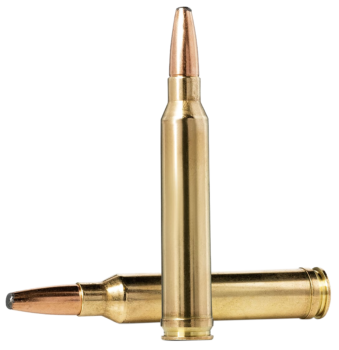
Norma Precision Oryx 300 Win Mag 180 Grain
At a Glance
| Feature | Detail |
|---|---|
| Primary Use | Big game hunting (deer, elk, moose, bear) |
| Bullet Type | Oryx Bonded Soft Point |
| Bullet Weight | 180 grain |
| Case Material | Brass |
| Primer Type | Boxer (type not specified by manufacturer) |
| Packaging | 20 rounds per box |
| Typical Price | $41.99/box — $2.10/round |
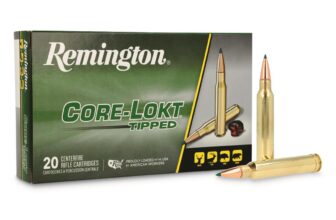
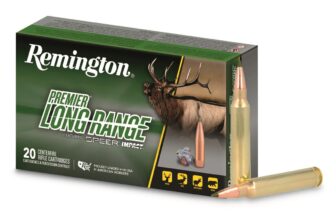
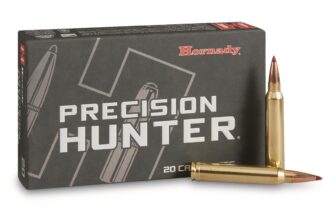
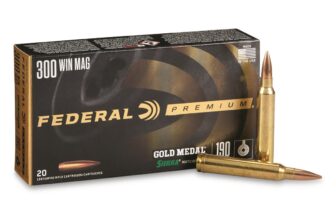
| Closest Competitors | Federal Premium Trophy Bonded Tip 300 Win Mag 180 gr, Hornady Precision Hunter 300 Win Mag 178 gr ELD-X, Winchester Expedition Big Game 300 Win Mag 180 gr Accubond |
Official Specs
| Spec | Value | Source |
|---|---|---|
| Muzzle Velocity (fps) | 2,919 | Product listing |
| Muzzle Energy (ft-lbs) | 3,404 | Product listing |
| Bullet Weight | 180 gr | Product listing |
| Bullet Type | Oryx Bonded Soft Point | Manufacturer |
| BC G1 | — | Not published |
| BC G7 | — | Not published |
| Manufacturer SKU | — | Not published |
| UPC | — | Not published |
| Reloadable | Yes | Brass case, Boxer primer |
Note — BC: Norma does not publish G1 or G7 ballistic coefficients for the Oryx line through standard retail channels. The ballistics table below is calculated using an estimated BC G1 of 0.474, which is a commonly cited approximation for the 180 gr Oryx projectile. Treat all trajectory values as estimates until confirmed by measured data.
Note — Muzzle Energy: At 2,919 fps with a 180 gr bullet, the calculated muzzle energy is approximately 3,404 ft-lbs — consistent with the listed value. No data integrity flag is required here; the figures are internally coherent.
Note — Test Barrel Length: Norma does not specify the barrel length used for velocity testing in the available product data. Most Norma .300 Win Mag data is derived from a 24-inch test barrel. Results from shorter hunting rifles will typically be lower.
 Norma Precision Oryx 300 Win Mag 180 Grain (Box)
 $41.99
in stock
Ballistics Table
Calculated estimate. Real-world results vary by barrel length, temperature,altitude, and lot. Community submissions will provide measured muzzlevelocity for comparison.
Zeroed at 200 yards. Sight height: 1.5" above bore. Based on estimated BC G1 ≈ 0.474, MV 2,919 fps.
| Yards | Velocity (fps) | Energy (ft-lbs) | Trajectory (in) |
|---|---|---|---|
| 0 | 2,919 | 3,404 | -1.5 |
| 100 | 2,729 | 2,974 | +1.8 |
| 200 | 2,546 | 2,590 | 0.0 ← zero |
| 300 | 2,369 | 2,244 | -7.7 |
| 400 | 2,199 | 1,933 | -22.4 |
| 500 | 2,035 | 1,654 | -45.9 |
| 600 | 1,877 | 1,408 | -79.5 |
| 700 | 1,727 | 1,193 | -125.4 |
| 800 | 1,585 | 1,004 | -185.8 |
Key takeaway: With a 200-yard zero, the Norma Oryx 300 Win Mag 180 gr stays within roughly ±2 inches of point of aim out to approximately 225 yards — a practical hold-over-free range for most big game hunting situations. By 400 yards, drop exceeds 22 inches, requiring deliberate correction; this is a capable long-range hunting load but not a flat-shooting target cartridge. Retained energy remains above 1,000 ft-lbs past 800 yards, confirming terminal performance potential well beyond typical ethical hunting distances. Most hunters will find this load optimally suited for shots inside 400 yards where wind drift and field conditions can be reasonably managed.
The Norma Oryx Bullet — Bonded Construction Explained
The Oryx bullet is the centerpiece of this load’s hunting performance. It uses a bonded core design in which the lead core is chemically or mechanically fused to the copper jacket, preventing the two from separating on impact — a critical feature when hunting heavy or tough-skinned game at varied distances. Unlike cup-and-core bullets that can shed jacket material and lose mass rapidly, the bonded Oryx is engineered to retain a high percentage of its original weight through the expansion cycle, typically delivering a wide, mushroomed frontal diameter while driving deep into muscle and bone.
The soft point tip initiates reliable expansion even at reduced terminal velocities encountered at longer ranges, distinguishing it from polymer-tipped designs that can be sensitive to jacket-tip contact in magazine feeding. Norma markets the Oryx as suitable for driven hunts and close-range encounters as well as open-country shots, citing the bullet’s structural integrity across a wide impact velocity window. This versatility makes the 180 gr Oryx a practical single-load choice for hunters who may encounter game at 50 yards in timber or 350 yards across a canyon — without needing to change ammunition for different terrain.
Best Uses
Good fit:
- Elk, moose, and large deer hunting at ranges from close timber shots to approximately 400 yards
- Hunters pursuing heavy or tough-skinned North American game where deep penetration and weight retention are priorities
- Mixed-terrain hunts where shot distances are unpredictable and a single versatile load is preferred
- Driven hunts and close-range encounters where bullet integrity at high impact velocity matters
- Hunters who reload brass and want quality Norma cases for future use
Not the right tool for:
- Varmint or predator hunting where rapid fragmentation is desired — the bonded construction is specifically designed against this
- Target shooting or precision long-range competition where a higher BC and published drop data are essential
- Jurisdictions with lead-free ammunition requirements — the Oryx contains a lead core and does not qualify as a non-toxic projectile
- Hunters who need sub-MOA guaranteed accuracy from factory loads for extreme long-range applications — performance at 600+ yards requires confirmed BC data not currently published by Norma
Reliability Notes
No structured submissions yet.
Based on manufacturer claims and open-source hunting reports, the Norma Oryx line has a long-standing reputation in European hunting markets, where it has been used extensively on driven game including wild boar — a demanding test of bullet integrity due to the heavy shoulder structure of the animal. Norma describes the Oryx as delivering controlled expansion with a retained weight typically cited above 90%, though this figure is not independently verified in the available product data for this specific load. Feeding reliability in bolt-action rifles is generally reported as consistent with the soft point profile, which avoids the occasional feed-ramp sensitivity associated with some hollow-point designs. All notes above are derived from manufacturer claims and open sources, not structured data.
Competitors
| Load | Weight | Bullet | BC G1 | Muzzle Velocity | Price/box | Notes |
|---|---|---|---|---|---|---|
| Federal Premium Trophy Bonded Tip 300 Win Mag | 180 gr | Trophy Bonded Tip (bonded) | 0.507 | 2,960 fps | ~$65–$75 | Premium alternative; published BC; bonded construction similar in concept |
| Hornady Precision Hunter 300 Win Mag | 178 gr | ELD-X | 0.552 | 2,960 fps | ~$55–$65 | Higher BC; not bonded in same manner; excellent long-range ballistics |
| Winchester Expedition Big Game 300 Win Mag | 180 gr | AccuBond CT | 0.507 | 2,950 fps | ~$60–$70 | Bonded tip; similar weight class; slightly higher published velocity |
| Remington Core-Lokt 300 Win Mag | 180 gr | Core-Lokt PSP | 0.383 | 2,960 fps | ~$30–$38 | Budget alternative; cup-and-core, not bonded; lower BC; widely available |
| Nosler Trophy Grade 300 Win Mag | 180 gr | AccuBond | 0.507 | 2,900 fps | ~$65–$80 | Premium bonded; similar velocity to Norma Oryx; strong accuracy reputation |
| Barnes VOR-TX 300 Win Mag | 180 gr | TTSX (lead-free) | 0.412 | 2,960 fps | ~$65–$75 | Lead-free alternative; all-copper construction; required in lead-free zones |
Price Reality
- Typical retail range: $38–$48 per box of 20 rounds; case pricing (typically 10 boxes) not widely advertised at standard retail
- Per-round cost: approximately $2.10 at the $41.99 price point
- The Norma Oryx sits below most premium bonded loads such as Federal Trophy Bonded Tip ($65–$75/box) and Nosler Trophy Grade ($65–$80/box), making it a competitive mid-tier option for bonded hunting ammunition
- Compared to the budget tier — Remington Core-Lokt at approximately $30–$38/box — the Oryx commands a roughly $4–$10 premium per box, justified by its bonded construction
- A price above $52–$55 per box for this load would place it outside its natural competitive range relative to comparable bonded options; at or below $45 represents fair market value
Prices change. Check the Where to Buy block for current listings.
Where to Buy
Norma Precision Oryx 300 Win Mag 180 Grain (Box)
Affiliate links. These do not influence ratings, data, or any editorial content on this page.
FAQ
What makes the Norma Oryx bullet different from a standard soft point?The Oryx uses a bonded core construction, meaning the lead core is fused to the copper jacket rather than simply swaged or crimped in place. This bonding process prevents core-jacket separation on impact, which is a known failure mode of conventional cup-and-core soft points when hitting bone at high velocity or when impacting game at close range where terminal velocity is very high. The result is a bullet that tends to retain more of its original weight and deliver a wider, more consistent mushroom. For hunters pursuing large or heavily built game, this structural integrity translates to deeper penetration and more reliable energy transfer.
How does this load compare to the Hornady ELD-X 178 gr in .300 Win Mag for long-range elk hunting?The Hornady Precision Hunter 178 gr ELD-X carries a published G1 BC of 0.552 versus the Oryx’s unpublished but estimated 0.474, giving the ELD-X a measurable advantage in wind deflection and retained velocity beyond 400 yards. However, the ELD-X uses an interlock design rather than a fully bonded core, which some hunters consider a disadvantage when shots are taken at close range with high residual velocity. The Norma Oryx 180 gr is arguably the more forgiving choice across a wider range of impact velocities, while the ELD-X rewards hunters who are confident in their ability to hold shots to specific distance ranges. For elk inside 400 yards, both are capable; beyond that, the ELD-X’s ballistic advantage becomes more practically significant.
Is this ammunition legal for hunting in California or other lead-free states?No. The Norma Oryx uses a lead core bonded to a copper jacket, which means it contains lead and does not qualify as non-toxic or lead-free ammunition. California’s Proposition 65 and its condor zone regulations — and in some cases statewide regulations — require the use of certified non-lead ammunition for hunting. Hunters in those jurisdictions should look at alternatives such as the Barnes VOR-TX with the all-copper TTSX bullet, which is specifically designed for lead-free compliance. Always verify current state and local regulations before purchasing hunting ammunition.
What bullet weight is ideal for .300 Win Mag, and why does Norma choose 180 grains for the Oryx?The 180 grain bullet weight is widely regarded as the general-purpose standard for the .300 Winchester Magnum, balancing sectional density, recoil, and terminal performance across a broad range of big game. Lighter bullets — 150 to 165 grains — are faster but sacrifice sectional density and penetration on heavy game; heavier bullets — 200 to 220 grains — offer more mass but at the cost of velocity and a steeper trajectory. Norma’s selection of 180 grains for the Oryx reflects the bullet’s intended use on medium to large game where penetration matters as much as expansion. It is a deliberate choice for hunters who want one load to handle deer, elk, and bear without compromise.
What barrel length should I expect to match the published 2,919 fps velocity?Norma does not specify the test barrel length in the available product data, but most European ammunition manufacturers test magnum rifle cartridges in 24-inch barrels per CIP standards. Hunters using 22-inch barrels — common in American bolt-action rifles — can typically expect a velocity reduction of approximately 25–40 fps per inch of barrel lost, meaning real-world muzzle velocity from a 22-inch barrel may be closer to 2,840–2,870 fps. This is a modest difference that has limited practical effect on trajectory inside 400 yards but is worth noting when comparing published specs across manufacturers who may use different test barrel lengths.