 Ammo Reports Team
| Official Spec | Value |
|---|---|
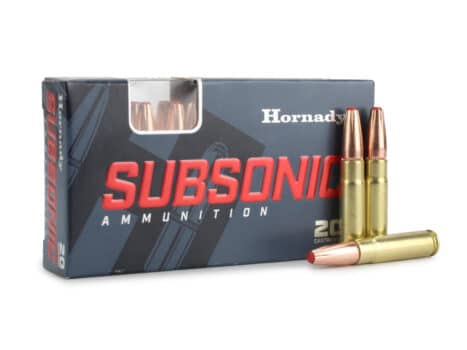
| Manufacturer | Hornady |
| Cartridge | 300 Blackout |
| Product Line | Subsonic |
| Bullet Name / Type | Sub-X expanding polymer-tip hollow point |
| Bullet Weight | 190 gr |
| SKU / Part Number | 80877 |
| UPC | Not found |
| Rounds per Box | 20 |
| Muzzle Velocity | 1050 fps |
| Muzzle Energy | 465 ft-lbs |
| Ballistic Coefficient G1 | Not found |
| Ballistic Coefficient G7 | Not found |
| Case Material | Not found |
| Primer | Not found |
| Reloadable | Not found |
| Test Barrel Length | 16 in |
| Zero Distance | 100 yd |
| Sight Height | Not found |
| Intended Use | Suppressed shooting and short-range expanding-bullet applications |
| Product Status | Current product listing verified |
| Closest Competitors | Remington Premier 300 BLK 220 gr OTM Subsonic, SIG Sauer Elite 300 BLK 220 gr OTM Subsonic, Fiocchi 300 BLK 220 gr OTM Subsonic, Barnes TAC-TX 300 BLK 110 gr Supersonic, Sellier & Bellot 300 BLK 200 gr FMJ Subsonic, Hornady BLACK 300 BLK 208 gr A-MAX |
Data is based on official manufacturer sources. Found an error? Send us the source link.
Manufacturer: Hornady. Exact official product pages and technical documents are recorded in the editorial verification log. Any retailer-listed field is labeled.
Ballistics Table
| Yards | Velocity (fps) | Energy (ft-lbs) | Trajectory (in) |
|---|---|---|---|
| Muzzle | 1050 | 465 | -1.5 |
| 100 | 998 | 420 | 0.0 |
| 200 | 955 | 384 | -33.4 |
| 300 | 918 | 355 | -104.6 |
| 400 | – | – | – |
| 500 | – | – | – |
Official-data note: Hornady publishes velocity, energy, and trajectory through 300 yards from a 16-inch test barrel with a 100-yard zero. Wind drift is not shown.
Key takeaway: Hornady lists item 80877 at 1050 fps and 465 ft-lbs. The Sub-X bullet is designed to expand at subsonic velocity.
Related 300 Blackout factory loads on Ammo Reports: Federal American Eagle 150 Gr FMJ, Sellier & Bellot 147 Gr FMJ, and Hornady Subsonic 190 Gr Sub-X.
The Sub-X Bullet: Why the Design Matters
The Hornady Sub-X projectile is not a conventional hunting or target bullet adapted for subsonic use — it was engineered specifically for the velocity range below the speed of sound. Standard expanding bullets often fail to reliably expand at subsonic velocities because they depend on hydraulic pressure generated at higher impact speeds. The Sub-X addresses this with a Flex Tip insert seated in the bullet’s hollow point cavity. On impact, the elastomeric tip is driven rearward into the lead core, initiating and sustaining expansion even at velocities in the 900–1,050 fps range.
The longitudinal grooves machined into the gilding metal jacket serve two functions: they reduce bearing surface contact with the bore (which can lower pressure and improve consistency at subsonic charge levels), and they act as predetermined fracture lines that guide the jacket’s petal formation during expansion. The result is a bullet designed to expand reliably, retain significant weight, and penetrate deeply — characteristics that matter most when terminal velocity is already limited by the subsonic constraint.
This design philosophy distinguishes the Sub-X from the open-tip match (OTM) bullets used by most competing subsonic 300 Blackout loads. OTM bullets are optimized for accuracy, not terminal performance, and their expansion behavior at subsonic velocities is inconsistent and largely incidental. Hunters selecting a suppressed 300 Blackout load specifically for taking game will find the Sub-X’s intentional terminal design more appropriate than a match bullet repurposed for the role.
Best Uses
Good fit:
- Suppressed hunting of deer, hogs, and similarly sized game inside 150–200 yards
- Tactical and home-defense applications where sound reduction is a priority and a suppressor is in use
- Range training with a suppressor where maintaining subsonic velocities is required for noise management
- Semi-automatic platforms (AR-15 with 300 BLK upper, pistol-length or rifle-length) configured for subsonic cycling
- Situations requiring a controlled-expansion bullet rather than a match-grade OTM in a subsonic role
Not the right tool for:
- Unsuppressed use — the subsonic load offers no meaningful noise advantage without a suppressor
- Long-range engagements beyond 200 yards, where the trajectory drop becomes difficult to manage and energy levels drop significantly
- Targets requiring deep penetration through heavy bone or barriers, where a heavier or harder projectile may be more appropriate
- Firearms with short barrels (under 9 inches) where cycling reliability with subsonic loads may be inconsistent without tuning
- Supersonic applications — this load is not designed to, and will not, exceed the speed of sound under standard conditions
Reliability Notes
No structured submissions yet.
Based on manufacturer claims and open-source user reports, the following observations are noted — these come from manufacturer documentation and publicly available discussion, not structured AmmoReports data:
- Hornady states this load is designed to function in semi-automatic platforms with standard 300 Blackout gas systems, though users on public forums report that some short-barreled pistol-length builds may require adjustable gas blocks for reliable cycling with subsonic loads generally
- The Flex Tip insert is reported by Hornady to initiate expansion consistently at velocities as low as subsonic impact speeds, though independent gel testing data from third-party sources varies by platform and distance
- Users who want Hornady’s 190 gr Sub-X expanding-bullet design at subsonic velocity
- No active recalls or safety notices were identified for this load at the time of publication
Competitors
This is the full comparison set preserved from the article’s existing competitor list. A link is added only when an exact Published review exists on Ammo Reports. Unverified competitor fields are labeled accordingly.
| Competitor | Bullet Type | Weight | Muzzle Velocity | Primary Use |
|---|---|---|---|---|
| Remington Premier 300 BLK 220 gr OTM Subsonic | Open Tip Match – Not verified | 220 gr – Not verified | Not verified | Not verified |
| SIG Sauer Elite 300 BLK 220 gr OTM Subsonic | Open Tip Match – Not verified | 220 gr – Not verified | Not verified | Not verified |
| Fiocchi 300 BLK 220 gr OTM Subsonic | Open Tip Match – Not verified | 220 gr – Not verified | Not verified | Not verified |
| Barnes TAC-TX 300 BLK 110 gr Supersonic | TAC-TX (lead-free) – Not verified | 110 gr – Not verified | Not verified | Not verified |
| Sellier & Bellot 300 BLK 200 gr FMJ Subsonic | FMJ – Not verified | 200 gr – Not verified | Not verified | Not verified |
| Hornady BLACK 300 BLK 208 gr A-MAX | A-MAX (OTM) – Not verified | 208 gr – Not verified | Not verified | Not verified |
Price Reality
Retail prices and availability change. Compare the current store listings below and verify SKU 80877 and the exact 20-round package before purchase. Price is not used to determine the technical data or editorial conclusion.
Where to Buy
Affiliate links. These do not influence ratings, data, or any editorial content on this page.
FAQ
What is the Hornady item number?
Hornady lists 80877.
What factory velocity is published?
Hornady lists 1,050 fps and 465 ft-lbs.
What is a Sub-X bullet?
It is a lead-core expanding bullet with a Flex Tip insert designed for subsonic impact velocities.
How many rounds are in a box?
Hornady lists 20 rounds.
What zero is used?
Hornady’s factory trajectory uses a 100-yard zero.