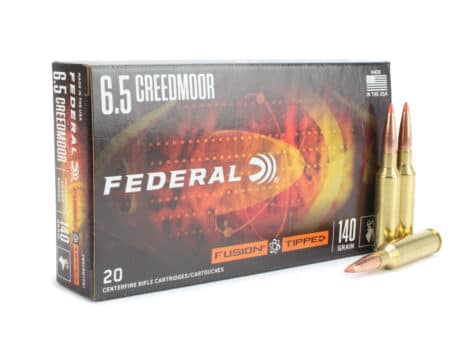
 Ammo Reports Team
| Official Spec | Value |
|---|---|
| Manufacturer | Federal Ammunition |
| Cartridge | 6.5 Creedmoor |
| Product Line | Fusion Tipped Rifle |
| Bullet Name / Bullet Type | Fusion Tipped |
| Bullet Weight | 140 gr |
| SKU / Part Number / Item Number | F65CRDTFS1 |
| UPC | 604544695250 |
| Rounds per Box | 20 |
| Muzzle Velocity | 2,715 fps |
| Muzzle Energy | 2,291 ft-lb |
| Ballistic Coefficient G1 | .529 |
| Ballistic Coefficient G7 | Not found |
| Case Material | Not found |
| Primer | Not found |
| Reloadable | Not found |
| Test Barrel Length | Not found |
| Zero Distance | 200 yd |
| Sight Height | 1.5 in |
| Intended Use | Big Game, Long Range |
| Product Status | Current – available |
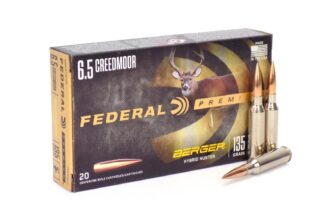
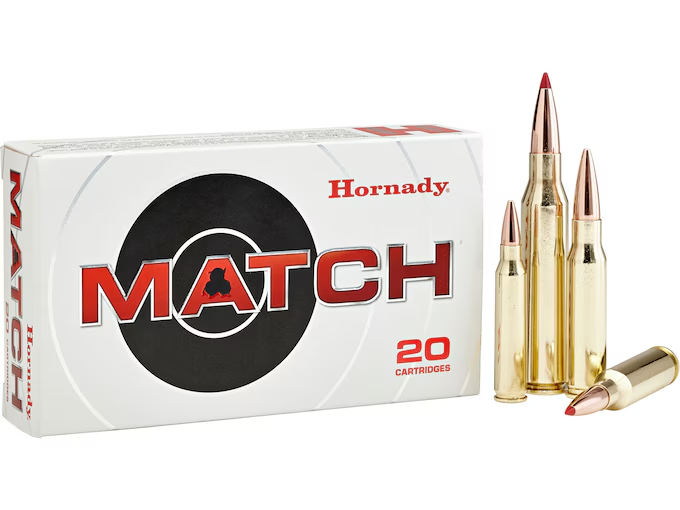
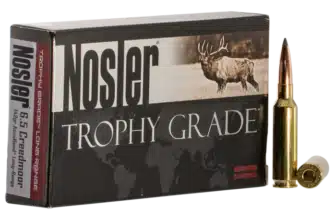
| Closest Competitors | Hornady Precision Hunter 6.5 Creedmoor 143 gr ELD-X; Federal Trophy Bonded Tip 6.5 Creedmoor 140 gr; Nosler Trophy Grade 6.5 Creedmoor 140 gr AccuBond; Winchester Deer Season XP Copper Impact 6.5 Creedmoor 125 gr; Remington Core-Lokt Tipped 6.5 Creedmoor 129 gr |
Data is based on official manufacturer sources. Found an error? Send us the source link.
Affiliate links. These do not influence ratings, data, or editorial content.
Ballistics
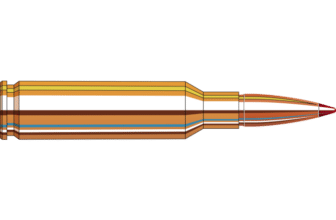
Federal Fusion Tipped combines the Fusion electro-chemical bonding process with a polymer tip and boat-tail profile. The 140 gr 6.5 Creedmoor load is intended for big-game and long-range hunting.
Source: Federal Ammunition published product and ballistic data. Wind drift is Federal’s published 10 mph crosswind value.
| Distance (yd) | Velocity (fps) | Energy (ft-lb) | 10 mph Wind Drift (in) |
|---|---|---|---|
| 0 | 2,715 | 2,291 | 0.0 |
| 100 | 2,546 | 2,015 | 0.6 |
| 200 | 2,383 | 1,765 | 2.5 |
| 300 | 2,226 | 1,541 | 6.1 |
| 400 | 2,076 | 1,339 | 11.3 |
| 500 | 1,930 | 1,158 | 18.0 |
Trajectory
Federal long-range trajectory data uses a 200-yard zero and a 1.5-inch sight height.
| Distance (yd) | Trajectory (in) |
|---|---|
| 50 | 0.8 |
| 100 | 1.9 |
| 200 | 0.0 |
| 300 | -8.1 |
| 400 | -23.3 |
| 500 | -46.2 |
Bullet Design and Intended Use
The polymer tip improves the ballistic profile and initiates expansion through a skived nose cavity. Federal bonds the copper jacket to the lead core to support weight retention and penetration.
Best Uses
Good fit:
- Deer and similar big game
- Long-range hunting
- Hunters who want a bonded 140 gr polymer-tipped load
Not the right tool for:
- Lead-free hunting zones
- Dedicated match competition
- High-volume practice
Reliability Notes
No structured AmmoReports submissions are available yet. Manufacturer specifications establish the baseline, but actual velocity and precision can vary with barrel length, firearm, ammunition lot, temperature, and other conditions.
Competitors
| Load | Weight | Bullet | BC G1 | Advertised Velocity | Notes |
|---|---|---|---|---|---|
| Hornady Precision Hunter 6.5 Creedmoor 143 gr ELD-X | 143 gr | ELD-X | .625 | 2,700 fps | Higher-BC hunting alternative |
| Federal Trophy Bonded Tip 6.5 Creedmoor 140 gr | 140 gr | Trophy Bonded Tip | .490 | 2,650 fps | Premium Federal bonded alternative |
| Nosler Trophy Grade 6.5 Creedmoor 140 gr AccuBond | 140 gr | AccuBond | .509 | 2,650 fps | Premium bonded alternative |
| Winchester Deer Season XP Copper Impact 6.5 Creedmoor 125 gr | 125 gr | Copper Impact | .430 | 2,850 fps | Lighter lead-free hunting alternative |
| Remington Core-Lokt Tipped 6.5 Creedmoor 129 gr | 129 gr | Core-Lokt Tipped | .458 | 2,850 fps | Lighter tipped hunting alternative |
FAQ
Does the bonded construction in the Federal Fusion Tipped actually matter for deer hunting, or is it marketing?
Bonding the jacket to the core prevents the two components from separating on impact, which matters most on angled shots, shoulder hits, or when the bullet must pass through heavy bone before reaching the vitals. On broadside lung shots at moderate velocity, a non-bonded cup-and-core bullet will often perform similarly. Where the bonded construction earns its cost is in edge cases — quartering-away shots at close range with high impact velocity, or longer shots where retained velocity is lower and expansion must still initiate reliably. For hunters who want one load that handles a variety of shot angles and distances, the bonded design provides a meaningful margin of reliability over standard cup-and-core bullets.
How does the Federal Fusion Tipped compare directly to the Hornady Precision Hunter 143gr ELD-X in 6.5 Creedmoor?
Both are polymer-tipped bonded hunting bullets in the same weight class, but the Hornady ELD-X uses a Heat Shield tip designed to resist aerodynamic deformation at high velocity and carries a published G1 BC of 0.625 — significantly higher than the Fusion Tipped’s 0.485 G1. In practical terms, the ELD-X will drift less in wind and drop less at 400–500 yards. The Fusion Tipped uses Federal’s electrochemical bonding process, which is a different but also proven approach to core-jacket integrity. The Hornady Precision Hunter also typically carries a lower street price. Hunters who already trust Federal’s Fusion line and have chronographed their specific rifle may prefer to stay with it; those who prioritize BC advantage and published ballistic data will find the ELD-X better supported.
Is the Federal Fusion Tipped 6.5 Creedmoor 140gr legal for hunting in California or other lead-free zones?
No. This is a lead-core bullet with a bonded construction — it retains lead and is not compliant with California’s Condor Zone lead-free regulations or similar restrictions in other jurisdictions. Hunters planning to use this load in areas with non-toxic ammunition requirements should look at copper or copper-alloy alternatives such as the Federal Trophy Copper, Barnes TTSX, or Hornady CX lines. Always verify current regulations with your state or provincial wildlife agency before the season, as lead-free zones continue to expand.
What game is this load appropriate for, and is it suitable for elk?
Federal positions the Fusion Tipped line as a deer-class hunting load, and it performs reliably on whitetail, mule deer, pronghorn, and similar animals. For elk, the 140gr bonded construction provides more penetration and mass retention than a non-bonded bullet of the same weight, which makes it a viable option at moderate ranges with careful shot placement. However, elk are substantially heavier and tougher than deer, and many experienced elk hunters prefer heavier bullets in the 143–156gr range or purpose-built loads that prioritize deep penetration over rapid expansion. The 6.5 Creedmoor cartridge itself is debated for elk; if you use it, the bonded construction in this load is the right direction, but range should be kept conservative and shot placement must be precise.
What muzzle velocity and ballistic coefficient does Federal publish for this load?
Federal publishes a muzzle velocity of 2700 fps from a 24-inch test barrel, with muzzle energy of 2266 ft-lbs. The published ballistic coefficients are G1: 0.485 and G7: 0.244. These figures are lower than match-grade projectiles in the same weight class (the Sierra MatchKing BTHP runs G7: 0.293), which reflects the design trade-off between a hunting-optimized bonded bullet and a pure aerodynamic match projectile. Hunters wanting to build a precise long-range firing solution should input the published G7 BC and their chronographed muzzle velocity into a ballistic solver, keeping in mind that real-world velocity from shorter hunting barrels (20–22″) will typically run 40–80 fps below the 24-inch test barrel figure.
Submit Your Data · Real-World Results
Manufacturer velocity figures are measured under controlled lab conditions — barrel length, temperature, and lot number all affect real-world performance. The data below comes from community submissions tied to specific test conditions and reviewed before publishing.
Once this page reaches 3 approved submissions, aggregate velocity and confidence level will appear here automatically.
| UPC # | Firearm | Barrel (in) | Avg Velocity (fps) | Shots | Temp (°F) | Chronograph | Lot | Notes |
|---|---|---|---|---|---|---|---|---|
| 604544624793 | — | — | — | — | — | — | — | No data yet |
Shot this load? Share your results — firearm type, barrel length, average velocity, shots fired, temperature. No account required.
All submissions are manually reviewed before appearing on this page.
You need to login first.Results vary by firearm, barrel condition, ammunition lot, and environmental factors. Submitted data is for reference only. AmmoReports does not guarantee accuracy of user-submitted results.