
 Ammo Reports Team
| Official Spec | Value |
|---|---|
| Manufacturer | Federal Ammunition |
| Cartridge | 6.5 Creedmoor |
| Product Line | Trophy Copper |
| Bullet Name / Bullet Type | Trophy Copper |
| Bullet Weight | 120 gr |
| SKU / Part Number / Item Number | P65CRDTC1 |
| UPC | 604544623987 |
| Rounds per Box | 20 |
| Muzzle Velocity | 2,875 fps |
| Muzzle Energy | 2,202 ft-lb |
| Ballistic Coefficient G1 | 0.497 |
| Ballistic Coefficient G7 | Not found |
| Case Material | Not found |
| Primer | Not found |
| Reloadable | Not found |
| Test Barrel Length | Not found |
| Zero Distance | 200 yd |
| Sight Height | 1.5 in |
| Intended Use | Big Game; Long Range |
| Product Status | Current |
| Closest Competitors | Hornady Superformance 6.5 Creedmoor 120 gr GMX; Barnes Vor-Tx 6.5 Creedmoor 127 gr LRX Boat-Tail; Federal Premium 6.5 Creedmoor 140 gr Terminal Ascent; Nosler Trophy Grade 6.5 Creedmoor 120 gr E-Tip; Remington Core-Lokt 6.5 Creedmoor 129 gr; Sig Sauer Elite Hunter 6.5 Creedmoor 130 gr |
Data is based on official manufacturer sources. Found an error? Send us the source link.
Product identity and ballistics were verified against Federal’s current exact-SKU product data. UPC was confirmed through an exact-SKU retail listing.
Affiliate links. These do not influence ratings, data, or editorial content on this page.
Official Ballistics
Federal publishes velocity, energy, and 10 mph crosswind drift for this exact load at 100-yard intervals. These are manufacturer-published values.
| Distance (yd) | Velocity (fps) | Energy (ft-lb) | 10 mph Wind Drift (in) |
|---|---|---|---|
| 0 | 2,875 | 2,202 | 0.0 |
| 100 | 2,689 | 1,926 | 0.7 |
| 200 | 2,510 | 1,679 | 2.6 |
| 300 | 2,338 | 1,457 | 6.0 |
| 400 | 2,174 | 1,259 | 11.1 |
| 500 | 2,015 | 1,082 | 17.9 |
Official Long-Range Trajectory
Federal’s long-range trajectory uses a 200-yard zero and sights 1.5 inches above the bore.
| Distance (yd) | Trajectory (in) |
|---|---|
| 50 | +0.6 |
| 100 | +1.7 |
| 200 | 0.0 |
| 300 | -7.1 |
| 400 | -20.8 |
| 500 | -41.6 |
Product Overview
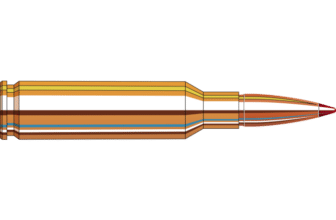
Federal Trophy Copper uses a one-piece copper, polymer-tipped boat-tail bullet. Federal states that the bullet can retain up to 99 percent of its weight and is designed for aggressive expansion and deep penetration on medium and big game.
Best Uses
- Lead-free hunting where local regulations require nonlead ammunition
- Deer, pronghorn, and similar game
- Hunters who want a 120 gr copper bullet with a published 200-yard-zero trajectory
Reliability Notes
- The official muzzle velocity is 2,875 fps and the current published G1 BC is 0.497.
- Copper bullets can produce a different point of impact than conventional lead-core loads; verify zero before hunting.
- The official wind and trajectory values should be treated as factory references and confirmed in the individual rifle.
Competitors
| Load | Bullet | Comparison |
|---|---|---|
| Hornady Superformance 6.5 Creedmoor 120 gr GMX | 120 gr GMX | Lead-free same-weight alternative |
| Barnes Vor-Tx 6.5 Creedmoor 127 gr LRX Boat-Tail | 127 gr LRX | Lead-free long-range alternative |
| Federal Premium 6.5 Creedmoor 140 gr Terminal Ascent | 140 gr Terminal Ascent | Heavier bonded hunting alternative |
| Nosler Trophy Grade 6.5 Creedmoor 120 gr E-Tip | 120 gr E-Tip | Lead-free same-weight alternative |
| Remington Core-Lokt 6.5 Creedmoor 129 gr | 129 gr Core-Lokt | Lead-core hunting alternative |
| Sig Sauer Elite Hunter 6.5 Creedmoor 130 gr | 130 gr copper hollow point | Lead-free hunting alternative |
FAQ
Is the Federal Premium Trophy Copper actually lead-free, and does that matter for my hunt?
Yes, the Trophy Copper bullet is constructed entirely from a copper alloy with no lead core, making it fully compliant with California’s Condor Zone regulations and any other jurisdiction that mandates or recommends non-toxic projectiles for hunting. If you hunt in California, certain national parks, or states with expanding lead restrictions, this distinction is legally significant — using a lead-core bullet in a restricted zone can result in fines or license revocation. Even outside restricted areas, some hunters choose lead-free ammunition to reduce environmental lead deposition at gut-pile sites. The compliance benefit comes at a cost premium over standard lead-core loads, which is worth factoring into your decision if lead restrictions do not apply to your hunting area.
How does the 120 grain Trophy Copper compare to the Federal 140 grain Terminal Ascent for deer hunting?
The two loads represent different design philosophies within Federal’s Premium line. The 120 grain Trophy Copper is lighter, likely faster, and fully lead-free — making it the correct choice when lead restrictions apply. The 140 grain Terminal Ascent uses a bonded lead-core bullet with a significantly higher ballistic coefficient, which provides better wind resistance and retained velocity at extended ranges beyond 400 yards. For most deer hunting inside 350 yards, the performance difference is unlikely to be decisive. If you hunt open country where 400–600 yard shots are realistic, the Terminal Ascent’s higher BC provides a measurable advantage. If you need lead-free compliance or prefer a lighter, faster load, the Trophy Copper is the appropriate selection.
Will the Trophy Copper bullet cause excessive copper fouling in my barrel?
Copper solid bullets do leave more bore fouling than lead-core jacketed bullets, and this is a known characteristic of the design rather than a defect. The fouling typically appears as a blue-green deposit visible on a patch when cleaning. Standard bore solvents may not fully remove copper fouling — a dedicated copper solvent (such as products containing ammonia or synthetic copper chelators) is recommended after shooting copper solids. Some shooters also note that groups tighten slightly after the first few rounds as the bore establishes a consistent fouling baseline. This is not a reliability concern but does require a modest adjustment to your cleaning routine compared to lead-core ammunition.
What game animals is the 120 grain Trophy Copper appropriate for?
Federal designed the Trophy Copper line for medium to large North American big game. At 120 grains in 6.5 Creedmoor, the load is well-suited to whitetail deer, mule deer, pronghorn, and black bear at reasonable hunting distances. For elk and similar large, heavy-bodied animals, the 120 grain weight is on the lighter end — shot placement becomes more critical, and shots should ideally be taken within 300 yards to ensure adequate terminal energy. Hunters targeting elk or moose regularly would be better served by a heavier 6.5 Creedmoor load with greater sectional density. The Trophy Copper’s high weight retention does help compensate for the lighter bullet weight on larger animals, but it does not eliminate the physics of reduced momentum.
How does the Trophy Copper differ from the Barnes LRX, which is also a lead-free copper bullet for 6.5 Creedmoor?
Both the Trophy Copper and the Barnes LRX are lead-free copper solid bullets with polymer tips and boat-tail bases, and both are designed for controlled expansion and high weight retention on big game. The primary differences are in bullet geometry and published ballistic data. The Barnes LRX in 6.5 Creedmoor is offered at 127 grains — 7 grains heavier — with a published G1 BC of approximately 0.468, which is generally higher than what would be expected for the 120 grain Trophy Copper based on its design profile. The heavier Barnes bullet offers marginally better wind resistance at long range. The Federal Trophy Copper, loaded by Federal with their proprietary primer and propellant combination, may offer a slight velocity advantage at the muzzle due to the lighter bullet. Both are legitimate choices; the decision often comes down to which performs best in your specific rifle’s chamber and twist rate.
Submit Your Data · Real-World Results
Manufacturer velocity figures are measured under controlled lab conditions – barrel length, temperature, and lot number all affect real-world performance. The data below comes from community submissions tied to specific test conditions and reviewed before publishing.
Once this page reaches 3 approved submissions, aggregate velocity and confidence level will appear here automatically.
You need to login first.Results vary by firearm, barrel condition, ammunition lot, and environmental factors. Submitted data is for reference only. Ammo Reports does not guarantee accuracy of user-submitted results.