 Ammo Reports Team
| Official Spec | Value |
|---|---|
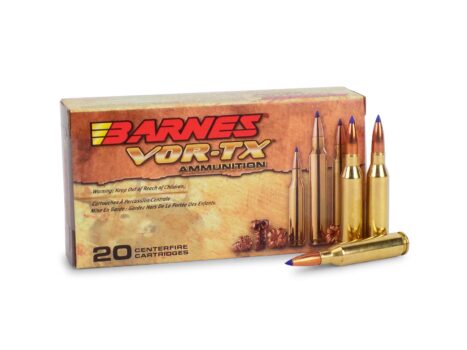
| Manufacturer | Barnes |
| Cartridge | 260 Remington |
| Product Line | VOR-TX Rifle |
| Bullet Name / Bullet Type | TTSX BT – tipped monolithic copper boat tail |
| Bullet Weight | 120 gr |
| SKU / Part Number / Item Number | 22010 |
| UPC | 716876026012 |
| Rounds per Box | 20 |
| Muzzle Velocity | 2,950 fps |
| Muzzle Energy | 2,319 ft-lbs |
| Ballistic Coefficient G1 | 0.412 |
| Ballistic Coefficient G7 | Not found |
| Case Material | Brass – retailer-listed |
| Primer | Boxer – retailer-listed |
| Reloadable | Yes – retailer-listed |
| Test Barrel Length | 24″ |
| Zero Distance | 200 yards |
| Sight Height | 1.5″ |
| Intended Use | Big game hunting; lead-free hunting |
| Product Status | Current |
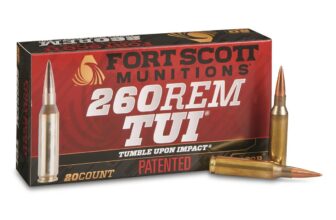
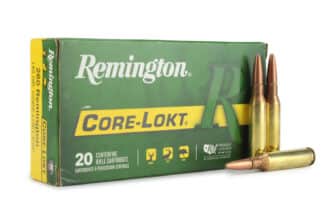
| Closest Competitors | Federal Premium 260 Rem 120 gr Trophy Copper, Hornady Precision Hunter 260 Rem 143 gr ELD-X, Nosler Trophy Grade 260 Rem 125 gr Partition, Nosler Trophy Grade 260 Rem 130 gr AccuBond, Winchester Deer Season XP 260 Rem 125 gr |
Data is based on official manufacturer sources. Found an error? Send us the source link.
Official Ballistics
Official Barnes ballistics for SKU 22010. Zero: 200 yards. Sight height: 1.5 inches. Barnes does not publish wind drift for this table, so no wind column is included.
| Yards | Velocity (fps) | Energy (ft-lbs) | Trajectory (in) |
|---|---|---|---|
| 0 | 2,950 | 2,319 | -1.5 |
| 100 | 2,723 | 1,976 | +1.6 |
| 200 | 2,506 | 1,674 | 0 |
| 300 | 2,300 | 1,410 | -7.1 |
| 400 | 2,104 | 1,180 | -20.9 |
| 500 | 1,918 | 980 | -42.5 |
The Barnes TTSX BT — Construction and Terminal Behavior
The TTSX (Tipped Triple-Shock X) is an evolution of Barnes’s original Triple-Shock X bullet. There is no lead core — the bullet is turned from a single piece of copper alloy, which eliminates core-jacket separation. Key design elements:
Polymer tip: initiates expansion reliably at a wider range of impact velocities than the open-tip TSX, including reduced-velocity long-range impacts. Slightly improves BC vs the hollow-point TSX version. Four-petal expansion: on impact the tip drives rearward into the nose cavity, causing four copper petals to peel back uniformly. Barnes reports ~99%+ weight retention in terminal tests — the monolithic construction stays in one piece. Pressure-reducing grooves: multiple grooves cut into the shank reduce bearing surface contact with the bore, managing pressure within SAAMI limits while allowing higher velocity.
Because there is no lead, this load is California-compliant and meets all other non-toxic hunting regulations. This is one of the most practical reasons to choose this load over conventional alternatives in California or other lead-restricted jurisdictions.
Best Uses
Good fit:
- Deer, pronghorn, and black bear at ranges from close brush to 350 yards where the TTSX BT’s deep penetration and near-100% weight retention deliver reliable performance
- California hunting and any other jurisdiction with lead-free ammunition requirements — fully non-toxic
- Hunters who prioritize deep penetration and high retained weight over wide surface expansion — the monolithic design retains mass and penetrates through bone
- Elk at moderate ranges (inside 300 yards) where the 260 Remington’s recoil profile and deep penetration are both appropriate
- Reloaders who want quality first-fire Barnes brass cases for subsequent handloads
Not the right tool for:
- Varmint or predator hunting where rapid fragmentation is preferred — monolithic construction retains mass and does not fragment
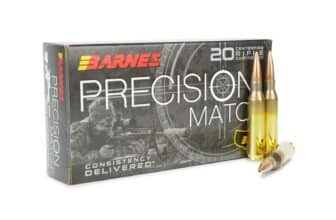
- Extended range beyond 400 yards where the BC of 0.412 produces more drop and wind drift than higher-BC alternatives like the Hornady ELD-X (0.625) or Barnes Precision Match OTM (0.586)
Reliability Notes
No structured submissions yet.
Barnes describes the VOR-TX line as loaded to consistent standards using TTSX bullets — the same projectiles Barnes sells as standalone components. Barnes claims ~99%+ weight retention and reliable four-petal expansion. Open-source hunter accounts on forums describe the 260 Remington TTSX performing well on deer-sized game with clean pass-throughs at standard hunting ranges. Some users note that all-copper monolithic bullets occasionally require seating depth or load adjustment for accuracy in specific rifles — a general characteristic of the design, not a documented issue with this factory load. All notes reflect manufacturer claims and open-source community observations, not structured data.
Competitors
The full comparison set is preserved. Exact published AmmoReports reviews are linked where available; unverified competitor specifications are not presented as official data.
| Load | Weight | Bullet | BC G1 | Advertised Velocity | Notes |
|---|---|---|---|---|---|
| Federal Premium 260 Rem 120 gr Trophy Copper | 120 gr | Trophy Copper | Not verified | Not verified | Lead-free monolithic hunting alternative |
| Hornady Precision Hunter 260 Rem 143 gr ELD-X | 143 gr | ELD-X | Not verified | Not verified | Heavier lead-core hunting alternative |
| Nosler Trophy Grade 260 Rem 125 gr Partition | 125 gr | Partition | Not verified | Not verified | Controlled-expansion lead-core alternative |
| Nosler Trophy Grade 260 Rem 130 gr AccuBond | 130 gr | AccuBond | Not verified | Not verified | Bonded lead-core hunting alternative |
| Winchester Deer Season XP 260 Rem 125 gr | 125 gr | Extreme Point | Not verified | Not verified | Tipped lead-core hunting alternative |
FAQ
Is this load California-legal for hunting?
Yes. The TTSX bullet is constructed entirely from copper with no lead core, qualifying as non-lead ammunition under California’s statewide non-lead hunting requirement. Hunters in California pursuing deer, elk, pronghorn, or other game should verify current California DFW regulations, but the all-copper monolithic construction is the design feature that makes this load compliant.
How does the TTSX differ from the standard TSX?
The Tipped TSX (TTSX) adds a polymer tip to the open cavity of the standard TSX. For hunting buyers, this matters in two ways: the tip initiates expansion more reliably at lower impact velocities (relevant at longer ranges), and it slightly improves the BC. The underlying monolithic copper construction, four-petal expansion, and ~99% weight retention are identical. For hunting applications where shot distance may vary, the TTSX is generally preferred over the TSX.
Is 120 gr optimal for 260 Remington or would 140 gr be better?
Both work effectively. The 120 gr TTSX exits at higher velocity (2,950 fps vs ~2,700 fps for typical 140 gr loads) with a flatter trajectory at moderate ranges — an advantage where precise range estimation is difficult. Heavier 140–143 gr bullets carry higher BCs, which improves wind resistance and retained energy at extended range. For deer and pronghorn inside 350 yards, the 120 gr TTSX excels. For elk at longer ranges or consistently windy conditions, a heavier, higher-BC load may be more appropriate.
How does this compare to the Federal Trophy Copper 260 Rem 120 gr?
Both are lead-free monolithic copper bullets with polymer tips at the same weight and velocity class. Federal Trophy Copper uses Federal’s own copper projectile rather than the Barnes TTSX — both deliver controlled expansion and high weight retention. Terminal performance on game is likely similar in practice. The meaningful differences are brand ecosystem (Barnes’s TTSX has a longer documented track record) and current pricing, which fluctuates. Rifle-specific accuracy is often the deciding factor.
Can the brass cases be reloaded?
Yes. The brass cases use standard Boxer primers and are fully reloadable. Given the premium price of the factory load, recovering cases for subsequent handloads with Barnes TTSX component bullets is a practical consideration. This page covers factory ammunition only and does not provide reloading data — consult Barnes’s published reloading manual for load data specific to the all-copper TTSX design, which typically requires different data than lead-core bullets of the same weight.
Submit Your Data · Real-World Results
Manufacturer velocity figures are measured under controlled lab conditions — barrel length, temperature, and lot number all affect real-world performance. The data below comes from community submissions tied to specific test conditions and reviewed before publishing.
Once this page reaches 3 approved submissions, aggregate velocity and confidence level will appear here automatically.
| UPC # | Firearm | Barrel (in) | Avg Velocity (fps) | Shots | Temp (°F) | Chronograph | Lot | Notes |
|---|---|---|---|---|---|---|---|---|
| 716876026012 | — | — | — | — | — | — | — | No data yet |
Shot this load? Share your results — firearm type, barrel length, average velocity, shots fired, temperature. No account required.
All submissions are manually reviewed before appearing on this page.
You need to login first.Results vary by firearm, barrel condition, ammunition lot, and environmental factors. Submitted data is for reference only. AmmoReports does not guarantee accuracy of user-submitted results.