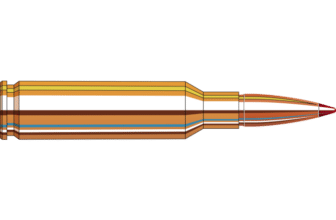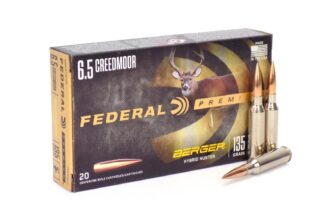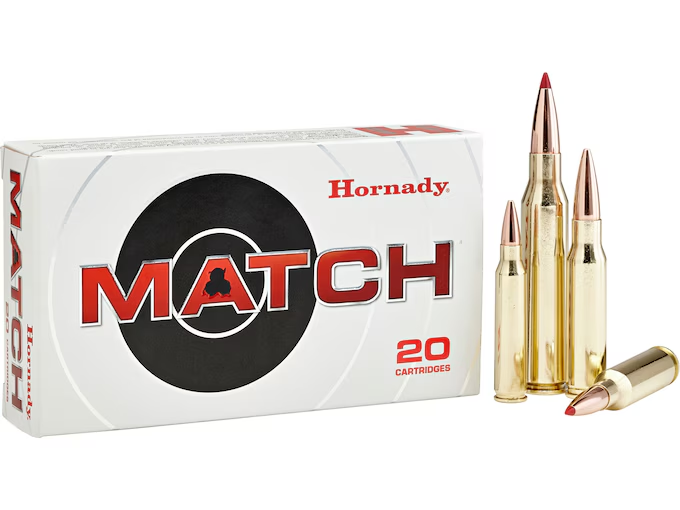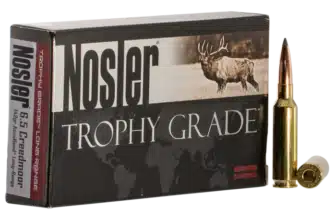
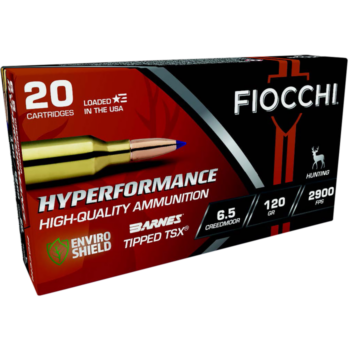
Fiocchi Hyperformance 6.5 Creedmoor 120 gr Barnes Tipped TSX
| Primary Use | Big game hunting · Lead-free hunting |
| Bullet Type | Barnes Tipped TSX — All-Copper Monolithic Polymer Tip |
| Bullet Weight | 120 gr |
| Case | Brass (reloadable) |
| Primer | Boxer |
| Packaging | 20 rounds per box |
| Typical Price | ~$54–58 / box (~$2.75–2.90 per round) |
| Closest Competitors | Barnes Vor-Tx 6.5 CM 120 gr TTSX · Hornady Outfitter 6.5 CM 120 gr CX · Federal Premium 6.5 CM 130 gr Terminal Ascent |
Official Specs
| Spec | Value | Source |
|---|---|---|
| Muzzle Velocity | 2,900 fps | Fiocchi / Ammunition Depot |
| Muzzle Energy | 2,241 ft-lbs | Calculated (not published by manufacturer) |
| Bullet Weight | 120 gr | Fiocchi / Barnes |
| Bullet Type | Barnes Tipped TSX (TTSX) — all-copper monolithic | Barnes Bullets |
| BC (G1) | ~0.453 | Barnes Bullets published data |
| BC (G7) | ~0.228 | Barnes Bullets published data |
| Manufacturer SKU | 65CMTTSX | Fiocchi |
| UPC | 762344713779 | — |
| Reloadable | Yes | Brass, Boxer-primed |
Muzzle energy note: Fiocchi does not publish muzzle energy for this load. The 2,241 ft-lbs figure is calculated from the published 2,900 fps muzzle velocity and 120 gr bullet weight. Community submissions will provide independently measured velocity data.
Ballistics Table
Calculated. Zero: 100 yards. Sight height: 1.5″ above bore. BC (G1): 0.453 (Barnes TTSX 120 gr, published).
Calculated from Barnes published BC. Real-world results vary by barrel length, temperature, altitude, and lot.
| Yards | Velocity (fps) | Energy (ft-lbs) | Trajectory (in) |
|---|---|---|---|
| 0 | 2,900 | 2,241 | +1.5 |
| 100 | 2,720 | 1,971 | 0.0 ← zero |
| 200 | 2,551 | 1,734 | -6.5 |
| 300 | 2,393 | 1,525 | -19.0 |
| 400 | 2,244 | 1,342 | -38.6 |
| 500 | 2,105 | 1,181 | -66.7 |
Key takeaway: at 2,900 fps this is one of the fastest factory 6.5 Creedmoor loads available. The lighter 120 gr bullet trades some long-range BC efficiency against the 140 gr class for a flatter near-range trajectory — at 200 yards only 6.5 inches of drop from a 100-yard zero. At 500 yards the load retains 1,181 ft-lbs, comfortably above the minimum threshold for ethical hunting of deer-sized game.
The Barnes Tipped TSX Bullet
The Barnes TTSX (Tipped Triple-Shock X) is an evolution of Barnes’ original TSX design — an all-copper monolithic hollow point with a red polymer tip inserted into the cavity. The all-copper construction is the defining feature:
- Lead-free construction — fully non-toxic, compliant with California hunting regulations and all lead-free mandates
- Monolithic design — no separate core and jacket to separate on impact; the bullet stays in one piece
- Double-diameter expansion — the hollow point expands to approximately twice the original diameter on impact, creating a large wound channel
- Exceptional weight retention — Barnes publishes 95–99% weight retention on recovered bullets; virtually all the bullet’s mass transfers energy to the target
- Polymer tip — initiates expansion reliably at a range of impact velocities; the “Tipped” upgrade over the original TSX improves long-range terminal performance
The result is a bullet that performs consistently across a wide range of impact velocities — from close-range high-velocity impacts to longer-range reduced-velocity hits where lead-core bullets sometimes fail to expand reliably.
Variants
This page covers Fiocchi Hyperformance 65CMTTSX · 6.5 Creedmoor · 120 gr Barnes TTSX only.
Barnes itself loads the same TTSX bullet in their own Vor-Tx line — see that report page for a direct comparison. Fiocchi’s Hyperformance line positions this as their premium hunting offering, using Barnes projectiles paired with Fiocchi’s Italian-made brass and propellant.
Best Uses
Good fit:
- Deer, mule deer, and pronghorn hunting at ranges up to 400 yards where flat trajectory and reliable expansion are both priorities
- California hunting and other lead-restricted jurisdictions — the all-copper TTSX is fully lead-free and compliant with California DFW nonlead regulations
- Elk hunting inside 300 yards — the 120 gr TTSX at 2,900 fps generates sufficient energy and the monolithic construction handles heavy bone reliably
- Hunters who prioritize weight retention and penetration over explosive fragmentation
- Shooters who want Barnes TTSX performance without buying Barnes-branded ammunition
Not the right tool for:
- Precision/match shooting — the TTSX is a hunting bullet; BC and consistency are optimized for terminal performance, not group size
- Varmint hunting — at $2.80/round this is far too expensive for volume varmint use
- Lead-core hunting loads in non-restricted areas where cost matters — functionally excellent alternatives exist at half the price
- Self-defense — not designed or rated for it
Reliability Notes
No structured submissions yet. General notes from open sources:
- Barnes TTSX has an extensive field record across North American big game — the all-copper monolithic design is used by professional guides and outfitters who need consistent performance on a wide variety of game and shot angles
- Fiocchi’s Italian brass is produced at their facility in Lecco, Italy and is well-regarded for consistent dimensions; the Hyperformance line represents their premium selection within that production
- All-copper bullets can produce higher chamber pressures than lead-core designs of the same weight due to the harder material — Fiocchi’s published velocity of 2,900 fps accounts for this in their load development; no reports of over-pressure issues in standard 6.5 Creedmoor chambers
- The polymer tip on TTSX initiates expansion at lower impact velocities than the original TSX, which is a practical advantage at longer ranges where velocity has dropped
Competitors
| Load | Weight | Bullet | BC (G1) | Adv. Velocity | Lead-Free | Price / box | Notes |
|---|---|---|---|---|---|---|---|
| Barnes Vor-Tx 6.5 CM 120 gr TTSX | 120 gr | Barnes TTSX | ~0.453 | 2,910 fps | ✓ | ~$56–62 | Identical bullet, Barnes own load — direct comparison |
| Hornady Outfitter 6.5 CM 120 gr CX | 120 gr | CX (copper) | ~0.458 | 2,910 fps | ✓ | ~$48–52 | Hornady’s monolithic copper — slightly cheaper |
| Federal Premium 6.5 CM 130 gr Terminal Ascent | 130 gr | Terminal Ascent | ~0.532 | 2,800 fps | ✗ | ~$62–68 | Bonded, higher BC, lead-core |
| Nosler Trophy Grade 6.5 CM 142 gr AccuBond LR | 142 gr | AccuBond LR | ~0.625 | 2,700 fps | ✗ | ~$67–72 | Heavier, bonded, lead-core, longer range |
| Winchester Power-Point 6.5 CM 140 gr SP | 140 gr | Power-Point SP | ~0.480 | 2,730 fps | ✗ | ~$34–50 | Lead-core, significantly cheaper |
Price Reality
- Typical retail range: $54–58 per box of 20 (~$2.75–2.90/round)
- vs. Barnes Vor-Tx (identical bullet): Barnes’ own TTSX load runs $2–6/box more — Fiocchi offers the same projectile at a slight discount
- vs. Hornady Outfitter CX: Hornady’s copper option is ~$5–8/box cheaper and uses a comparable monolithic design; the practical performance difference at hunting distances is minimal
- Lead-free premium: expect to pay $20–30/box more than equivalent lead-core hunting loads — this is consistent across all lead-free hunting ammunition categories
- Fair price benchmark: under $56/box is competitive for Barnes TTSX factory loads; above $62/box without supply constraints is overpriced
Where to Buy
Affiliate links. These do not influence ratings, data, or any editorial content on this page.
- MidwayUSA — add link
- Brownells — add link
- Palmetto State Armory — add link
- Natchez Shooters Supplies — add link
FAQ
What makes the Barnes TTSX different from a standard copper bullet?
The Barnes TTSX is a monolithic hollow point — the entire bullet is made from a single piece of copper alloy, with no separate lead core. On impact, the hollow point opens into four petals that fold back, creating a wound channel approximately double the original bullet diameter. The petals remain attached, keeping the bullet in one piece. This is fundamentally different from jacketed lead-core bullets where the jacket can separate from the core and the core can fragment. The result is 95–99% weight retention and consistent penetration regardless of whether the bullet hits bone or soft tissue first.
Is this load California-legal for hunting?
Yes. The Barnes TTSX is an all-copper, lead-free bullet with no lead core or lead components. It fully qualifies as nonlead ammunition under California’s nonlead hunting regulation, which requires lead-free ammunition for all licensed hunting statewide. Always verify current California DFW requirements before your hunt as regulations can change.
Fiocchi vs Barnes Vor-Tx — same TTSX bullet, which should I buy?
The projectile is identical — both use the Barnes 120 gr TTSX in 6.5 Creedmoor. The difference is the brass and powder. Fiocchi uses Italian-made brass; Barnes uses domestic US brass. Barnes’ own Vor-Tx typically runs $2–6/box more than Fiocchi’s Hyperformance. For most hunters, the practical difference in field performance is negligible. Fiocchi offers a slight cost advantage for the same terminal performance.
Is 120 gr heavy enough for elk in 6.5 Creedmoor?
At 2,900 fps the 120 gr TTSX generates over 2,200 ft-lbs at the muzzle and retains approximately 1,525 ft-lbs at 300 yards. Combined with the monolithic construction’s deep penetration and reliable expansion on heavy bone, this load is capable on elk inside 300 yards with proper shot placement. Beyond 300 yards on elk, the 140 gr class with higher BC and more retained energy is the more conservative choice. The TTSX’s penetration on heavy game is its key strength — the all-copper bullet handles shoulder shots that would cause lead-core bullets to fragment prematurely.
Why is all-copper ammunition more expensive?
Copper is more expensive than lead as a raw material, and monolithic bullet manufacturing requires more precise machining than forming a jacket around a poured lead core. The tooling and production process for consistent monolithic bullets is more complex. Additionally, lead-free hunting loads represent a smaller market segment than standard ammunition, so production volumes are lower — reducing economies of scale. The premium over lead-core loads typically runs 40–60% per round across all calibers.
Submit Your Data · Real-World Results
Manufacturer velocity figures are measured under controlled lab conditions — barrel length, temperature, and lot number all affect real-world performance. The data below comes from community submissions tied to specific test conditions and reviewed before
publishing.
Once this page reaches 3 approved submissions, aggregate velocity
and confidence level will appear here automatically.
| UPC # | Firearm | Barrel (in) | Avg Velocity (fps) | Shots | Temp (°F) | Chronograph | Lot | Notes |
|---|---|---|---|---|---|---|---|---|
Shot this load? Share your results — firearm type, barrel length, average velocity, shots fired, temperature. No account required.
All submissions are manually reviewed before appearing on this page.
You need to login first.
Results vary by firearm, barrel condition, ammunition lot, and environmental factors.
Submitted data is for reference only.
AmmoReports does not guarantee accuracy of user-submitted results.
Last updated: April 2026 · Data confidence: Low (0 submissions) ·