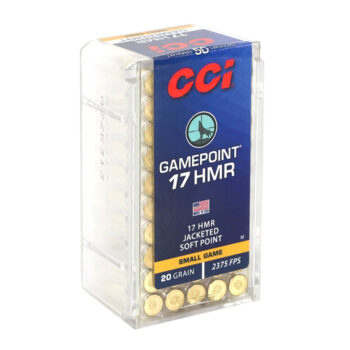
 Ammo Reports Team
At a Glance
| Feature | Details |
|---|---|
| Manufacturer | CCI |
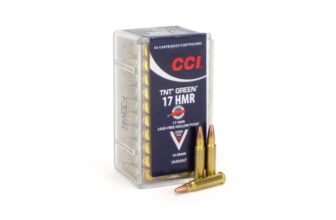
| Cartridge | 17 HMR |
| Product Line | Gamepoint |
| Primary Use | Small game hunting |
| Bullet Type | Jacketed Soft Point with Dimple-Tip |
| Bullet Weight | 20 gr |
| Case | Brass (rimfire – action-length class not applicable) |
| Primer | Rimfire – neither Boxer nor Berdan |
| Packaging | 50 rounds per box |
| Typical Price | ~$14–16 / box (~$0.28–0.30 per round) |
| Closest Competitors | 17 HMR – Remington Magnum Rimfire 20 gr JSP · Hornady Varmint Express 17 HMR 20 gr XTP · Winchester Super-X 17 HMR 20 gr XTP |
Official Specs
Verified manufacturer specifications for this exact factory load. Missing values were not calculated.
| Spec | Value | Source |
|---|---|---|
| Muzzle Velocity | 2,375 fps | Current CCI manufacturer data |
| Muzzle Energy | 250 ft-lbs | Current CCI manufacturer data |
| Bullet Weight | 20 gr | Current CCI manufacturer data |
| Bullet Type | Jacketed Soft Point with Dimple-Tip | Current CCI manufacturer data |
| BC G1 | .125 | Current CCI manufacturer data |
| BC G7 | — | Not found in verified official manufacturer sources |
| Manufacturer SKU | 0052 | Current CCI manufacturer data |
| UPC | 076683000521 | Current CCI manufacturer data |
| Case Material | Brass | Current CCI manufacturer data |
| Primer | Rimfire – neither Boxer nor Berdan | Rimfire cartridge design |
| Reloadable | No – not conventionally reloadable | Rimfire cartridge design |
Not verified: G7 BC, test barrel length. These fields remain blank where applicable.
Ballistics Table
Official CCI data. 100-yard zero, 1.5-inch sight height. CCI also publishes a 75-yard row; this table follows the requested 50-yard spacing. Blank cells were not published.
| Distance (yd) | Velocity (fps) | Energy (ft-lbs) | Trajectory (in) | 10 mph Wind Drift (in) |
|---|---|---|---|---|
| 0 | 2375 | 250 | — | — |
| 50 | 2051 | 187 | 0.3 | — |
| 100 | 1754 | 137 | 0 | — |
| 150 | — | — | — | — |
| 200 | — | — | — | — |
| 250 | — | — | — | — |
| 300 | — | — | — | — |
Variants
This page covers only CCI Gamepoint 17 HMR 20 gr Jacketed Soft Point with Dimple-Tip, SKU 0052. Different bullet weights, bullet designs, product lines, or SKUs are separate factory loads.
Best Uses
- Manufacturer-designated fit: Small game hunting.
- Lead restrictions: This load is not identified here as a lead-free option.
- Firearm fit: Use only in a firearm correctly marked for 17 HMR and follow the firearm maker’s ammunition guidance.
Reliability Notes
AmmoReports has no approved structured field submissions for this exact SKU yet. Manufacturer figures above are controlled test data; actual results can vary by firearm, barrel, lot, and conditions. For semi-automatic firearms, follow the ammunition and firearm manufacturers’ current instructions.
Competitors
| Published AmmoReports Load | Weight | Bullet | Official Muzzle Velocity | Relationship |
|---|---|---|---|---|
| 17 HMR – Remington Magnum Rimfire 20 gr JSP | 20 gr | Jacketed Soft Point | 2,375 fps | Different factory load – compare in the same rifle |
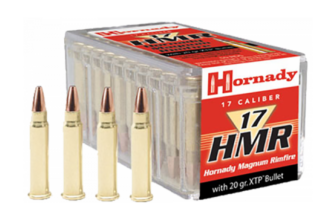
| Hornady Varmint Express 17 HMR 20 gr XTP | 20 gr | XTP Jacketed Hollow Point | 2,375 fps | Different factory load – compare in the same rifle |
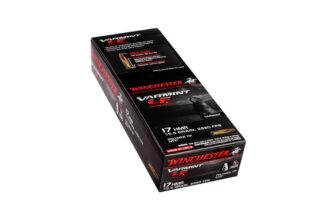
| Winchester Super-X 17 HMR 20 gr XTP | 20 gr | Jacketed Hollow Point | 2,375 fps | Different factory load – compare in the same rifle |
Each link above goes to the exact published AmmoReports page for that manufacturer, cartridge, product line or bullet, and weight.
Price Reality
- Typical retail range: $14–16 per box of 50 (US market, 2025–2026)
- Per-round cost: approximately $0.28–0.30
- Case pricing: ~$560 / 2,000 rounds (~$0.26–0.28/round) — one of the best bulk values in the .17 HMR expanding category
- vs. Remington 20 gr JSP: same bullet type, same velocity — CCI Game Point runs $6–8/box cheaper than Remington Magnum Rimfire, a significant difference for a functionally similar product
- vs. CCI FMJ: the FMJ (0055) lists at a similar or higher retail price despite offering no expansion — the Game Point JSP is the better value for any hunting application
- Fair price benchmark: under $15/box is excellent; above $18/box is overpriced for this load
Prices change. Check the Where to Buy block for current listings.
Where to Buy
Affiliate links. These do not influence ratings, data, or any editorial content on this page.
- TargetSportsUSA — add link
- MidwayUSA — add link
- Brownells — add link
- Palmetto State Armory — add link
FAQ
What exact factory load does this report cover?
This report covers CCI Gamepoint 17 HMR 20 gr Jacketed Soft Point with Dimple-Tip, manufacturer SKU 0052.
Are the ballistics in this article official manufacturer data?
Yes. Published manufacturer values are shown unchanged, and distances the manufacturer does not publish are left blank.
Does 17 HMR use a Boxer or Berdan primer?
Neither. 17 HMR is a rimfire cartridge. The priming compound is located in the rim rather than in a separate centerfire primer.
Can the fired 17 HMR case be reloaded?
17 HMR cases are not conventionally reloadable. The rimfire priming system is not designed for normal Boxer-primer reloading.
Submit Your Data · Real-World Results
Manufacturer velocity figures are measured under controlled lab conditions — barrel length, temperature, and lot number all affect real-world performance. The data below comes from community submissions tied to specific test conditions and reviewed before
publishing.
Once this page reaches 3 approved submissions, aggregate velocity
and confidence level will appear here automatically.
| UPC # | Firearm | Barrel (in) | Avg Velocity (fps) | Shots | Temp (°F) | Chronograph | Lot | Notes |
|---|---|---|---|---|---|---|---|---|
Shot this load? Share your results — firearm type, barrel length, average velocity, shots fired, temperature. No account required.
All submissions are manually reviewed before appearing on this page.
You need to login first.
Results vary by firearm, barrel condition, ammunition lot, and environmental factors.
Submitted data is for reference only.
AmmoReports does not guarantee accuracy of user-submitted results.
Last updated: April 2026 · Data confidence: Low (0 submissions) ·