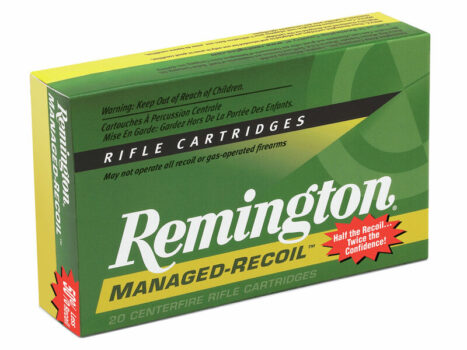
 Ammo Reports Team
| Feature | Detail |
|---|---|
| Primary Use | Deer hunting, reduced-recoil training, youth and recoil-sensitive shooters |
| Bullet Type | Core-Lokt Soft Point (lead core with gilding metal jacket, mechanically locked) |
| Bullet Weight | 125 grain |
| Case Material | Brass |
| Primer Type | Boxer (Large Rifle, Remington 9½) |
| Packaging | 20 rounds per box |
| Typical Price | $33.49/box · $1.67/round |
| Closest Competitors | Federal Power-Shok 30-30 Win 150gr JSP, Winchester Super-X 30-30 Win 150gr Power-Point, Hornady LEVERevolution 30-30 Win 160gr FTX |
Official Specs
| Spec | Value | Source |
|---|---|---|
| Muzzle Velocity (fps) | 2175 | Remington 2024 catalog, rifle ballistics |
| Muzzle Energy (ft-lbs) | 1313 | Remington 2024 catalog, rifle ballistics |
| Bullet Weight | 125 gr | Remington 2024 catalog, rifle ballistics |
| Bullet Type | Core-Lokt Soft Point, Managed-Recoil | Remington 2024 catalog, rifle ballistics |
| BC G1 | 0.215 | Remington 2024 catalog, rifle ballistics |
| BC G7 | – | Not found in verified official manufacturer sources |
| Manufacturer SKU | RL30301 / 27644 | Remington 2024 catalog, rifle ballistics |
| UPC | 047700384900 | Remington product structured data |
| Reloadable | Yes – brass case | Remington catalog |
| Case Material | Brass | Remington catalog |
| Primer | Boxer (Large Rifle, Remington 9½) | Remington catalog |
Verified factory load: Remington RL30301 / 27644, .30-30 Winchester, 125 gr. Source: Remington 2024 catalog, rifle ballistics. G7 BC was not found in the verified official sources.


Ballistics Table
Manufacturer data and calculated estimates are separated below. All trajectories shown use a 100-yard zero.
Official manufacturer ballistics. Remington 2024 catalog, rifle ballistics. Original published distances through 300 yards; unlisted distances are not interpolated. Test barrel: 24 inches. Sight height: 0.9 inch.
| Yards | Official velocity (fps) | Official energy (ft-lb) | Official trajectory (in) |
|---|---|---|---|
| 0 | 2175 | 1313 | -0.9 |
| 100 | 1820 | 919 | 0 |
| 200 | 1508 | 631 | -9.1 |
| 300 | 1255 | 437 | -33.7 |
Calculated estimate – not manufacturer data. 0-300 yards, 50-yard increments. G1 point-mass model (py-ballisticcalc); 125 gr, muzzle velocity 2175 fps, G1 BC 0.215, 100-yard zero, sight height 0.9 inches, sea level, 59°F, 29.92 inHg, 0% humidity, no wind. Model atmosphere is stated separately from manufacturer conditions. Actual results vary with firearm, ammunition lot and conditions.
| Yards | Calculated velocity (fps) | Calculated energy (ft-lb) | Calculated trajectory (in) |
|---|---|---|---|
| 0 | 2175 | 1313 | -0.9 |
| 50 | 1990 | 1099 | 0.7 |
| 100 | 1814 | 914 | -0.0 |
| 150 | 1650 | 756 | -3.3 |
| 200 | 1499 | 623 | -9.8 |
| 250 | 1362 | 515 | -20.2 |
| 300 | 1244 | 429 | -35.3 |
Key takeaway: The manufacturer table and the 50-yard model serve different purposes and should not be treated as interchangeable measurements. Energy alone does not establish a guaranteed hunting range or terminal performance.
Why This Load Exists
The Managed-Recoil designation is Remington’s answer to a real demand: lever-action rifles like the Marlin 336 and Winchester Model 94 are among the most popular deer rifles in North America, but standard 30-30 loads generate enough recoil to discourage youth hunters, smaller-framed adults, and shooters recovering from shoulder injuries. Rather than simply reducing powder charge in a standard projectile, Remington engineered this line around a lighter 125 grain Core-Lokt bullet, which requires less propellant to achieve useful velocities while cutting felt recoil roughly in half compared to the 150 gr standard load.
The Core-Lokt construction — Remington’s oldest controlled-expansion design, introduced in 1939 — uses a tapered jacket that is mechanically locked to the lead core at the cannelure. This design is specifically intended to produce consistent double-diameter expansion while retaining approximately 75% of original bullet weight, which is the critical factor that makes a lighter, slower bullet still viable for deer-sized game at reasonable distances. The Managed-Recoil concept does not compromise lethality within its intended range envelope; it simply redefines what that range envelope is.
Best Uses
Good fit:
- Youth hunters using lever-action rifles for whitetail or mule deer at distances under 150 yards
- Recoil-sensitive or smaller-framed adult hunters who want to shoot a familiar platform more comfortably
- Hunters in dense woods or brush where shots are consistently close and a flat trajectory is not required
- Introducing new shooters to centerfire lever-action rifles without developing flinch habits
- Deer seasons or jurisdictions where lead-core soft points are permitted and tube-magazine safety is a requirement
Not the right tool for:
- Shots beyond 150 yards, where trajectory drop and energy loss become significant limitations
- Elk, black bear, or other large or dangerous game where deeper penetration and higher retained energy are essential
- Competitive lever-action shooting where velocity and flat trajectory are prioritized
- Hunters who specifically want a lead-free or copper projectile for regulatory compliance
- Situations requiring maximum terminal energy from the 30-30 cartridge
Reliability Notes
No structured submissions yet.
Based on manufacturer claims and open-source product information: Remington states the Core-Lokt projectile consistently achieves double-diameter expansion across a range of impact velocities, which is particularly relevant for a reduced-recoil load since terminal velocity at 100 yards will be lower than standard loads. The brass case and Boxer primer construction are described as consistent with Remington’s standard production tolerances for the Core-Lokt line. The Managed-Recoil line has been commercially available for several years with no publicly documented pattern of feeding, extraction, or ignition failures specific to this load in lever-action rifles. All notes above come from manufacturer claims or open sources, not structured data.
Competitors
| Load | Weight | Bullet | BC G1 | Adv. Velocity | Price/box | Notes |
|---|---|---|---|---|---|---|
| Federal Power-Shok 30-30 Win 150gr JSP | 150 gr | Jacketed Soft Point | 0.218 | 2390 fps | ~$28–$32 | Manufacturer reference: 3030A. |
| Winchester Super-X 30-30 Win 150gr Power-Point | 150 gr | Power-Point SP | 0.218 | 2390 fps | ~$29–$34 | Manufacturer reference: X30306. |
| Hornady LEVERevolution 30-30 Win 160gr FTX | 160 gr | FTX Flex Tip | 0.330 | 2400 fps | ~$32–$38 | Manufacturer reference: Hornady 82730. Original price estimate was not refreshed. |
| Remington Core-Lokt 30-30 Win 150gr SP | 150 gr | Core-Lokt SP | 0.193 | 2390 fps | ~$28–$33 | Manufacturer reference: R30301. |
| HSM Trophy Gold 30-30 Win 150gr | 150 gr | Ballistic Tip | – | – | ~$38–$45 | Exact factory identity/specifications not verified. Original price estimate is not verified. |
| Winchester Super-X 30-30 Win 125gr HP | 125 gr | Hollow Point | – | – | ~$28–$33 | Exact factory identity/specifications not verified. Original price estimate is not verified. |
Price Reality
- At $33.49 per box (20 rounds), this load sits at the higher end of the 30-30 market compared to budget soft point options
- Per-round cost is approximately $1.67, which is above the typical $1.40–$1.60 range for standard 30-30 factory loads
- Standard Remington Core-Lokt 150 gr loads typically retail for $28–$33, meaning the Managed-Recoil premium is roughly $3–$5 per box for the reduced-recoil feature
- Hornady LEVERevolution 160 gr FTX, the primary premium competitor, runs $32–$38 and offers a meaningfully higher BC and faster velocity — making it a strong alternative if recoil reduction is not the primary goal
- Federal Power-Shok 150 gr JSP at $28–$32 represents the clearest budget alternative for shooters who do not require reduced recoil
- A price above $38–$40 per box for this load should be considered overpriced given current market conditions
Prices change. Check the Where to Buy block for current listings.
Where to Buy
Remington Managed-Recoil 30-30 Winchester 125 Grain Core-Lokt SP (Box)
Affiliate links. These do not influence ratings, data, or any editorial content on this page.
FAQ
Does the 125 grain Core-Lokt bullet expand reliably at the lower velocities produced by this reduced-recoil load?
The Core-Lokt design was engineered to expand across a broad velocity window, which is one reason Remington selected it for the Managed-Recoil line rather than a standard cup-and-core bullet. At 100-yard impact velocities estimated around 1,870 fps, the soft point construction should initiate consistent expansion on deer-sized game. However, reduced-velocity expansion is always more sensitive to shot placement than high-velocity loads, so this load rewards hunters who prioritize ethical shot selection over marginal angles.
How does this load compare directly to the standard Remington Core-Lokt 30-30 150 gr in terms of felt recoil?
This load’s verified specifications are 125 gr, 2175 fps and G1 BC 0.215. Compare factory tables only when their zero and test conditions are stated. The Ballistics Table separates published manufacturer values from the 50-yard calculated model; it does not establish comparative terminal performance.
Is this load safe to use in tube-magazine lever-action rifles like the Marlin 336 or Winchester Model 94?
This review concerns the exact .30-30 Winchester factory load identified in Official Specs. Follow the firearm manual and the ammunition manufacturer’s compatibility instructions for tubular magazines. Bullet-tip material alone does not prove magazine compatibility; this conclusion must not be generalized to other tipped bullets or other calibers.
Can this load be used for game larger than whitetail deer?
This load is not recommended for elk, black bear, or other large-bodied or dangerous game. The combination of a 125 gr bullet and reduced-recoil velocity results in lower retained energy and potentially shallower penetration compared to full-power 30-30 loads or larger cartridges. For deer-sized game at distances under 150 yards, it is appropriately lethal; for anything substantially larger, a higher-energy load or larger cartridge is a more responsible choice.
Why would a hunter choose this over Hornady LEVERevolution, which is also 30-30 and similarly priced?
The two loads serve different priorities. Hornady LEVERevolution with the 140 gr FTX bullet is optimized for maximum ballistic performance from the 30-30 cartridge – it offers a higher BC, flatter trajectory, and more retained energy at distance, making it the better choice for hunters who may take shots out to 200 yards. The Managed-Recoil load is optimized for shooter comfort, specifically for youth hunters, recoil-sensitive adults, or those building shooting confidence. If recoil is not a concern, LEVERevolution is the stronger performing option at comparable price points.